Start Your Recovery Today - Call Now
Sponsored Helpline (866) 567-3138

Drug and Alcohol Rehabs in Vermont

Burlington tops the list with 10 listed centers, followed by Rutland and Montpelier. Across Vermont, 23 centers in our directory offer medication-assisted treatment for opioid use disorder, and 38 accept Medicare. Private insurance is thinner, with BlueCross BlueShield accepted at just 8 and Cigna at 6.

Begin Your Recovery Journey and Call Today!

(866) 567-3138 Sponsored Helpline
Country road winding through autumn forest in Vermont
9

107 Fisher Pond Road, Saint Albans, Vermont 05478 3.0 (6 Google reviews)

Day treatment Outpatient Aftercare

Accepts: Medicaid · Medicare · TRICARE

Treats: Co-occurring mental health

Teens LGBTQ+ affirming Veterans
Tue 8:00 AM – 7:00 PM View center
2

178 McGinn Drive, Saint Albans Bay, Vermont 05481 4.0 (8 Google reviews)

Day treatment

Accepts: Medicaid

Treats: Co-occurring mental health

Teens
Hours not listed View center
NUNo photo yet
Northshire UCS State licensed

5312 Main Street, Manchester Center, Vermont 05255

Outpatient Aftercare

Accepts: Medicaid · Medicare · TRICARE

Treats: Co-occurring mental health

Teens LGBTQ+ affirming 12-step
Tue 9:00 AM – 5:00 PM View center
SSNo photo yet

62 Barre Street, Montpelier, Vermont 05602

Levels of care and insurance are not listed for this center yet. Call to ask what they offer.

Hours not listed View center
BFNo photo yet

1740 Lower Plain, Bradford, Vermont 05033 2.7 (6 Google reviews)

Outpatient

Accepts: Medicaid · Medicare · TRICARE

Treats: Co-occurring mental health

Offers MAT Teens LGBTQ+ affirming
Hours not listed View center
ABNo photo yet

35 Ayers Brook Road, Randolph, Vermont 05060

Outpatient

Accepts: Medicaid · Medicare · TRICARE

Treats: Co-occurring mental health

Offers MAT Teens LGBTQ+ affirming
Open 24 hours View center

I want to receive more information about Rehab.

By pressing submit, you accept the Terms and Conditions and Privacy Policy

Alcoholism, Drug Abuse, Mental Health, and Treatment in Vermont
Alcoholism, Drug Abuse, Mental Health, and Treatment in Vermont

What are the main addictions people in Vermont suffer from?

The main addictions people in Vermont suffer from include;

  • Alcohol Addiction: 68,000 individuals aged 12 or older have alcohol addiction, equating to 12.5% of the population. 45,560 (16.2% of the male population) males are higher in number as compared to 22,440 (8.8%) of the female population.
  • Opioid Addiction: 42,000 individuals aged 12 or older have Opioid addiction, equating to 7.7% of the population. 28,140 (10% of the male population) males are higher in number as compared to 13,860 (5.4% of the female population) females. 
  • Cannabis Addiction: 187,000 individuals aged 12 or older have cannabis addiction, equating to 32.9% of the population. 125,290 (44.5% of the male population) males are higher in number as compared to 61,710 (24.2% of the female population) females. 
  • Stimulant Addiction: 24,000 individuals aged 12 or older have stimulant addiction, equating to 4.2% of the population. 16,080 (5.7% of the male population) males are higher in number as compared to 7,920 (33.1% of the female population) females.
  • Illicit Drug Addiction: 15,000 individuals aged 12 or older have illicit drug addiction, equating to 2.6% of the population. 10,050 (3.6% of the male population) males are higher in number as compared to 4,950 (1.9% of the female population) females.
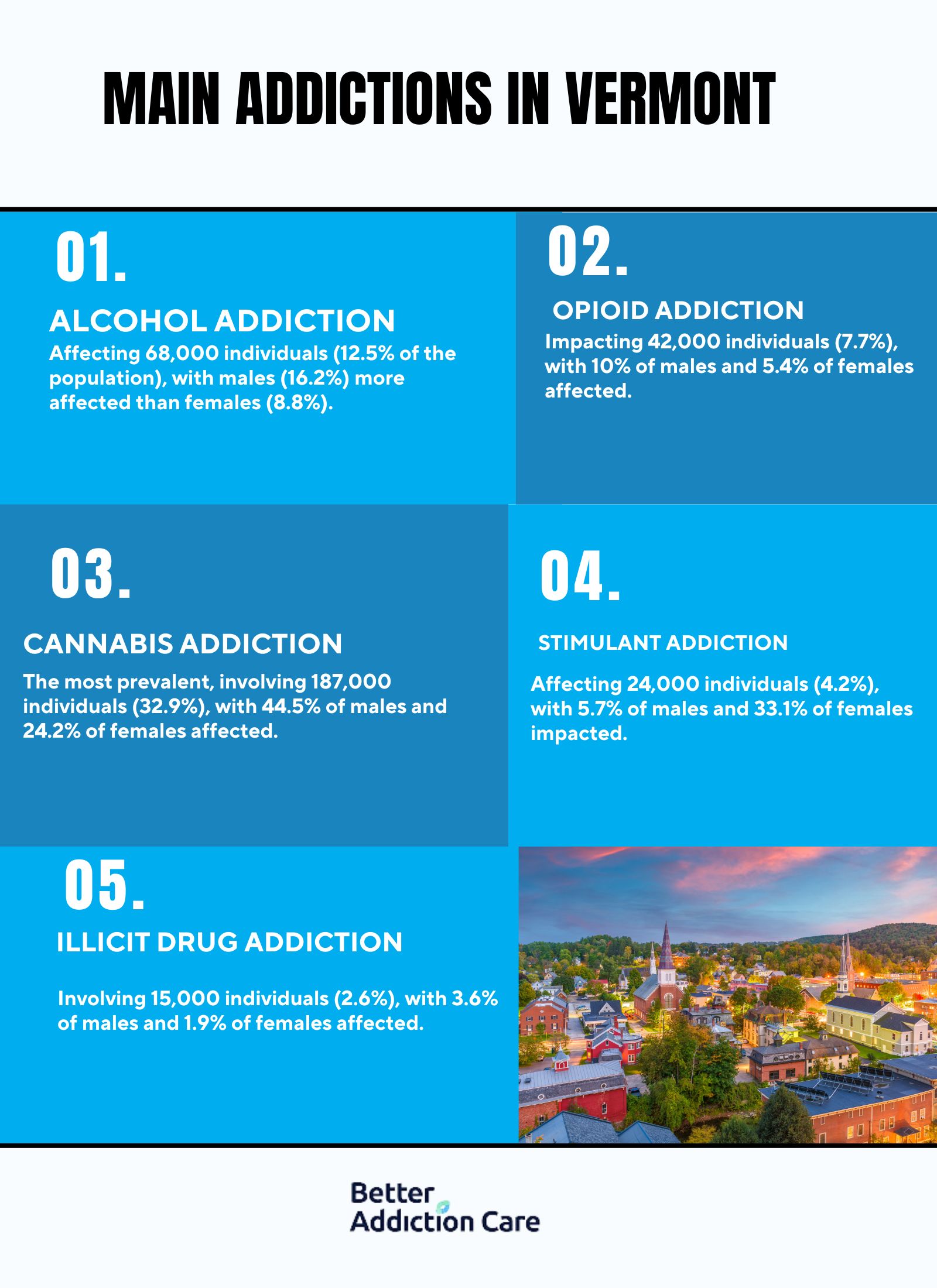
Main Addictions in Vermont

What is the cost of rehab centers in Vermont?

The cost of rehab centers in Vermont is $10,000. Inpatient treatment, which includes accommodations, meals, therapy, and medical supervision, costs $640.74 per day, totaling $19,222.20 for a 30-day program. Outpatient treatment, which requires regular visits but does not include accommodations, is significantly less expensive at $51.43 per day, or $1,542.90 for a 30-day program. The cost of rehab centers vary based on the type of treatment and facility.
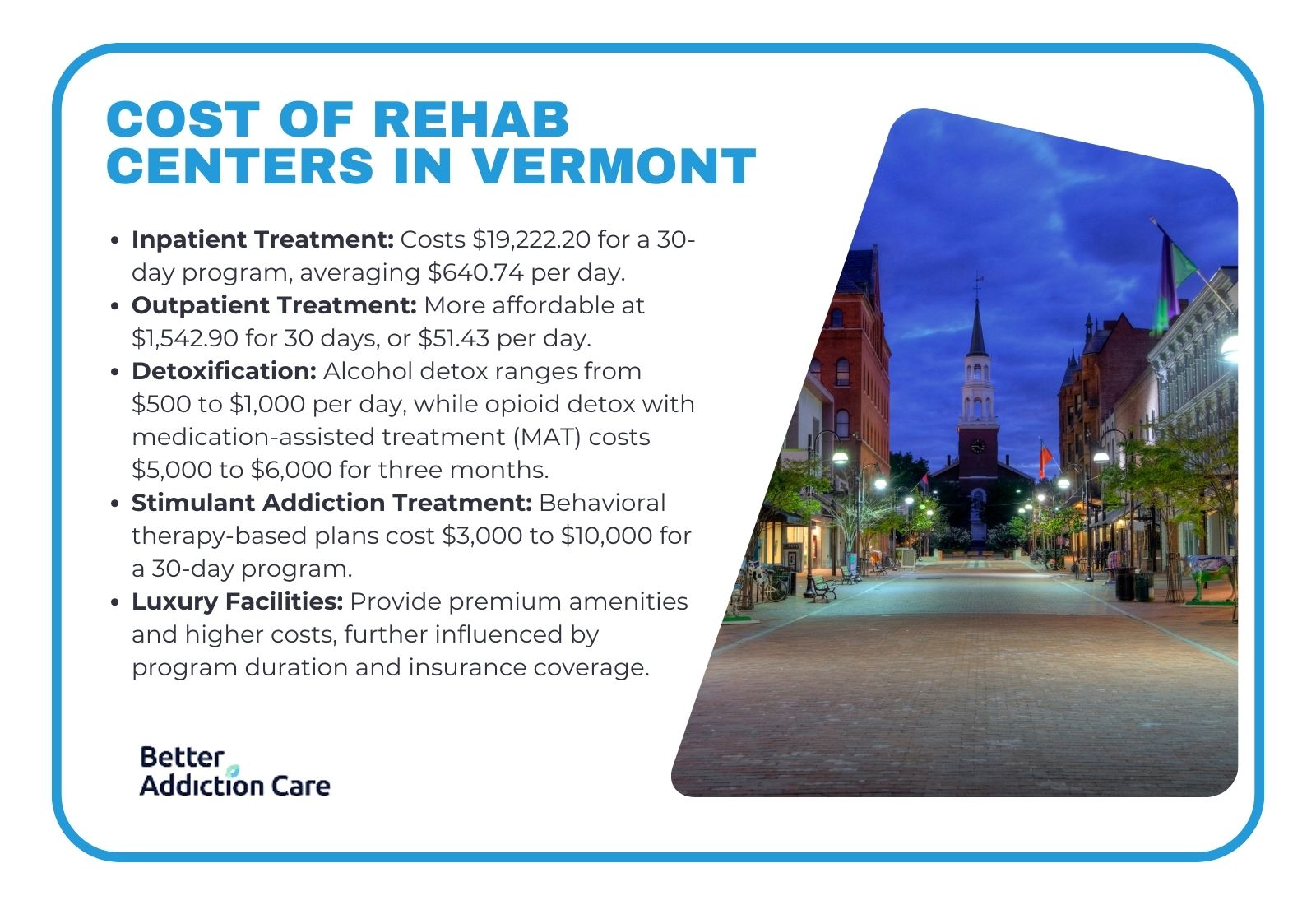
Cost of Rehab Centers in Vermont

Costs of rehab centers fluctuate based on the type of addiction being treated. For example, detox for alcohol addiction costs $500 to $1,000 per day, while medication-assisted treatment (MAT) for opioid addiction ranges from $5,000 to $6,000 for a three-month program. Treatment for stimulant use disorder, often involving intensive behavioral therapies, cost between $3,000 and $10,000 for a 30-day plan. The type of facility, such as luxury rehab centers offering premium amenities, also affects costs, as do the duration of the program and the availability of insurance coverage.

Vermont’s median household income of $81,211, the cost of rehab centers represents 23.7% of the annual income, making it a significant financial burden for many households. In contrast, outpatient programs cost only 1.9%, offering a more affordable alternative. Overall, costs of rehab centers vary widely based on the type of rehab center, with luxury options and extended stays driving expenses higher.

What is the cost of LGBTQ+ rehab centers in Vermont?

The cost of LGBTQ+ rehab centers in Vermont is $25,000, increasing by 10% to 15%. Inpatient treatment, which includes accommodations, meals, therapy, and medical supervision, costs an additional $1,922.22 to $2,883.33, raising the total cost to $21,144.42 to $22,105.53 for a 30-day program. For outpatient treatment, the increase adds $154.29 to $231.44, resulting in a total cost of $1,697.19 to $1,774.34 for the same duration. The cost of LGBTQ+ rehab centers vary based on the type of treatment and facility.

Costs of LGBTQ+ rehab centers fluctuate based on the type of addiction being treated. For example, detox for alcohol addiction costs $500 to $1,000 per day, while medication-assisted treatment (MAT) for opioid addiction ranges from $5,000 to $6,000 for a three-month program. Treatment for stimulant use disorder, often involving intensive behavioral therapies, cost between $3,000 and $10,000 for a 30-day plan. The type of facility, such as luxury rehab centers offering premium amenities, also affects costs of LGBTQ+ rehab centers, as do the duration of the program and the availability of insurance coverage.

Vermont’s median household income of $81,211, the cost of LGBTQ+ rehab centers represents 30.7% of the annual income, making it a significant financial burden for many households. In contrast, outpatient programs cost only 1.9%, offering a more affordable alternative. Overall, costs of LGBTQ+ rehab centers vary widely based on the type of rehab center, with luxury options and extended stays driving expenses higher.

What is the cost of Faith-Based rehab centers in Vermont?

The cost of Faith-Based rehab centers in Vermont is $12,000. Inpatient treatment, which includes accommodations, meals, therapy, and medical supervision, costs $640.74 per day, totaling $19,222.20 for a 30-day program. Outpatient treatment, which requires regular visits but does not include accommodations, is significantly less expensive at $51.43 per day, or $1,542.90 for a 30-day program. The cost of Faith-Based rehab centers vary based on the type of treatment and facility.

Costs of Faith-Based rehab centers fluctuate based on the type of addiction being treated. For example, detox for alcohol addiction costs $500 to $1,000 per day, while medication-assisted treatment (MAT) for opioid addiction ranges from $5,000 to $6,000 for a three-month program. Treatment for stimulant use disorder, often involving intensive behavioral therapies, cost between $3,000 and $10,000 for a 30-day plan. The type of facility, such as luxury rehab centers offering premium amenities, also affects costs, as do the duration of the program and the availability of insurance coverage.

Vermont’s median household income of $81,211, the cost of Faith-Based rehab centers represents 14.7% of the annual income, making it a significant financial burden for many households. In contrast, outpatient programs cost only 1.9%, offering a more affordable alternative. Overall, costs of Faith-Based rehab centers vary widely based on the type of rehab center, with luxury options and extended stays driving expenses higher.

#BBD0E0 »

Common Drug Addictions

Opioids, meth, cocaine and alcohol are some of the most commonly abused substances. If you or someone you know is struggling with an addiction, help is available.

Alcohol

Alcohol addiction, also known as alcoholism, is a chronic disease where individuals lose control over their drinking habits despite harmful consequences. Alcohol use disorder is marked by both physical and psychological dependence, which causes significant damage to one’s health...

Continue Reading
Begin Your Recovery Journey and Call Today!
(866) 567-3138 Sponsored Helpline
Cocaine

Cocaine addiction is a chronic and relapsing disorder that involves an uncontrollable craving for cocaine, a powerful drug derived from coca plant leaves. Cocaine gives a powerful release of dopamine, which creates a quick but short tip of euphoria, which makes the drug highly ad...

Continue Reading
Begin Your Recovery Journey and Call Today!
(866) 567-3138 Sponsored Helpline
Heroin

Heroin addiction is a chronic condition where people become dependent on heroin, an opioid that affects the brain's reward system, leading to intense cravings and compulsive drug use. The main causes of heroin addiction include genetic factors, mental health issues like depressio...

Continue Reading
Begin Your Recovery Journey and Call Today!
(866) 567-3138 Sponsored Helpline
Methamphetamine

Crystal meth addiction is a severe substance use disorder that involves the abuse of methamphetamine, a powerful stimulant that affects the central nervous system. Crystal meth addiction starts with casual and fun use but quickly escalates due to the drug’s highly addictive natur...

Continue Reading
Begin Your Recovery Journey and Call Today!
(866) 567-3138 Sponsored Helpline
Fentanyl

Fentanyl addiction is driven by its extreme potency and rapid dependence potential, poses severe dangers, including high overdose risk and fatal respiratory depression, and is treated through medication-assisted therapy, behavioral counseling, and comprehensive support programs....

Continue Reading
Begin Your Recovery Journey and Call Today!
(866) 567-3138 Sponsored Helpline
Prescription Opioids

Opioid use disorder (OUD), or opioid addiction, is the problematic pattern of opioid use leading to major issues and psychological distress in lives. Opioid use disorder usually begins with prescribed opioid medications or illicit drugs, such as heroin.The main types of opioid us...

Continue Reading
Begin Your Recovery Journey and Call Today!
(866) 567-3138 Sponsored Helpline

Common Questions About Rehab

In Vermont, choosing the right rehab means finding accredited programs that offer individualized treatment and strong community support. Residents have access to both inpatient and outpatient services across the state, with major resources in Burlington, Montpelier, and Rutland. Many programs focus on holistic recovery and aftercare planning. Touring facilities helps ensure the program is a good match.
The cost of rehab in Vermont depends on program type and length. Outpatient treatment is typically more affordable, while inpatient rehab is more expensive due to meals, housing, and supervision. Specialized services and therapies may add to costs. Some facilities provide sliding-scale payment options.
Most Vermont rehab centers accept insurance, including private carriers and state Medicaid. Facilities usually assist with verifying benefits before admission. This helps residents plan financially. Patients should confirm details with both their provider and insurer.
Dual diagnosis rehab in Vermont is often more costly than standard programs because it combines addiction and mental health care. Services include therapy, psychiatric support, and medication management. Insurance usually offsets part of the cost. State residents value these programs for their comprehensive care.

Continue Reading

View more Articles