
Our directory lists 530 rehab centers in Massachusetts across 136 cities and towns, with levels of care that range from outpatient programs to residential treatment and detox. Outpatient care is the most common form of drug rehab in Massachusetts, with 283 programs, and 147 facilities treat co-occurring mental health conditions. Services and payment options can change, so confirm both directly with a program before you go.
MassHealth is the state's Medicaid program, and 266 facilities in our directory accept it, while 230 facilities accept Medicare. Addiction services fall under the Massachusetts Department of Public Health's Bureau of Substance Addiction Services (BSAS), which also licenses treatment programs. If you do not have coverage, BSAS-funded programs are intended to serve residents regardless of ability to pay, though openings can vary, so a good first step is the Massachusetts Substance Use Helpline, 1-800-327-5050. It is free, open 24 hours, and screens callers for state-funded beds. Our free and Medicaid rehab page for Massachusetts has more on public options.
Worcester has the most rehab centers in Massachusetts in our directory, with 38 listed on the Worcester page, followed by Boston with 34, Springfield with 23 and New Bedford with 17. If you live outside these cities, start by narrowing the list to the level of care you need. You can also look at the 57 virtual and in-home programs, which offer a way to take part in drug rehab in Massachusetts from home.
Families should know about Section 35 (M.G.L. c. 123, s. 35), the state's involuntary commitment law. Under it, a family member, doctor or police officer can petition a court to commit someone to treatment for up to 90 days. For ongoing peer support, the Massachusetts meetings page lists 1,842 AA meetings and 331 NA meetings.
Alcoholism, Drug Abuse, Mental Health, and Treatment in Massachusetts
What are the main addictions people in Massachusetts suffer from?
The main addictions people in Massachusetts suffer from include:
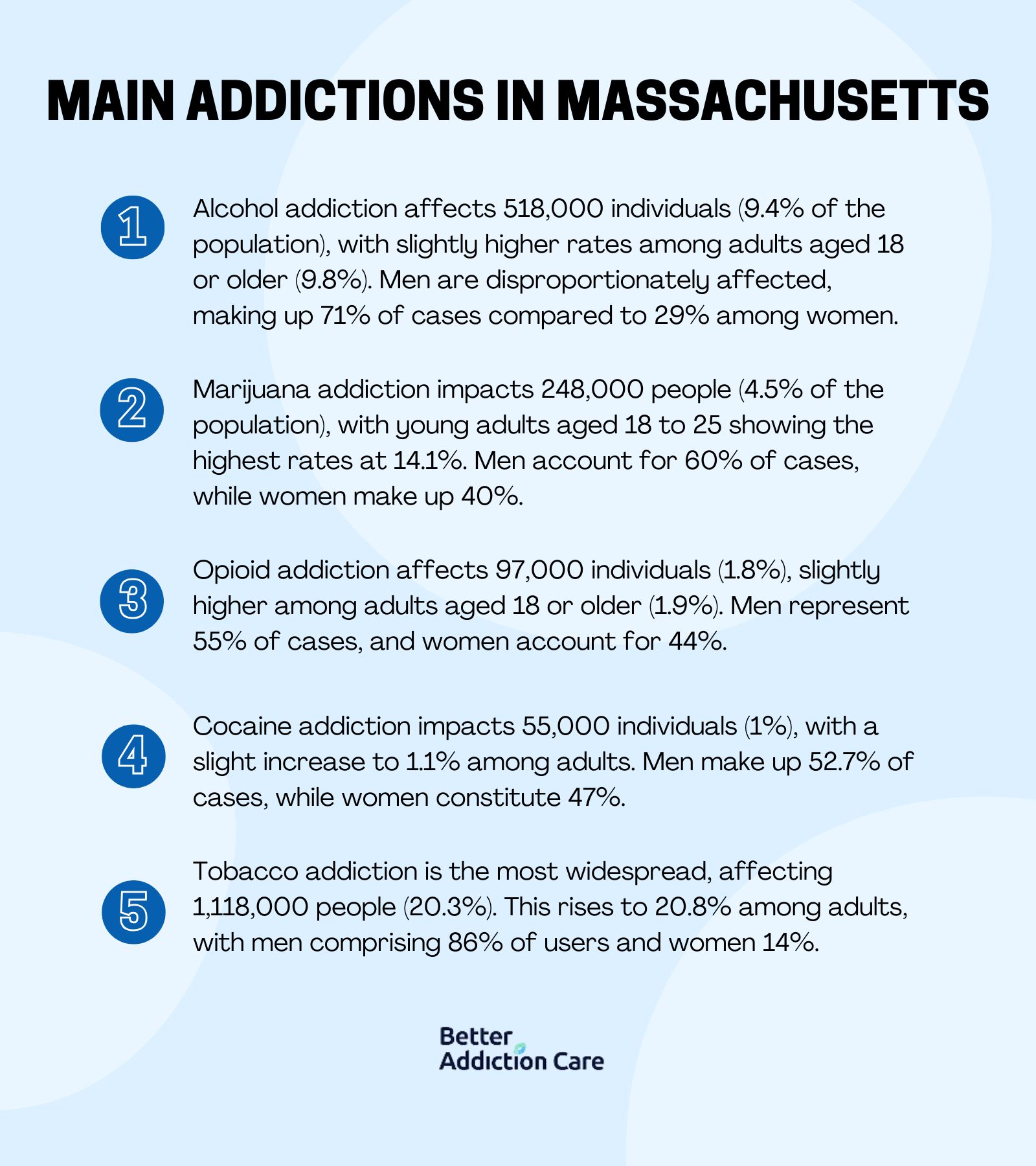
- Alcohol Addiction: 518,000 individuals aged 12 or older experienced Alcohol Addiction in the past year, representing 9.4% of this age group. Among adults aged 18 or older, 9.8% had Alcohol Addiction. 369,000 (71%) Men are more likely than 149,000 (29%) women to develop AUD.
- Marijuana Addiction: 248,000 individuals aged 12 or older had a marijuana addiction in the past year, accounting for 4.5% of this population. Among young adults aged 18 to 25, the rate was higher at 14.1%. 149,000 (60%) Men are more likely than 99,000 (40%) women to use marijuana and develop related disorders.
- Opioid Addiction: 97,000 individuals aged 12 or older had Opioid Addiction in the past year, 1.8% of this group. Among adults aged 18 or older, 1.9% experienced OUD. 54,000 (55%) Men are more likely than 43,000 (44%) women to misuse opioids and develop OUD.
- Cocaine Addiction: 55,000 individuals aged 12 or older had a cocaine addiction in the past year, representing 1% of this population. Among adults aged 18 or older, the rate was 1.1%. 29,000 (52.7%) Men are more likely than 26,000 (47%) women to use cocaine and develop related disorders.
- Tobacco Addiction: 1,118,000 individuals aged 12 or older used tobacco products in the past month, 20.3% of this group. Among adults aged 18 or older, 20.8% used tobacco products. 960,000 (86%) Men are more likely than 158,000 (14%) women to use tobacco and develop related disorders.
What is the cost of rehab centers in Massachusetts?
The cost of rehab centers in Massachusetts is $56,725 per individual, equating to 59%. A 30-day inpatient program costing $15,000 to $30,000 and 90-day programs aligning with the average of $56,725 or higher. Outpatient programs tend to be less expensive, ranging from $5,000 to $10,000 for a three-month duration. Inpatient programs are generally the most expensive due to 24/7 care, accommodations, and specialized therapies, while outpatient programs cost less.
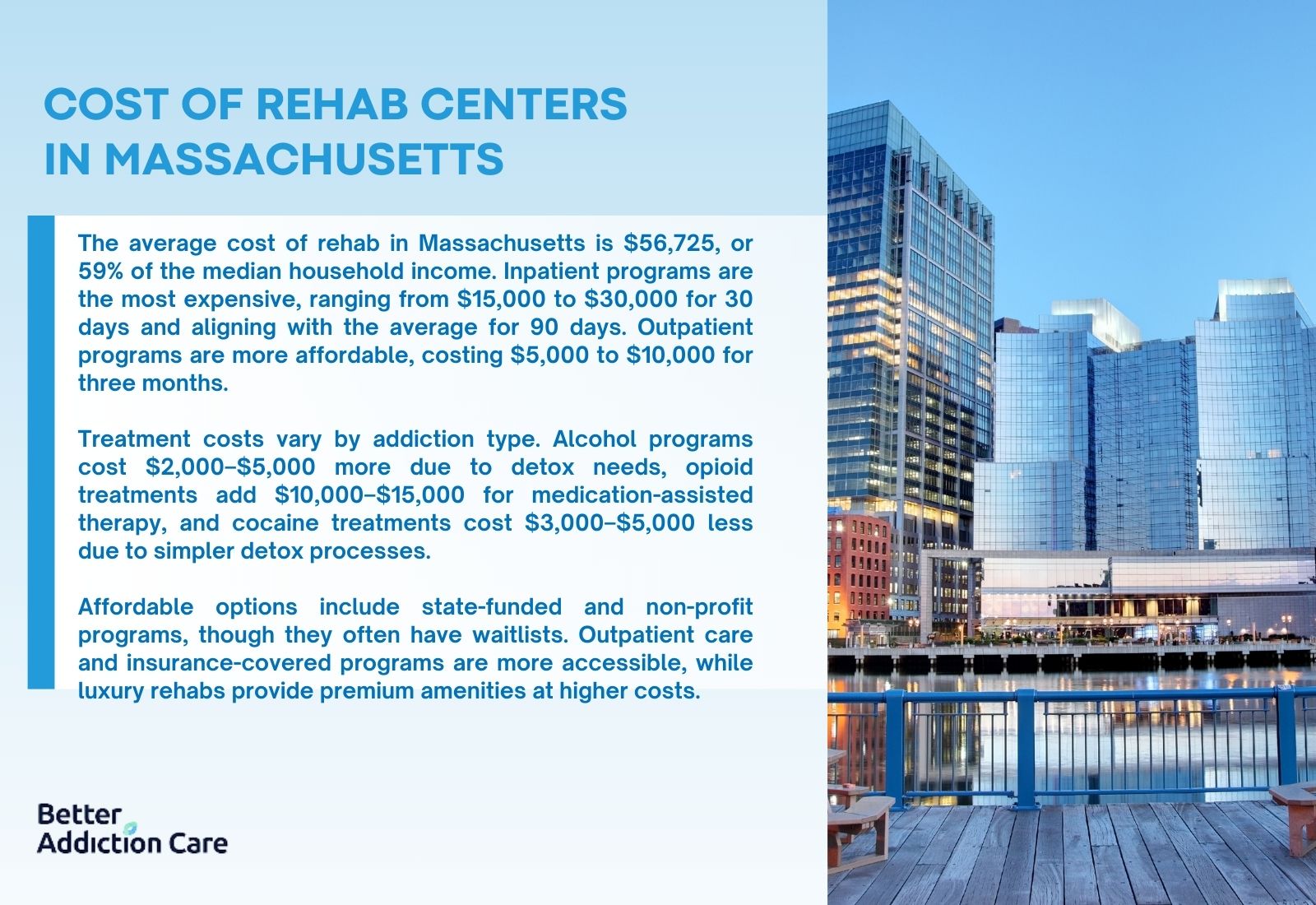
Costs of rehab centers in Massachusetts vary significantly depending on factors such as addiction type, program type, and duration of treatment. For instance, alcohol addiction programs often involve more intensive medical supervision during detox, increasing the cost by $2,000 to $5,000, or 4% to 9% above the average. Treatments for opioid addiction, which frequently include medication-assisted therapy with drugs like methadone or Suboxone, raise the cost by $10,000 to $15,000, representing a 17% to 26% increase.
Conversely, treatment for cocaine addiction, which requires less intensive detoxification, costs $3,000 to $5,000 less, or 5% to 9% below the average..
Massachusetts’ median household income is $96,505. The cost of rehab centers is 59% of the median annual income. The cost of rehab centers in Massachusetts represent a significant financial commitment, highlighting the financial burden rehab poses for many families, particularly those earning below the median income. For individuals with limited resources, outpatient care or programs covered by insurance provide more accessible options.
The affordability of rehab also depends on the type of center. State-funded facilities and faith-based or non-profit programs offer more budget-friendly or even free options but have longer waiting times. Luxury rehab centers, though more costly, provide enhanced amenities for those seeking privacy and comfort.
What is the cost of LGBTQ+ rehab centers in Massachusetts?
The cost of LGBTQ+ rehab centers in Massachusetts is $54,725 per individual, equating to 57%. A 30-day inpatient program costing $15,000 to $30,000 and 90-day programs aligning with the average of $56,725 or higher. Outpatient programs tend to be less expensive, ranging from $5,000 to $10,000 for a three-month duration. Inpatient programs are generally the most expensive due to 24/7 care, accommodations, and specialized therapies, while outpatient programs cost less.
Costs of LGBTQ+ rehab centers in Massachusetts vary significantly depending on factors such as addiction type, program type, and duration of treatment. For instance, alcohol addiction programs often involve more intensive medical supervision during detox, increasing the cost by $2,000 to $5,000, or 4% to 9% above the average. Treatments for opioid addiction, which frequently include medication-assisted therapy with drugs like methadone or Suboxone, raise the cost by $10,000 to $15,000, representing a 17% to 26% increase. Conversely, treatment for cocaine addiction, which requires less intensive detoxification, costs $3,000 to $5,000 less, or 5% to 9% below the average.
Massachusetts’ median household income is $96,505. The cost of LGBTQ+ rehab centers is 57% of the median annual income. The cost of LGBTQ+ rehab centers in Massachusetts represent a significant financial commitment, highlighting the financial burden rehab poses for many families, particularly those earning below the median income. For individuals with limited resources, outpatient care or programs covered by insurance provide more accessible options.
The affordability of LGBTQ+ rehab also depends on the type of center. State-funded facilities and faith-based or non-profit programs offer more budget-friendly or even free options but have longer waiting times. Luxury rehab centers, though more costly, provide enhanced amenities for those seeking privacy and comfort.
What is the cost of Faith-Based rehab centers in Massachusetts?
The cost of Faith-Based Rehab centers in Massachusetts is $55,000 per individual, equating to 57%. A 30-day inpatient program costing $15,000 to $30,000 and 90-day programs aligning with the average of $56,725 or higher. Outpatient programs tend to be less expensive, ranging from $5,000 to $10,000 for a three-month duration. Inpatient programs are generally the most expensive due to 24/7 care, accommodations, and specialized therapies, while outpatient programs cost less.
Costs of Faith-Based rehab centers in Massachusetts vary significantly depending on factors such as addiction type, program type, and duration of treatment. For instance, alcohol addiction programs often involve more intensive medical supervision during detox, increasing the cost by $2,000 to $5,000, or 4% to 9% above the average. Treatments for opioid addiction, which frequently include medication-assisted therapy with drugs like methadone or Suboxone, raise the cost by $10,000 to $15,000, representing a 17% to 26% increase. Conversely, treatment for cocaine addiction, which requires less intensive detoxification, costs $3,000 to $5,000 less, or 5% to 9% below the average.
Massachusetts’ median household income is $96,505. The cost of Faith-Based rehab centers is 57% of the median annual income. The cost of Faith-Based rehab centers in Massachusetts represent a significant financial commitment, highlighting the financial burden rehab poses for many families, particularly those earning below the median income. For individuals with limited resources, outpatient care or programs covered by insurance provide more accessible options.
The affordability of Faith-Based rehab also depends on the type of center. State-funded facilities and faith-based or non-profit programs offer more budget-friendly or even free options but have longer waiting times. Luxury rehab centers, though more costly, provide enhanced amenities for those seeking privacy and comfort.
What is the cost of Men-Only rehab centers in Massachusetts?
The cost of Men-Only rehab centers in Massachusetts is $54,300 per individual, equating to 56%. A 30-day inpatient program costing $15,000 to $30,000 and 90-day programs aligning with the average of $56,725 or higher. Outpatient programs tend to be less expensive, ranging from $5,000 to $10,000 for a three-month duration. Inpatient programs are generally the most expensive due to 24/7 care, accommodations, and specialized therapies, while outpatient programs cost less.