Our directory lists 866 treatment facilities in Pennsylvania, located in 244 cities and towns across the state. Of those, 542 accept Medicaid and 314 accept Medicare. Outpatient care is the most common level of care, offered at 554 facilities. Other options include day treatment or partial hospitalization at 131 facilities, residential programs at 99, intensive outpatient programs at 93, and detox at 50. For people who also have a mental health condition, 218 facilities treat both conditions at the same time.
In Pennsylvania, Medicaid is called Medical Assistance (MA), and it is delivered through HealthChoices managed care plans. The Pennsylvania Department of Drug and Alcohol Programs (DDAP) oversees addiction services in the state and licenses its drug and alcohol treatment facilities. People without insurance can contact their county's Single County Authority (SCA), which may fund treatment for residents, subject to eligibility and available funds. The state's Pennsylvania Get Help Now line, at 1-800-662-4357, can also help with finding care. For a shorter list, see our free and Medicaid rehab centers in Pennsylvania page.
Philadelphia and Pittsburgh have the most listings for drug rehab in Pennsylvania, with 116 facilities in Philadelphia and 65 in Pittsburgh, followed by Erie with 27 and York with 23. People who live elsewhere in the state can choose their city above or filter the list by level of care. For those who have difficulty traveling to a facility, 137 programs offer virtual or in-home treatment.
The Pennsylvania meetings directory lists 2,857 AA meetings and 1,022 NA meetings. The Better Addiction Care helpline, 866-567-3138, is a sponsored line.
Alcoholism, Drug Abuse, Mental Health, and Treatment in Pennsylvania
What are the main addictions people in Pennsylvania suffer from?
The main addictions people in Pennsylvania suffer from include;
- Alcohol Addiction: 2,000,000 individuals are affected with alcohol use, which is 18% of the population. 1,150,000 which is 23% of adult males and 850,000 which is 13% of adult females have alcohol addiction.
- Tobacco Addiction: 2,000,000 individuals are affected with tobacco use, which is 18% of the population. 1,100,000 that is 22% of adult males and 900,000 that is 16% of adult females have tobacco addiction.
- Marijuana Addiction: 2,131,000 individuals used marijuana in the past month, which is 19.23% of the population. 452,000 females that are 34.71% and 1,578,000 males that is 17.86% have marijuana addiction.
- Illicit Drug Addiction: 1,754,000 individuals used illicit drugs, which is 15.82% of the population. 336,000 females that is 25.82% and 1,346,000 males that is 15.22% have illicit drug addiction.
- Substance Use Addiction: 731,000 individuals face substance use disorder, equates to 6.59% of the population. 144,000 individuals that is 11.07% and 566,000 individuals that is 6.40% have substance addiction.
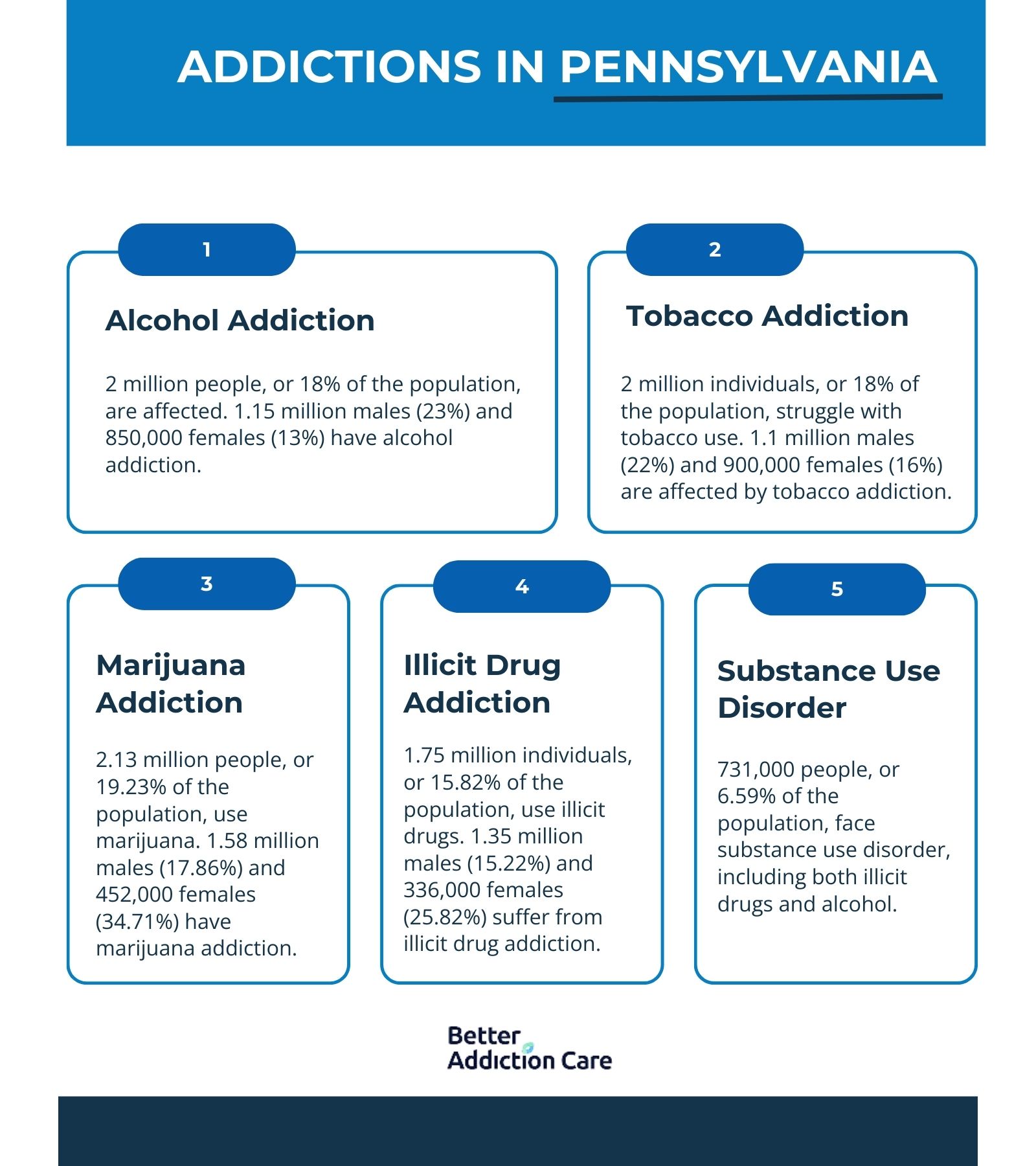
These figures highlight the prevalence of substance use and related disorders among Pennsylvania residents, with notable differences across genders.
What is the cost of rehab centers in Pennsylvania?
The cost of rehab centers in Pennsylvania is $56,708. Inpatient rehab is the most expensive, costing an average of $630.09 per day without insurance. For a 30-day program, this totals $18,902.70. With 60% insurance coverage, the cost drops to $7,561.20. With 80% coverage, the cost of rehab centers reduces to $3,780.60. In contrast, outpatient rehab is far more affordable, with an average cost of $56.87 per day. For a 30-day program, this totals $1,706.10 without insurance. With 60% coverage, the cost is $682.50, and with 80% coverage, it decreases to $341.10. The cost of rehab centers vary significantly depending on the type of treatment program.
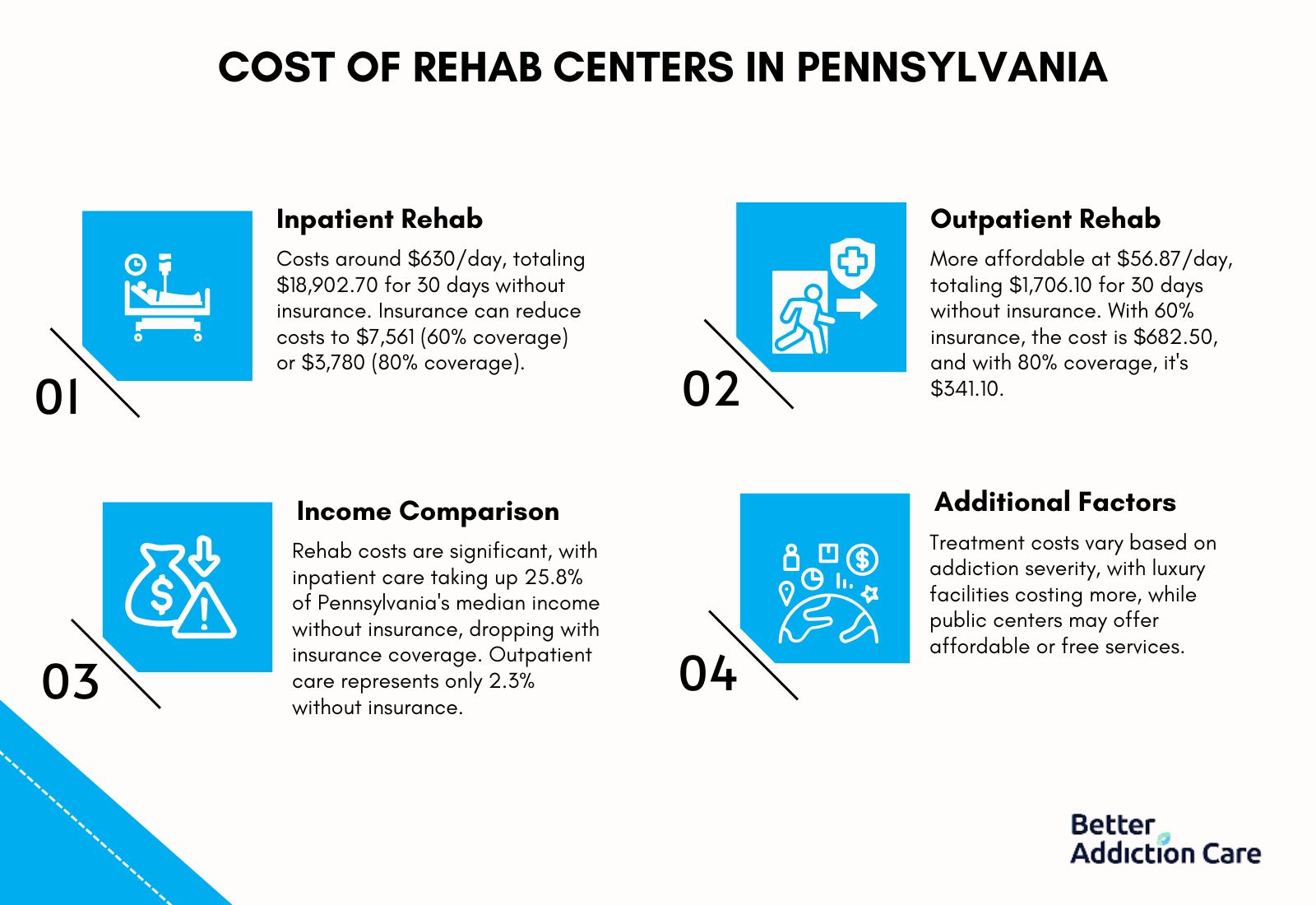
Pennsylvania's median household income is $73,170, the cost of rehab centers in Pennsylvania constitutes 77.5%. For inpatient rehab without insurance, the cost represents 25.8% of the median income. With 60% insurance coverage, it drops to 10.3%, and with 80% coverage, it accounts for 5.2% of the median income. Outpatient rehab is much more accessible. Without insurance, it represents 2.3% of the median income, while with 60% and 80% coverage, the cost falls to 0.9% and 0.5%, respectively.
The cost of rehab centers is influenced by other factors, including the type of addiction being treated. Programs requiring medical detoxification or specialized therapies for severe addictions often incur higher costs. The type of rehab center plays a significant role in determining expenses. Luxury rehab facilities with upscale amenities tend to be far more expensive than standard programs, while publicly funded or non-profit centers may provide more affordable options or even free services based on eligibility and availability.
What is the cost of LGBTQ+ rehab centers in Pennsylvania?
The cost of LGBTQ+ rehab centers in Pennsylvania is $56,000. Inpatient rehab is the most expensive, costing an average of $630.09 per day without insurance. For a 30-day program, this totals $18,902.70. With 60% insurance coverage, the cost drops to $7,561.20. With 80% coverage, the cost of rehab centers reduces to $3,780.60. In contrast, outpatient rehab is far more affordable, with an average cost of $56.87 per day. For a 30-day program, this totals $1,706.10 without insurance. With 60% coverage, the cost is $682.50, and with 80% coverage, it decreases to $341.10. The cost of LGBTQ+ rehab centers vary significantly depending on the type of treatment program.
Pennsylvania's median household income is $73,170, the cost of LGBTQ+ rehab centers in Pennsylvania constitutes 76.5%. For inpatient rehab without insurance, the cost represents 25.8% of the median income. With 60% insurance coverage, it drops to 10.3%, and with 80% coverage, it accounts for 5.2% of the median income. Outpatient rehab is much more accessible. Without insurance, it represents 2.3% of the median income, while with 60% and 80% coverage, the cost falls to 0.9% and 0.5%, respectively.
The cost of LGBTQ+ rehab centers is influenced by other factors, including the type of addiction being treated. Programs requiring medical detoxification or specialized therapies for severe addictions often incur higher costs. The type of LGBTQ+ rehab center plays a significant role in determining expenses. Luxury rehab facilities with upscale amenities tend to be far more expensive than standard programs, while publicly funded or non-profit centers may provide more affordable options or even free services based on eligibility and availability.
What is the cost of Faith-Based rehab centers in Pennsylvania?
The cost of Faith-Based rehab centers in Pennsylvania is $55,000. Inpatient rehab is the most expensive, costing an average of $630.09 per day without insurance. For a 30-day program, this totals $18,902.70. With 60% insurance coverage, the cost drops to $7,561.20. With 80% coverage, the cost of Faith-Based rehab centers reduces to $3,780.60. In contrast, outpatient rehab is far more affordable, with an average cost of $56.87 per day. For a 30-day program, this totals $1,706.10 without insurance. With 60% coverage, the cost is $682.50, and with 80% coverage, it decreases to $341.10. The cost of Faith-Based rehab centers vary significantly depending on the type of treatment program.
Pennsylvania's median household income is $73,170, the cost of Faith-Based rehab centers in Pennsylvania constitutes 75%. For inpatient rehab without insurance, the cost represents 25.8% of the median income. With 60% insurance coverage, it drops to 10.3%, and with 80% coverage, it accounts for 5.2% of the median income. Outpatient rehab is much more accessible. Without insurance, it represents 2.3% of the median income, while with 60% and 80% coverage, the cost falls to 0.9% and 0.5%, respectively.
The cost of Faith-Based rehab centers is influenced by other factors, including the type of addiction being treated. Programs requiring medical detoxification or specialized therapies for severe addictions often incur higher costs. The type of Faith-Based rehab center plays a significant role in determining expenses. Luxury rehab facilities with upscale amenities tend to be far more expensive than standard programs, while publicly funded or non-profit centers may provide more affordable options or even free services based on eligibility and availability.
What is the cost of Men-Only rehab centers in Pennsylvania?
The cost of Men-Only rehab centers in Pennsylvania is $53,500. Inpatient rehab is the most expensive, costing an average of $630.09 per day without insurance. For a 30-day program, this totals $18,902.70. With 60% insurance coverage, the cost drops to $7,561.20. With 80% coverage, the cost of Men-Only rehab centers reduces to $3,780.60. In contrast, outpatient rehab is far more affordable, with an average cost of $56.87 per day. For a 30-day program, this totals $1,706.10 without insurance. With 60% coverage, the cost is $682.50, and with 80% coverage, it decreases to $341.10. The cost of Men-Only rehab centers vary significantly depending on the type of treatment program.
Pennsylvania's median household income is $73,170, the cost of Men-Only rehab centers in Pennsylvania constitutes 73%. For inpatient rehab without insurance, the cost represents 25.8% of the median income. With 60% insurance coverage, it drops to 10.3%, and with 80% coverage, it accounts for 5.2% of the median income. Outpatient rehab is much more accessible. Without insurance, it represents 2.3% of the median income, while with 60% and 80% coverage, the cost falls to 0.9% and 0.5%, respectively.
The cost of Men-Only rehab centers is influenced by other factors, including the type of addiction being treated. Programs requiring medical detoxification or specialized therapies for severe addictions often incur higher costs. The type of Men-Only rehab center plays a significant role in determining expenses. Luxury rehab facilities with upscale amenities tend to be far more expensive than standard programs, while publicly funded or non-profit centers may provide more affordable options or even free services based on eligibility and availability.
What is the cost of Women-Only rehab centers in Pennsylvania?
The cost of Women-Only rehab centers in Pennsylvania is $52,000. Inpatient rehab is the most expensive, costing an average of $630.09 per day without insurance. For a 30-day program, this totals $18,902.70. With 60% insurance coverage, the cost drops to $7,561.20. With 80% coverage, the cost of Women-Only rehab centers reduces to $3,780.60. In contrast, outpatient rehab is far more affordable, with an average cost of $56.87 per day. For a 30-day program, this totals $1,706.10 without insurance. With 60% coverage, the cost is $682.50, and with 80% coverage, it decreases to $341.10. The cost of Women-Only rehab centers vary significantly depending on the type of treatment program.
Pennsylvania's median household income is $73,170, the cost of Women-Only rehab centers in Pennsylvania constitutes 71%. For inpatient rehab without insurance, the cost represents 25.8% of the median income. With 60% insurance coverage, it drops to 10.3%, and with 80% coverage, it accounts for 5.2% of the median income. Outpatient rehab is much more accessible. Without insurance, it represents 2.3% of the median income, while with 60% and 80% coverage, the cost falls to 0.9% and 0.5%, respectively.
The cost of Women-Only rehab centers is influenced by other factors, including the type of addiction being treated. Programs requiring medical detoxification or specialized therapies for severe addictions often incur higher costs. The type of Women-Only rehab center plays a significant role in determining expenses. Luxury rehab facilities with upscale amenities tend to be far more expensive than standard programs, while publicly funded or non-profit centers may provide more affordable options or even free services based on eligibility and availability.
What is the cost of Teen rehab centers in Pennsylvania?
The cost of Teen rehab centers in Pennsylvania is $54,000. Inpatient rehab is the most expensive, costing an average of $630.09 per day without insurance. For a 30-day program, this totals $18,902.70. With 60% insurance coverage, the cost drops to $7,561.20. With 80% coverage, the cost of Teen rehab centers reduces to $3,780.60. In contrast, outpatient rehab is far more affordable, with an average cost of $56.87 per day. For a 30-day program, this totals $1,706.10 without insurance. With 60% coverage, the cost is $682.50, and with 80% coverage, it decreases to $341.10. The cost of Teen rehab centers vary significantly depending on the type of treatment program.
Pennsylvania's median household income is $73,170, the cost of Teen rehab centers in Pennsylvania constitutes 73%. For inpatient rehab without insurance, the cost represents 25.8% of the median income. With 60% insurance coverage, it drops to 10.3%, and with 80% coverage, it accounts for 5.2% of the median income. Outpatient rehab is much more accessible. Without insurance, it represents 2.3% of the median income, while with 60% and 80% coverage, the cost falls to 0.9% and 0.5%, respectively.
The cost of Teen rehab centers is influenced by other factors, including the type of addiction being treated. Programs requiring medical detoxification or specialized therapies for severe addictions often incur higher costs. The type of Teen rehab center plays a significant role in determining expenses. Luxury rehab facilities with upscale amenities tend to be far more expensive than standard programs, while publicly funded or non-profit centers may provide more affordable options or even free services based on eligibility and availability.
What is the cost of Young Adult rehab centers in Pennsylvania?
The cost of Young Adult rehab centers in Pennsylvania is $50,000. Inpatient rehab is the most expensive, costing an average of $630.09 per day without insurance. For a 30-day program, this totals $18,902.70. With 60% insurance coverage, the cost drops to $7,561.20. With 80% coverage, the cost of Young Adult rehab centers reduces to $3,780.60. In contrast, outpatient rehab is far more affordable, with an average cost of $56.87 per day. For a 30-day program, this totals $1,706.10 without insurance. With 60% coverage, the cost is $682.50, and with 80% coverage, it decreases to $341.10. The cost of Young Adult rehab centers vary significantly depending on the type of treatment program.
Pennsylvania's median household income is $73,170, the cost of Young Adult rehab centers in Pennsylvania constitutes 68%. For inpatient rehab without insurance, the cost represents 25.8% of the median income. With 60% insurance coverage, it drops to 10.3%, and with 80% coverage, it accounts for 5.2% of the median income. Outpatient rehab is much more accessible. Without insurance, it represents 2.3% of the median income, while with 60% and 80% coverage, the cost falls to 0.9% and 0.5%, respectively.
The cost of Young Adult rehab centers is influenced by other factors, including the type of addiction being treated. Programs requiring medical detoxification or specialized therapies for severe addictions often incur higher costs. The type of Young Adult rehab center plays a significant role in determining expenses. Luxury rehab facilities with upscale amenities tend to be far more expensive than standard programs, while publicly funded or non-profit centers may provide more affordable options or even free services based on eligibility and availability.
What is the cost of Luxury Rehab centers in Pennsylvania?
The cost of Luxury rehab centers is $35,000. The cost of Luxury rehab centers ranges from $20,000 to $50,000 per month, while high-end facilities charge between $100,000 and $200,000 per month. These costs of Luxury rehab centers reflect a substantial increase compared to standard treatment programs. For example, medical detoxification, often required for severe addiction cases, averages $139,806, representing an increase of $83,098 or 146.5% above the standard treatment cost.
Pennsylvania’s median household income is $73,170, luxury rehab centers constitute 48%. A $20,000 monthly program equates to 27.3% of the annual median income, while a $50,000 program represents 68.3%. For high-end programs, costs reach 136.7% to 273.4% of the median household income, making these programs unaffordable for most residents without substantial financial resources or insurance coverage.
The type of addiction also influences treatment costs of Luxury rehab centers, particularly for substances that require intensive medical intervention, such as opioid or alcohol dependence. The overall cost of luxury rehab varies based on the type of facility. Luxury centers offer high-end amenities and specialized care, driving costs higher, while standard rehab programs, non-profit facilities, or publicly funded centers provide more affordable options. It is essential for individuals to explore various treatment avenues, including insurance coverage, to find the best fit for their needs and financial capacity.
What is the cost of Dual Diagnosis rehab centers in Pennsylvania?
The cost of Dual Diagnosis rehab centers in Pennsylvania is $52,900. Inpatient rehab is the most expensive, costing an average of $630.09 per day without insurance. For a 30-day program, this totals $18,902.70. With 60% insurance coverage, the cost drops to $7,561.20. With 80% coverage, the cost of Dual Diagnosis rehab centers reduces to $3,780.60. In contrast, outpatient rehab is far more affordable, with an average cost of $56.87 per day. For a 30-day program, this totals $1,706.10 without insurance. With 60% coverage, the cost is $682.50, and with 80% coverage, it decreases to $341.10. The cost of Dual Diagnosis rehab centers vary significantly depending on the type of treatment program.
Pennsylvania's median household income is $73,170, the cost of Dual Diagnosis rehab centers in Pennsylvania constitutes 72%. For inpatient rehab without insurance, the cost represents 25.8% of the median income. With 60% insurance coverage, it drops to 10.3%, and with 80% coverage, it accounts for 5.2% of the median income. Outpatient rehab is much more accessible. Without insurance, it represents 2.3% of the median income, while with 60% and 80% coverage, the cost falls to 0.9% and 0.5%, respectively.
The cost of Dual Diagnosis rehab centers is influenced by other factors, including the type of addiction being treated. Programs requiring medical detoxification or specialized therapies for severe addictions often incur higher costs. The type of Dual Diagnosis rehab center plays a significant role in determining expenses. Luxury rehab facilities with upscale amenities tend to be far more expensive than standard programs, while publicly funded or non-profit centers provide more affordable options or even free services based on eligibility and availability.
Is drug abuse and addiction a problem in Pennsylvania?
Yes, drug abuse and addiction is a problem in Pennsylvania. Firstly, Pennsylvania has experienced a substantial increase in drug overdose deaths, rising from 4,491 in 2021 to 5,425 in 2024, marking a 20.8% increase. This upward trend highlights the growing severity of the issue. Secondly, the widespread availability of potent synthetic opioids, such as fentanyl, has exacerbated the crisis, leading to a surge in overdose fatalities. Thirdly, the economic impact is also profound, with Pennsylvania incurring substantial costs related to healthcare, law enforcement, and lost productivity due to substance abuse. These factors underscore the escalating challenge of drug addiction in Pennsylvania over recent years.
Is alcoholism a problem in Pennsylvania?
Yes, alcoholism is a problem in Pennsylvania. 60% of adults in Pennsylvania consume alcohol regularly, with 28% engaging in binge drinking, defined as consuming five or more drinks in a two-hour period. This high prevalence of excessive drinking contributes to numerous health and social issues. Between 2019 and 2023, Pennsylvania reported more than 5,700 annual alcohol-related deaths, surpassing fatalities from drug overdoses during the same period.
The economic impact is substantial; in 2019, excessive alcohol consumption cost Pennsylvania $9.5 billion, accounting for healthcare expenses, lost productivity, and other related costs.
Over the years, the rate of alcohol-related deaths has been gradually increasing, with a notable spike in 2024. These statistics underscore the growing challenge of alcoholism in Pennsylvania.
Is Mental Health a problem in Pennsylvania?
Yes, mental health is a problem in Pennsylvania. 19.7% of adults in Pennsylvania experience mental illness, equating to nearly 2 million individuals. Alarmingly, 51.9% of these adults do not receive the necessary treatment, leaving over 1 million people without adequate mental health care. 4.83% of adults, or 482,000 individuals, suffer from serious thoughts of suicide. Over recent years, the prevalence of mental health issues has increased, with a notable rise in substance use disorders among adults with mental illness, affecting 7.31% of the adult population, 728,000 people. These statistics highlight the growing mental health challenges faced by Pennsylvania residents.
Can you travel to Pennsylvania for rehab?
Yes, you can travel to Pennsylvania for rehab as it is a viable option. Pennsylvania offers a diverse range of treatment centers, including specialized facilities that cater to various needs, such as dual diagnosis and LGBTQ-friendly programs. This diversity ensures that individuals find tailored treatment plans suited to their specific circumstances. Seeking treatment away from one's familiar environment provides enhanced privacy and anonymity, allowing individuals to focus solely on their recovery without external distractions.
Over the years, there has been a growing recognition of the benefits associated with traveling for addiction treatment, leading to an increase in individuals opting for out-of-Pennsylvania rehab programs. This trend reflects a broader understanding of the importance of personalized care and the positive impact of a change in environment on the recovery process. Moreover, Pennsylvania's commitment to providing comprehensive addiction treatment services has positioned it as a favorable destination for those seeking effective rehab options.
Can addiction be treated in Pennsylvania?
Yes, addiction can be treated in Pennsylvania. Pennsylvania offers a comprehensive network of treatment facilities, including both inpatient and outpatient programs, ensuring that individuals have access to the care they need. Additionally, Pennsylvania has implemented state-funded programs to make treatment more accessible, providing services such as detoxification, rehab, and counseling at low or no cost to eligible residents.
The success rates of substance use treatment in Pennsylvania are promising, with 60% of individuals maintaining sobriety after completing their programs. These factors demonstrate Pennsylvania's commitment to providing effective addiction treatment options for those in need.
What is the state of Pennsylvania?
The state of Pennsylvania is located in the northeastern United States, shares borders with New York to the north, New Jersey to the east, Delaware to the southeast, Maryland to the south, West Virginia to the southwest, and Ohio to the west. As of 2024, Pennsylvania's population is 12,961,683, with females comprising 50.7% and males 49.3%. Economically, Pennsylvania ranks sixth in the nation, contributing 3.5% to the U.S. economy. Pennsylvania's median household income is $76,081, with a per capita income of $43,104. 12.0% of residents live below the poverty line, slightly below the national average of 12.5%. These figures indicate that Pennsylvania maintains a relatively strong economic position within the United States.
What is the population of Pennsylvania?
The population of Pennsylvania is 12,961,683. The gender distribution is relatively balanced, with 49.35% males, equating to 6.4 million individuals, and 50.65% females, totaling 6.56 million. When examining the population by age, 5.1% of residents, or 661,000, are under the age of 5, while 20.3%, 2.63 million, are under 18 years old. The working-age group (18 to 64 years) accounts for the majority, comprising 60.7% of the population, or 7.86 million individuals. Additionally, 20.0%, roughly 2.59 million, are aged 65 years and older. The largest age subgroup is between 60 and 64 years, representing 7.05% of the population, or 916,206 individuals. These statistics highlight a balanced gender ratio and a significant portion of the population in both the working-age and senior demographics, which reflects Pennsylvania's evolving age structure.
What is the income of people from Pennsylvania?
The income of people from Pennsylvania is $41,234, per capita income, while the median household income is $73,170. Income varies significantly by age group. Householders under 25 years have a median income of $40,108, reflecting entry-level earnings. This increases to $84,653 for those aged 25 to 44 years, as individual’s progress in their careers. Householders aged 45 to 64 years earn the highest median income at $89,726, representing peak earning years. For those aged 65 and over, the median income declines to $51,201 due to retirement and reduced income streams. Gender disparities are also notable in Pennsylvania. Males aged 15 and over earn a median income of $46,717, while females in the same age group earn significantly less at $30,605. These figures highlight both age-related income growth and the persistent gender wage gap within the state of Pennsylvania.