AA is a supportive community built on shared experience, mutual accountability, and the belief that lasting change is possible. Its Twelve Steps offer a spiritual, not religious, framework to help individuals stop drinking and stay sober, one day at a time.
AA’s influence goes far beyond its meetings. It has inspired countless recovery programs and shaped how society understands addiction and healing. From city centers to remote villages, AA continues to transform lives, quietly, consistently, and powerfully. Whether you're seeking help or simply curious, the story of AA is one of courage, connection, and the enduring strength of community.
When and Where Did Alcoholics Anonymous Begin?
Alcoholics Anonymous began in 1935 in Akron, Ohio, when Bill Wilson, a New York stockbroker, met Dr. Bob Smith, an Akron surgeon, through connections in the Oxford Group, a Christian fellowship. Their first meeting lasted six hours and proved life-changing, not just for them, but for millions to come.
Following that pivotal meeting in 1935, Alcoholics Anonymous began to grow as Wilson and Smith worked together to help others achieve sobriety. By 1939, they published Alcoholics Anonymous, also known as “The Big Book,” which outlined their philosophy and introduced the Twelve Steps. This publication sparked national interest and helped spread the movement beyond Ohio and New York. As more groups formed, AA maintained its grassroots structure, self-supporting, non-professional, and open to all. Through their shared struggle with alcoholism, they discovered the power of one alcoholic helping another, laying the foundation for what would become AA’s core principle: mutual support as the key to recovery.
How Has Alcoholics Anonymous Changed Over The Years?
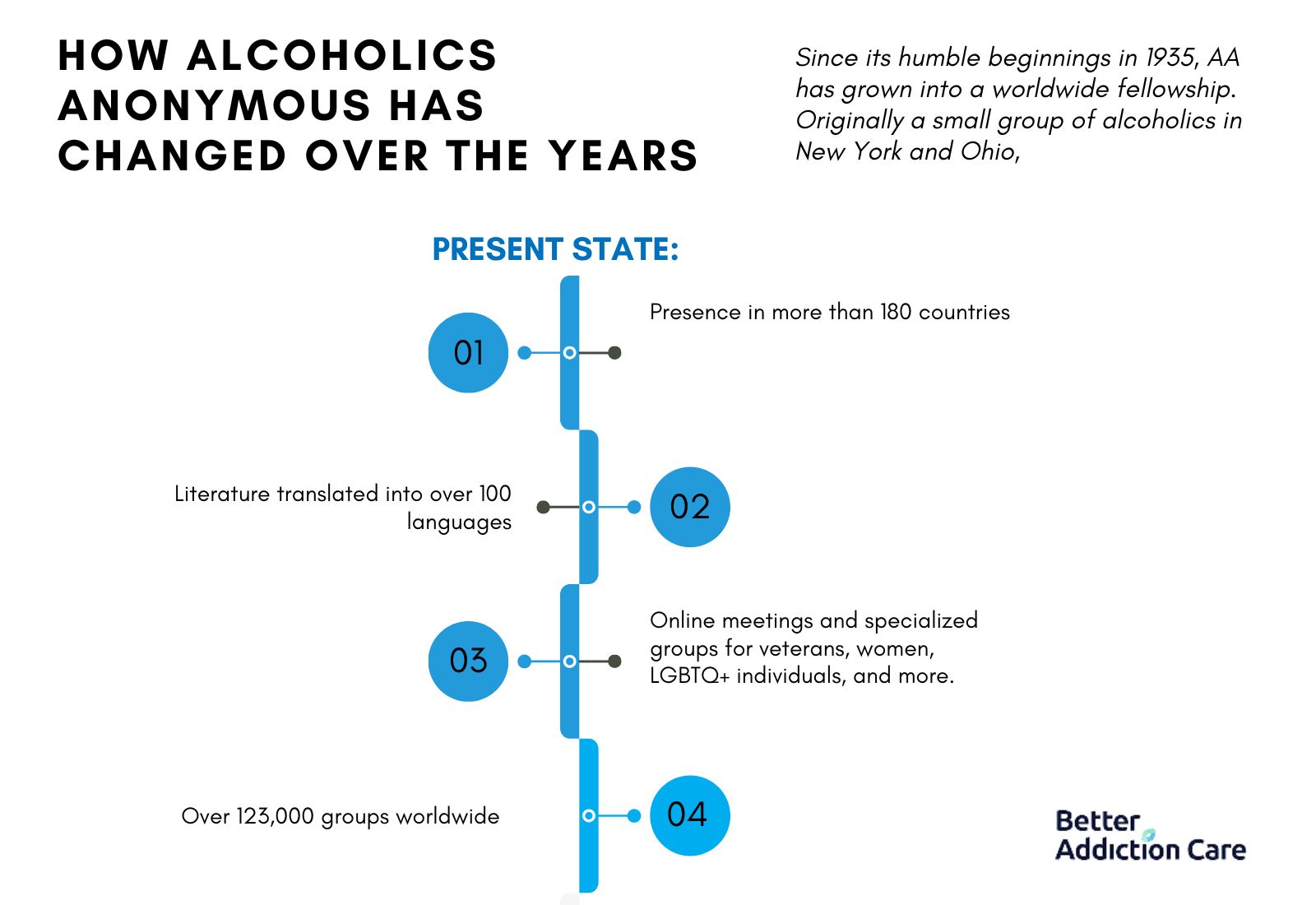
Since its humble beginnings in 1935, AA has grown into a worldwide fellowship. Originally a small group of alcoholics in New York and Ohio, it now includes:
-
Over 123,000 groups worldwide
-
Presence in more than 180 countries
-
Literature translated into over 100 languages
-
Online meetings and specialized groups for veterans, women, LGBTQ+ individuals, and more.
What Was The Original Purpose of AA?
The initial goal of AA was to create a supportive environment where alcoholics could recover by sharing their struggles and applying a structured, spiritually focused program. It wasn’t medical or clinical, it was based on the idea that one alcoholic helping another creates a uniquely powerful path to sobriety.
As of 2025, Alcoholics Anonymous has been helping individuals recover from alcohol addiction for 90 years. It remains one of the most well-known and widely used mutual-aid models in addiction recovery history.
How Did the 12 Steps come into existence?
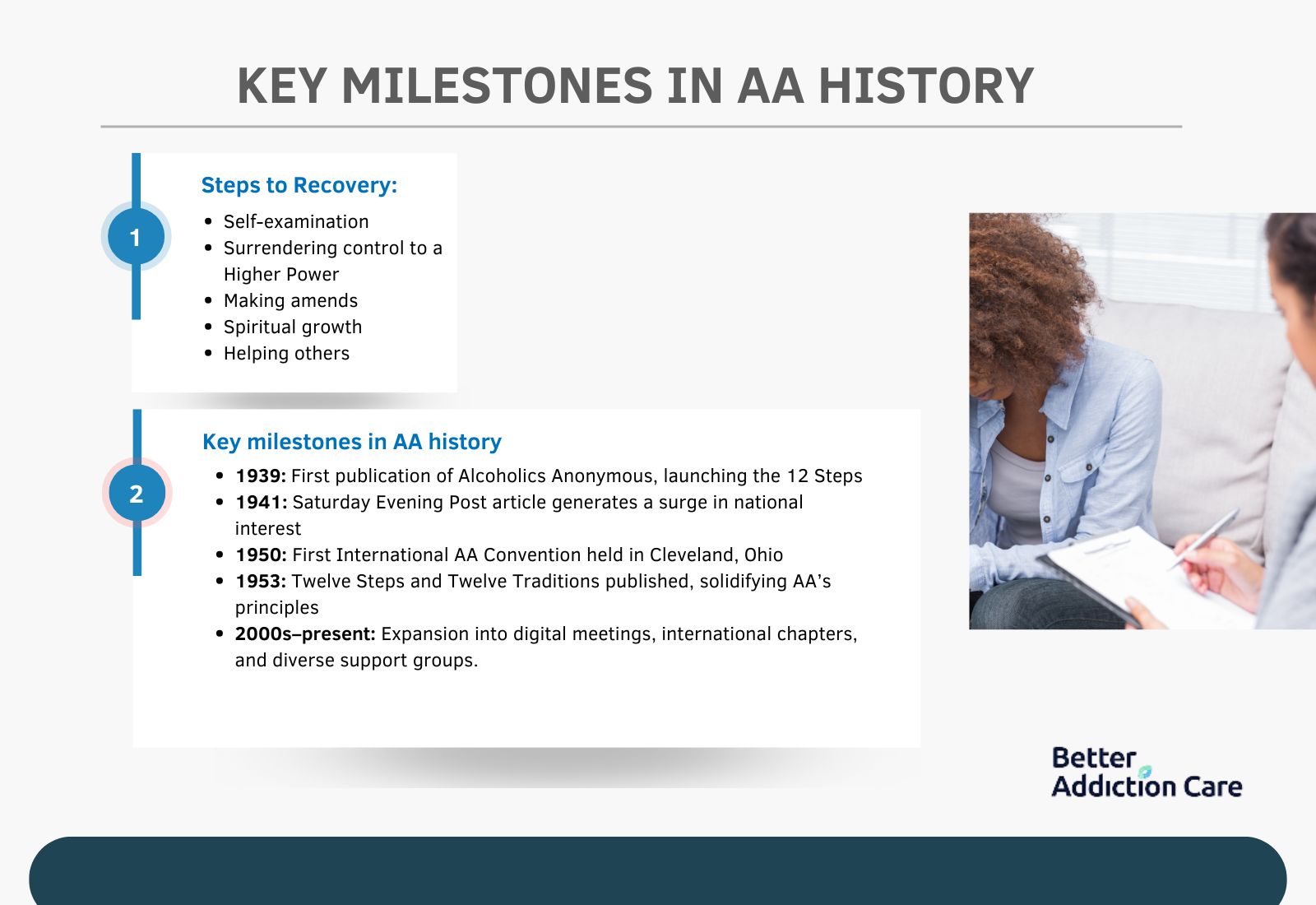
The 12 Steps were developed by Bill Wilson in 1938, influenced by his experience with the Oxford Group, a Christian fellowship focused on spiritual living. These steps were published in the 1939 book Alcoholics Anonymous (often called "The Big Book"), outlining a path to recovery based on:
-
Self-examination
-
Surrendering control to a Higher Power
-
Making amends
-
Spiritual growth
-
Helping others
The 12 Steps remain at the heart of AA’s recovery program today.
Key milestones in AA history
-
1939: First publication of Alcoholics Anonymous, launching the 12 Steps
-
1941: Saturday Evening Post article generates a surge in national interest
-
1950: First International AA Convention held in Cleveland, Ohio
-
1953: Twelve Steps and Twelve Traditions published, solidifying AA’s principles
-
2000s–present: Expansion into digital meetings, international chapters, and diverse support groups.
Did AA Come Before Drug and Alcohol Rehab?
Yes, Alcoholics Anonymous was founded in 1935, before modern inpatient alcohol rehab programs existed. Formal drug rehab centers began developing in the late 1940s and 1950s, inspired in part by AA’s 12-Step model and growing recognition of alcoholism as a disease.
How Does AA Compare to Outpatient Rehab Programs?
Alcoholics Anonymous (AA) and drug rehab programs share the goal of helping individuals achieve and maintain sobriety, but they differ significantly in structure, approach, and scope of services.
Alcoholics Anonymous is a peer-led, spiritually based support group that operates independently of medical or clinical supervision. It follows the 12-Step model and emphasizes regular meetings, mutual support, personal accountability, and spiritual growth. AA is free to attend, widely available, and can be accessed in-person or online. It does not provide medical detox, therapy, or psychiatric care but serves as a long-term recovery support system for those dealing with alcohol addiction.
Outpatient rehab programs, on the other hand, are clinically managed treatment services that may include IOP, outpatient, or residential levels of care. Rehab typically involves medical detox, individual and group therapy, psychiatric evaluation, medication management, and aftercare planning. These programs are staffed by licensed professionals and use evidence-based therapies such as cognitive behavioral therapy (CBT), dialectical behavior therapy (DBT), and medication-assisted treatment (MAT) to address substance use disorders, including co-occurring mental health conditions.