Alcoholism, Drug Abuse, Mental Health, and Treatment in New Jersey
What are the main addictions people in New Jersey suffer from?
The main addictions people in New Jersey suffer from include:
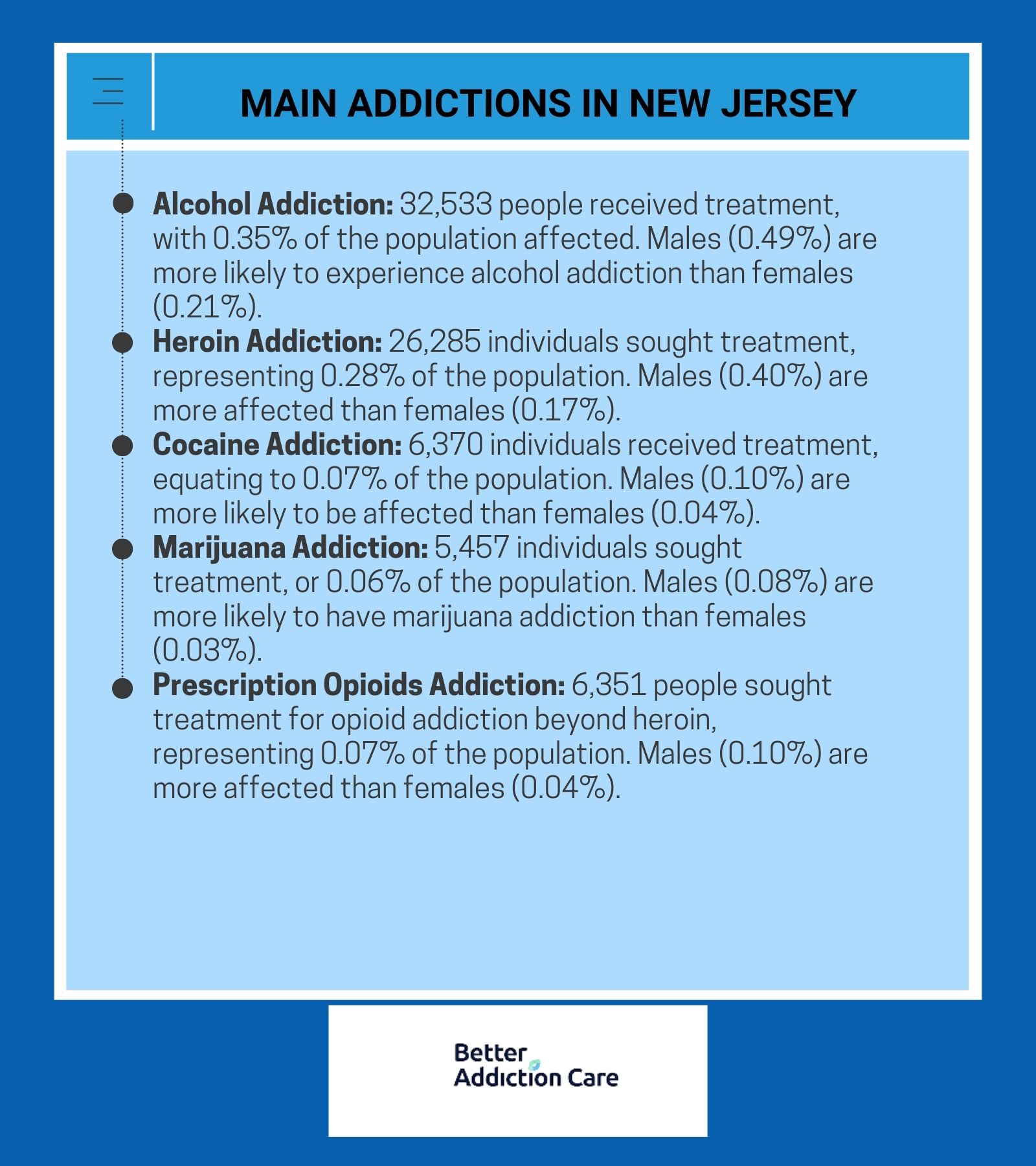
- Alcohol Addiction: 32,533 people received treatment for alcohol addiction in 2024, which is 9.24 million, 0.35% of the total population sought treatment for alcohol addiction. 22,773 (0.49%) of the male population. 9,760 (0.21%) of the female population have alcohol addiction.
- Heroin Addiction: 26,285 people sought treatment for heroin addiction, which is 0.28%. 18,400 (0.40%) of the male population and 7,885 (0.17%) of the female population have heroin addiction.
- Cocaine Addiction: 6,370 individuals were admitted for cocaine addiction treatment, which is 0.07%. 4,459 (0.10%) of the male population, 1,911 (0.04%) of the female population have Cocaine addiction.
- Marijuana Addiction: 5,457 individuals received treatment for marijuana use disorder, which is 0.06%. 3,820 (0.08%) of the male population, 1,637 (0.03%) of the female population have Marijuana addiction.
- Prescription Opioids Addiction: 6,351 people sought treatment for opioid addiction beyond heroin, which is 0.07%. 4,446 (0.10%) of the male population, 1,905 (0.04%) of the female population have Opioid addiction.
What is the cost of rehab centers in New Jersey?
The cost of rehab in New Jersey is $56,570 per person. A 30-day inpatient program costs between $5,000 and $30,000, while outpatient programs range from $1,000 to $10,000 for the same period.
The cost of rehab centers in New Jersey varies widely depending on factors such as treatment type, program duration, facility amenities, and the substance being treated. The type of addiction also influences costs. For instance, treating opioid use disorder often involves Medication-Assisted Treatment (MAT), which adds $5,000 to $6,000 annually, representing a 10% to 15% increase over standard outpatient costs. Alcohol addiction treatment requires medically supervised detoxification, which raises inpatient costs by $1,000 to $1,500, a 3% to 5% increase.
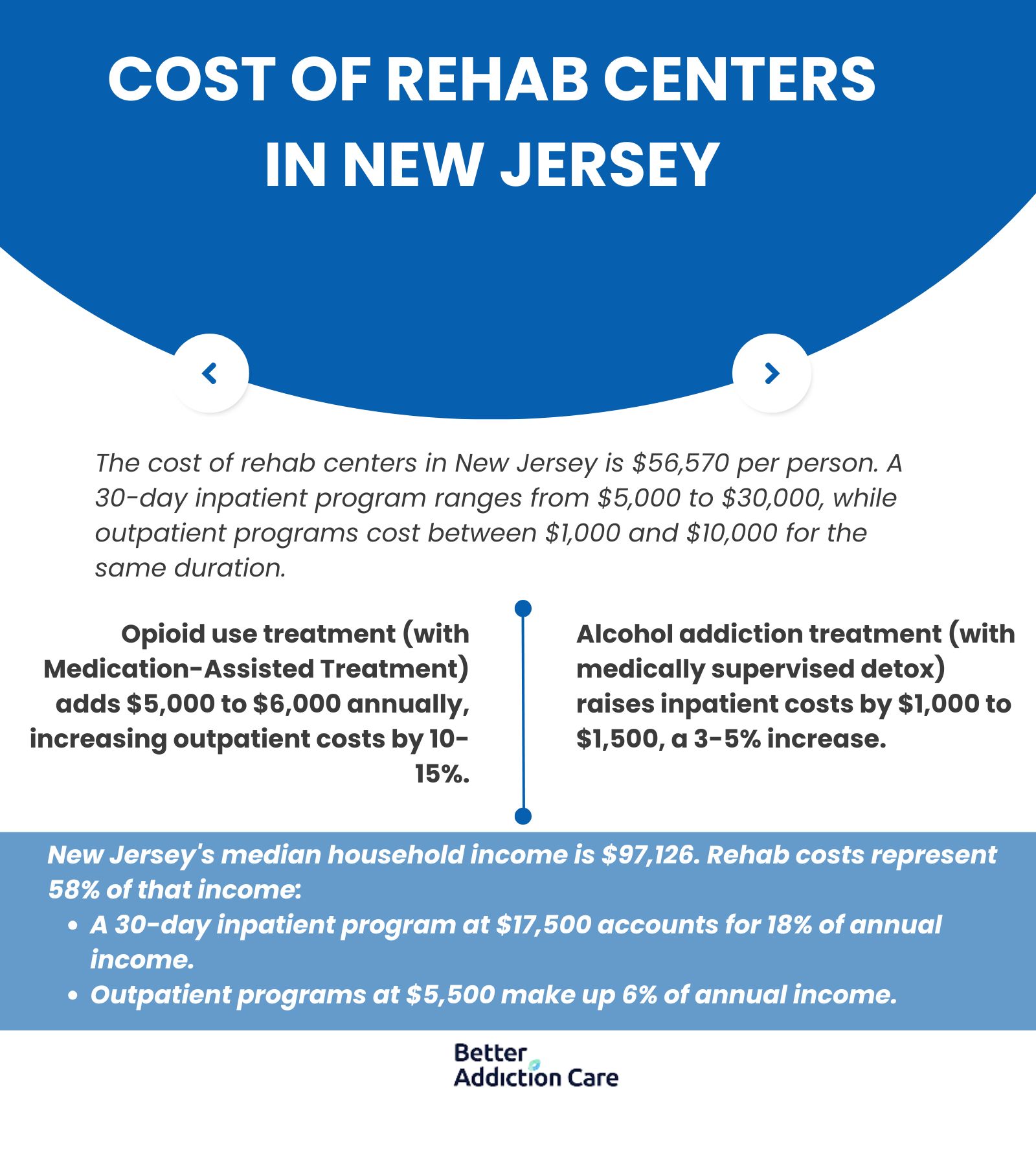
New Jersey's median household income is $97,126. The cost of rehab in New Jersey constitutes 58%. An average 30-day inpatient program at $17,500 accounts for 18% of the annual income, while outpatient programs at $5,500 represent 6%. While these costs are significant, many insurance plans provide coverage for rehab under the Affordable Care Act, reducing out-of-pocket expenses.
The type of rehab center impacts costs of rehab centers in New Jersey. Luxury or private facilities with enhanced amenities charge higher fees, whereas state-funded or non-profit centers offer more affordable or even free options for eligible individuals.
What is the cost of LGBTQ+ rehab centers in New Jersey?
The cost of LGBTQ+ rehab in New Jersey is $55,000 per person. A 30-day inpatient program costs between $5,000 and $30,000, while outpatient programs range from $1,000 to $10,000 for the same period.
The cost of LGBTQ+ rehab centers in New Jersey varies widely depending on factors such as treatment type, program duration, facility amenities, and the substance being treated. The type of addiction also influences costs. For instance, treating opioid use disorder often involves Medication-Assisted Treatment (MAT), which adds $5,000 to $6,000 annually, representing a 10% to 15% increase over standard outpatient costs. Alcohol addiction treatment requires medically supervised detoxification, which raises inpatient costs by $1,000 to $1,500, a 3% to 5% increase.
New Jersey's median household income is $97,126. The cost of LGBTQ+ rehab in New Jersey constitutes 56.6%. An average 30-day inpatient program at $17,500 accounts for 18% of the annual income, while outpatient programs at $5,500 represent 6%. While these costs are significant, many insurance plans provide coverage for rehab under the Affordable Care Act, reducing out-of-pocket expenses.
The type of rehab center impacts costs of LGBTQ+ rehab centers in New Jersey. Luxury or private facilities with enhanced amenities charge higher fees, whereas state-funded or non-profit centers offer more affordable or even free options for eligible individuals.
What is the cost of Faith-Based rehab centers in New Jersey?
The cost of Faith-Based rehab in New Jersey is $54,500 per person. A 30-day inpatient program costs between $5,000 and $30,000, while outpatient programs range from $1,000 to $10,000 for the same period.
The cost of Faith-Based rehab centers in New Jersey varies widely depending on factors such as treatment type, program duration, facility amenities, and the substance being treated. The type of addiction also influences costs. For instance, treating opioid use disorder often involves Medication-Assisted Treatment (MAT), which adds $5,000 to $6,000 annually, representing a 10% to 15% increase over standard outpatient costs. Alcohol addiction treatment requires medically supervised detoxification, which raises inpatient costs by $1,000 to $1,500, a 3% to 5% increase.
New Jersey's median household income is $97,126. The cost of Faith-Based rehab in New Jersey constitutes 56%. An average 30-day inpatient program at $17,500 accounts for 18% of the annual income, while outpatient programs at $5,500 represent 6%. While these costs are significant, many insurance plans provide coverage for rehab under the Affordable Care Act, reducing out-of-pocket expenses.
The type of rehab center impacts costs of Faith-Based rehab centers in New Jersey. Luxury or private facilities with enhanced amenities charge higher fees, whereas state-funded or non-profit centers offer more affordable or even free options for eligible individuals.
What is the cost of Men-Only rehab centers in New Jersey?
The cost of Men-Only rehab in New Jersey is $52,570 per person. A 30-day inpatient program costs between $5,000 and $30,000, while outpatient programs range from $1,000 to $10,000 for the same period.
The cost of Men-Only rehab centers in New Jersey varies widely depending on factors such as treatment type, program duration, facility amenities, and the substance being treated. The type of addiction also influences costs. For instance, treating opioid use disorder often involves Medication-Assisted Treatment (MAT), which adds $5,000 to $6,000 annually, representing a 10% to 15% increase over standard outpatient costs. Alcohol addiction treatment requires medically supervised detoxification, which raises inpatient costs by $1,000 to $1,500, a 3% to 5% increase.
New Jersey's median household income is $97,126. The cost of Men-Only rehab in New Jersey constitutes 54%. An average 30-day inpatient program at $17,500 accounts for 18% of the annual income, while outpatient programs at $5,500 represent 6%. While these costs are significant, many insurance plans provide coverage for rehab under the Affordable Care Act, reducing out-of-pocket expenses.
The type of rehab center impacts costs of Men-Only rehab centers in New Jersey. Luxury or private facilities with enhanced amenities charge higher fees, whereas state-funded or non-profit centers offer more affordable or even free options for eligible individuals.
What is the cost of Women-Only rehab centers in New Jersey?
The cost of Women-Only rehab in New Jersey is $56,000 per person. A 30-day inpatient program costs between $5,000 and $30,000, while outpatient programs range from $1,000 to $10,000 for the same period.
The cost of Women-Only rehab centers in New Jersey varies widely depending on factors such as treatment type, program duration, facility amenities, and the substance being treated. The type of addiction also influences costs. For instance, treating opioid use disorder often involves Medication-Assisted Treatment (MAT), which adds $5,000 to $6,000 annually, representing a 10% to 15% increase over standard outpatient costs. Alcohol addiction treatment requires medically supervised detoxification, which raises inpatient costs by $1,000 to $1,500, a 3% to 5% increase.
New Jersey's median household income is $97,126. The cost of Women-Only rehab in New Jersey constitutes 57.6%. An average 30-day inpatient program at $17,500 accounts for 18% of the annual income, while outpatient programs at $5,500 represent 6%. While these costs are significant, many insurance plans provide coverage for rehab under the Affordable Care Act, reducing out-of-pocket expenses.
The type of rehab center impacts costs of Women-Only rehab centers in New Jersey. Luxury or private facilities with enhanced amenities charge higher fees, whereas state-funded or non-profit centers offer more affordable or even free options for eligible individuals.
What is the cost of Teen rehab centers in New Jersey?
The cost of Teen rehab in New Jersey is $54,900 per person. A 30-day inpatient program costs between $5,000 and $30,000, while outpatient programs range from $1,000 to $10,000 for the same period.
The cost of Teen rehab centers in New Jersey varies widely depending on factors such as treatment type, program duration, facility amenities, and the substance being treated. The type of addiction also influences costs. For instance, treating opioid use disorder often involves Medication-Assisted Treatment (MAT), which adds $5,000 to $6,000 annually, representing a 10% to 15% increase over standard outpatient costs. Alcohol addiction treatment requires medically supervised detoxification, which raises inpatient costs by $1,000 to $1,500, a 3% to 5% increase.
New Jersey's median household income is $97,126. The cost of Teen rehab in New Jersey constitutes 56.5%. An average 30-day inpatient program at $17,500 accounts for 18% of the annual income, while outpatient programs at $5,500 represent 6%. While these costs are significant, many insurance plans provide coverage for rehab under the Affordable Care Act, reducing out-of-pocket expenses.
The type of rehab center impacts costs of Teen rehab centers in New Jersey. Luxury or private facilities with enhanced amenities charge higher fees, whereas state-funded or non-profit centers offer more affordable or even free options for eligible individuals.
What is the cost of Young Adult rehab centers in New Jersey?
The cost of Young Adult rehab in New Jersey is $53,500 per person. A 30-day inpatient program typically costs between $5,000 and $30,000, while outpatient programs range from $1,000 to $10,000 for the same period.
The cost of Young Adult rehab centers in New Jersey varies widely depending on factors such as treatment type, program duration, facility amenities, and the substance being treated. The type of addiction also influences costs. For instance, treating opioid use disorder often involves Medication-Assisted Treatment (MAT), which adds $5,000 to $6,000 annually, representing a 10% to 15% increase over standard outpatient costs. Alcohol addiction treatment requires medically supervised detoxification, which raises inpatient costs by $1,000 to $1,500, a 3% to 5% increase.
New Jersey's median household income is $97,126. The cost of Young Adult rehab in New Jersey constitutes 55%. An average 30-day inpatient program at $17,500 accounts for 18% of the annual income, while outpatient programs at $5,500 represent 6%. While these costs are significant, many insurance plans provide coverage for rehab under the Affordable Care Act, reducing out-of-pocket expenses.
The type of rehab center impacts costs of Young Adult rehab centers in New Jersey. Luxury or private facilities with enhanced amenities charge higher fees, whereas state-funded or non-profit centers offer more affordable or even free options for eligible individuals.
What is the cost of Luxury Rehab centers in New Jersey?
The cost of Luxury rehab in New Jersey is $57,000 per person. A 30-day inpatient program typically costs between $30,000 and $100,000, while outpatient programs range from $1,000 to $10,000 for the same period.
The cost of Luxury rehab centers in New Jersey varies widely depending on factors such as treatment type, program duration, facility amenities, and the substance being treated. The type of addiction also influences costs of Luxury rehab in New Jersey. For instance, treating opioid use disorder often involves Medication-Assisted Treatment (MAT), which adds $5,000 to $6,000 annually, representing a 10% to 15% increase over standard outpatient costs. Alcohol addiction treatment requires medically supervised detoxification, which raises inpatient costs by $1,000 to $1,500, a 3% to 5% increase.
New Jersey's median household income is $97,126. The cost of Luxury rehab in New Jersey rehab in New Jersey constitutes 58.6%. An average 30-day inpatient program at $17,500 accounts for about 18% of the annual income, while outpatient programs at $5,500 represent roughly 6%. While these costs are significant, many insurance plans provide coverage for rehab under the Affordable Care Act, reducing out-of-pocket expenses.
The type of rehab center impacts costs of Luxury rehab in New Jersey rehab centers in New Jersey. Luxury or private facilities with enhanced amenities charge higher fees, whereas state-funded or non-profit centers offer more affordable or even free options for eligible individuals.
What is the cost of Dual Diagnosis rehab centers in New Jersey?
The cost of Dual Diagnosis rehab in New Jersey is $54,000 per person. A 30-day inpatient program costs between $5,000 and $30,000, while outpatient programs range from $1,000 to $10,000 for the same period.
The cost of Dual Diagnosis rehab centers in New Jersey varies widely depending on factors such as treatment type, program duration, facility amenities, and the substance being treated. The type of addiction also influences costs of Dual Diagnosis rehab centers. For instance, treating opioid use disorder often involves Medication-Assisted Treatment (MAT), which adds $5,000 to $6,000 annually, representing a 10% to 15% increase over standard outpatient costs. Alcohol addiction treatment requires medically supervised detoxification, which raises inpatient costs by $1,000 to $1,500, a 3% to 5% increase.
New Jersey's median household income is $97,126. The cost of Dual Diagnosis rehab in New Jersey constitutes 55%. An average 30-day inpatient program at $17,500 accounts for 18% of the annual income, while outpatient programs at $5,500 represent 6%. While these costs of Dual Diagnosis are significant, many insurance plans provide coverage for rehab under the Affordable Care Act, reducing out-of-pocket expenses.
The type of rehab center impacts costs of Dual Diagnosis rehab centers in New Jersey. Luxury or private facilities with enhanced amenities charge higher fees, whereas state-funded or non-profit centers offer more affordable or even free options for eligible individuals.
Is drug abuse and addiction a problem in New Jersey?
Yes, drug abuse and addiction is a problem in New Jersey. Firstly, the state of New Jersey has experienced a high number of substance abuse treatment admissions, with 85,266 in 2024, up from 82,254 in 2022. Secondly, opioid-related deaths have been alarmingly high in 2024, nearly 90% of drug overdoses involved opioids, resulting in 2,583 fatalities. Thirdly, the rate of heroin overdose in New Jersey is three times the national average, contributing to 14,000 deaths from drug overdoses since 2009. These statistics underscore the persistent and growing challenge of drug abuse in the state of New Jersey over recent years.
Is alcoholism a problem in New Jersey?
Yes, alcoholism is a problem in New Jersey. In 2024, 31,807 individuals were admitted for alcohol addiction treatment, accounting for 37% of all substance use treatment admissions in the state of New Jersey. This marks an increase from 2021, when there were 20,651 admissions for alcohol abuse, representing 31% of total substance abuse treatment admissions. The five-year average annual rate of alcohol-related deaths per capita in New Jersey rose by 42.8% from 2019 to 2024. 23% of high school students reported consuming alcohol within the past 30 days, with females at 27% and males at 19%. These statistics indicate a growing problem with alcohol consumption among both adults and adolescents in New Jersey over recent years.
Is Mental Health a problem in New Jersey?
Yes, mental health is a problem in New Jersey. 27.7% of adults in the state of New Jersey reported symptoms of anxiety and/or depressive disorders in 2024. This marks an increase from previous years, indicating a growing prevalence of mental health challenges. 42.2% of adults in New Jersey reported symptoms of anxiety or depression, with 19.9% unable to access necessary counseling or therapy.
The COVID-19 pandemic has exacerbated mental health issues, with more than half of Americans, including New Jersey residents, reporting a negative impact on their mental well-being. These statistics underscore the escalating mental health crisis in the state over recent years.
Can you travel to New Jersey for rehab?
Yes, you can travel to New Jersey for rehab, and there are several compelling reasons to consider it. New Jersey offers a wide range of specialized treatment programs tailored to various addictions, including options for opioid dependency, alcohol abuse, and co-occurring mental health disorders, providing access to cutting-edge therapies like Medication-Assisted Treatment (MAT) and holistic care. The state of New Jersey is known for its diverse and highly qualified network of rehab centers, many of which integrate evidence-based practices with personalized care plans, ensuring that individuals receive treatment suited to their unique needs. New Jersey's strategic location offers proximity to serene coastal areas, such as the Jersey Shore, where clients benefit from a peaceful and therapeutic environment, enhancing their recovery process. These distinctive attributes make New Jersey a standout choice for individuals seeking comprehensive and effective addiction treatment.
Can addiction be treated in New Jersey?
Yes, addiction can be treated in New Jersey for several reasons. The state of New Jersey has a robust network of rehab centers offering evidence-based treatments, including detoxification, counseling, and Medication-Assisted Treatment (MAT), tailored to various addictions. New Jersey also provides access to specialized programs addressing co-occurring mental health disorders, ensuring a holistic approach to recovery.
The state of New Jersey has strong community support systems, such as peer recovery programs and outpatient resources, which help individuals maintain long-term sobriety. These factors make New Jersey a reliable place for effective addiction treatment.
What is the state of New Jersey?
The state of New Jersey is in the northeastern United States, is bordered by New York to the north and northeast, the Atlantic Ocean to the east and southeast, Delaware to the southwest, and Pennsylvania to the west. As of 2024, New Jersey's population is 9.25 million, with about 4.56 million males (49.3%) and 4.69 million females (50.7%). Economically, New Jersey ranks 10th among U.S. states, contributing 2.9% to the national economy. New Jersey's median household income is $97,126, reflecting its relatively affluent status. However, New Jersey faces economic challenges, ranking 46th in economic outlook due to factors like high taxation and cost of living.
What is the population of New Jersey?
The population of New Jersey is 9.25 million, with a gender distribution of 51.2% female and 48.8% male. The population is divided across age groups, with 21.79% under 18 years (2.015 million individuals), 61.64% between 18 and 64 years (5.701 million), and 16.57% aged 65 and over (1.533 million). The largest single age group is 55 to 59 years, making up 7.10% of the population, or roughly 656,383 individuals. The median age in New Jersey is 39.5 years, reflecting a relatively balanced demographic structure with a significant portion in the working-age range.
What is the income of people from New Jersey?
The income of people from New Jersey is $50,995, per capita income, reflecting the average income earned per person in New Jersey. The median household income stood at $97,126, indicating that half of the households earned more than this amount, while the other half earned less. Income levels vary across different age groups and between genders. Households headed by individuals aged 45 to 64 have the highest median income, $118,213. Those led by individuals aged 25 to 44 have a median income $105,714. Households with heads under 25 years old have a median income of $47,184, while those headed by individuals 65 and older have a median income near $66,128.
Gender disparities are evident in income statistics. The median income for male workers aged 15 and older is $54,762, whereas for female workers in the same age group, it's $37,321. These income figures highlight significant income variations across different age groups and between genders in New Jersey.