
Start Your Recovery Today - Call Now
Sponsored Helpline (866) 567-3138

Drug and Alcohol Rehabs in North Carolina

Medication-assisted treatment for opioid use disorder is offered at 167 of the North Carolina centers in our directory, and 328 hold Joint Commission or CARF accreditation. TRICARE is accepted at 186 centers and Aetna at 82. Veteran programs run at 145 centers, and there are 1,998 AA meetings and 851 NA meetings listed statewide.

Begin Your Recovery Journey and Call Today!

(866) 567-3138 Sponsored Helpline
Green Appalachian Mountains near Asheville, North Carolina
21

1089 X Ray Drive, Gastonia, North Carolina 28054 4.5 (325 Google reviews)

Detox Residential Outpatient detox

Accepts: Medicaid · TRICARE · UnitedHealth Group +8 more

Treats: alcohol, opioids, stimulants, benzos +1 · co-occurring mental health

Veterans
Open 24 hours View center
14

7349 Statesville Rd B, Charlotte, North Carolina 28269 4.7 (473 Google reviews)

Detox Outpatient detox Aftercare

Treats: alcohol, opioids, stimulants, benzos +1 · co-occurring mental health

Insurance not listed. Call to check coverage.

Offers MAT
Open 24 hours View center
11

203 Capcom Ave, Wake Forest, North Carolina 27587 4.6 (20 Google reviews)

Day treatment IOP Outpatient

Accepts: United Healthcare, BlueCross BlueShield +4 more

Teens
Tue 8:00 AM – 4:00 PM View center
14

7349 Statesville Rd, Charlotte, North Carolina 28269 4.7 (473 Google reviews)

Day treatment Outpatient

Treats: alcohol, opioids, stimulants, benzos · co-occurring mental health

Insurance not listed. Call to check coverage.

Offers MAT EMDR
Open 24 hours View center
2

100 Billingsley Road, Charlotte, North Carolina 28211 4.4 (200 Google reviews)

Residential Day treatment Outpatient Aftercare

Accepts: Medicaid · Medicare · TRICARE · Aetna

Treats: alcohol, opioids, stimulants · co-occurring mental health

Teens LGBTQ+ affirming Veterans
Tue 8:00 AM – 5:00 PM View center
10
Pavillon CARF

241 Pavillon Place, Mill Spring, North Carolina 28756 4.4 (80 Google reviews)

Detox Residential IOP Outpatient +1

Accepts: Cigna

Treats: alcohol, opioids, stimulants, benzos +1 · co-occurring mental health

12-step
Open 24 hours View center

213 East Bessemer Ave, Greensboro, North Carolina 27401 4.1 (91 Google reviews)

Outpatient

Accepts: Medicaid · Medicare · TRICARE

Treats: alcohol, opioids, stimulants, benzos

Teens LGBTQ+ affirming Veterans
Tue 9:00 AM – 6:00 PM View center
14

183 Old Turnpike Road, Mills River, North Carolina 28759 4.7 (233 Google reviews)

Detox Residential Day treatment Outpatient +1

Accepts: BlueCross BlueShield, Aetna +2 more

Treats: alcohol, opioids, stimulants, benzos +1 · co-occurring mental health

Veterans
Open 24 hours View center
17
Fellowship Hall Joint Commission

5140 Dunstan Road, Greensboro, North Carolina 27405 4.2 (99 Google reviews)

Detox Residential Day treatment IOP +4

Accepts: TRICARE · UnitedHealth Group +10 more

Treats: alcohol, opioids, stimulants, benzos · co-occurring mental health

EMDR 12-step
Open 24 hours View center
13

1100 Tunnel Road, Asheville, North Carolina 28805 4.2 (400 Google reviews)

Levels of care and insurance are not listed for this center yet. Call to ask what they offer.

Open 24 hours View center

104 North Main street, Louisburg, North Carolina 27549 3.1 (18 Google reviews)

Outpatient Aftercare

Accepts: Medicaid · Medicare · TRICARE

Treats: Co-occurring mental health

Offers MAT LGBTQ+ affirming Veterans
Tue 8:30 AM – 5:00 PM View center

1601 Brenner Avenue, Salisbury, North Carolina 28144 3.6 (30 Google reviews)

Outpatient Sober living Aftercare

Accepts: Medicare · TRICARE · UnitedHealth Group +5 more

Treats: alcohol, opioids, stimulants, benzos · co-occurring mental health

LGBTQ+ affirming Veterans 12-step
Open 24 hours View center
15

2001 Vail Avenue, Charlotte, North Carolina 28207 3.4 (454 Google reviews)

Outpatient

Accepts: Medicaid · Medicare · TRICARE · UnitedHealth Group +4 more

Treats: alcohol, opioids, stimulants, benzos

Offers MAT 12-step
Open 24 hours View center

Find Rehab By City in North Carolina

A
B
C
D
E
F
G
H
J
K
L
M
N
O
P
R
S
T
W
Y
Z

I want to receive more information about Rehab.

By pressing submit, you accept the Terms and Conditions and Privacy Policy

Our directory lists 617 rehab centers in North Carolina across 140 cities and towns. Of these, 297 accept Medicaid and 235 accept Medicare. Outpatient care is the most common level of care, offered at 340 facilities. For more structure, 36 facilities run intensive outpatient programs, 80 offer day treatment or partial hospitalization (PHP), 34 provide residential care and 15 offer detox. In addition, 175 facilities treat co-occurring mental health conditions.

NC Medicaid pays for drug rehab in North Carolina for people who qualify, and eligibility depends on income. Since the expansion on December 1, 2023, NC Medicaid covers adults earning up to 138% of the federal poverty level. The NCDHHS Division of Mental Health, Developmental Disabilities and Substance Use Services oversees addiction services, and the NCDHHS Division of Health Service Regulation licenses treatment facilities. If you have no insurance, your regional LME/MCO (local management entity/managed care organization) manages state-funded treatment, and each one runs a 24-hour access line. To see which facilities accept public coverage, visit our page of free and Medicaid programs in North Carolina.

Charlotte has the most listings in the state, with 65 facilities. Raleigh has 41, Asheville has 31 and Wilmington has 25. If you live outside these cities, use the level of care filter above to narrow the rehab centers in North Carolina to the type of program you need. If the nearest facility is far away, 33 programs provide drug rehab in North Carolina through virtual or in-home care.

For families, North Carolina law allows involuntary commitment for substance use in some circumstances under N.C. Gen. Stat. Chapter 122C. For peer support, our North Carolina meetings page lists 1,576 AA meetings and 645 NA meetings. To talk with someone about treatment options, you can call the sponsored Better Addiction Care helpline at 866-567-3138.

Alcoholism, Drug Abuse, Mental Health, and Treatment in North Carolina
Alcoholism, Drug Abuse, Mental Health, and Treatment in North Carolina

What are the main addictions people in North Carolina suffer from?

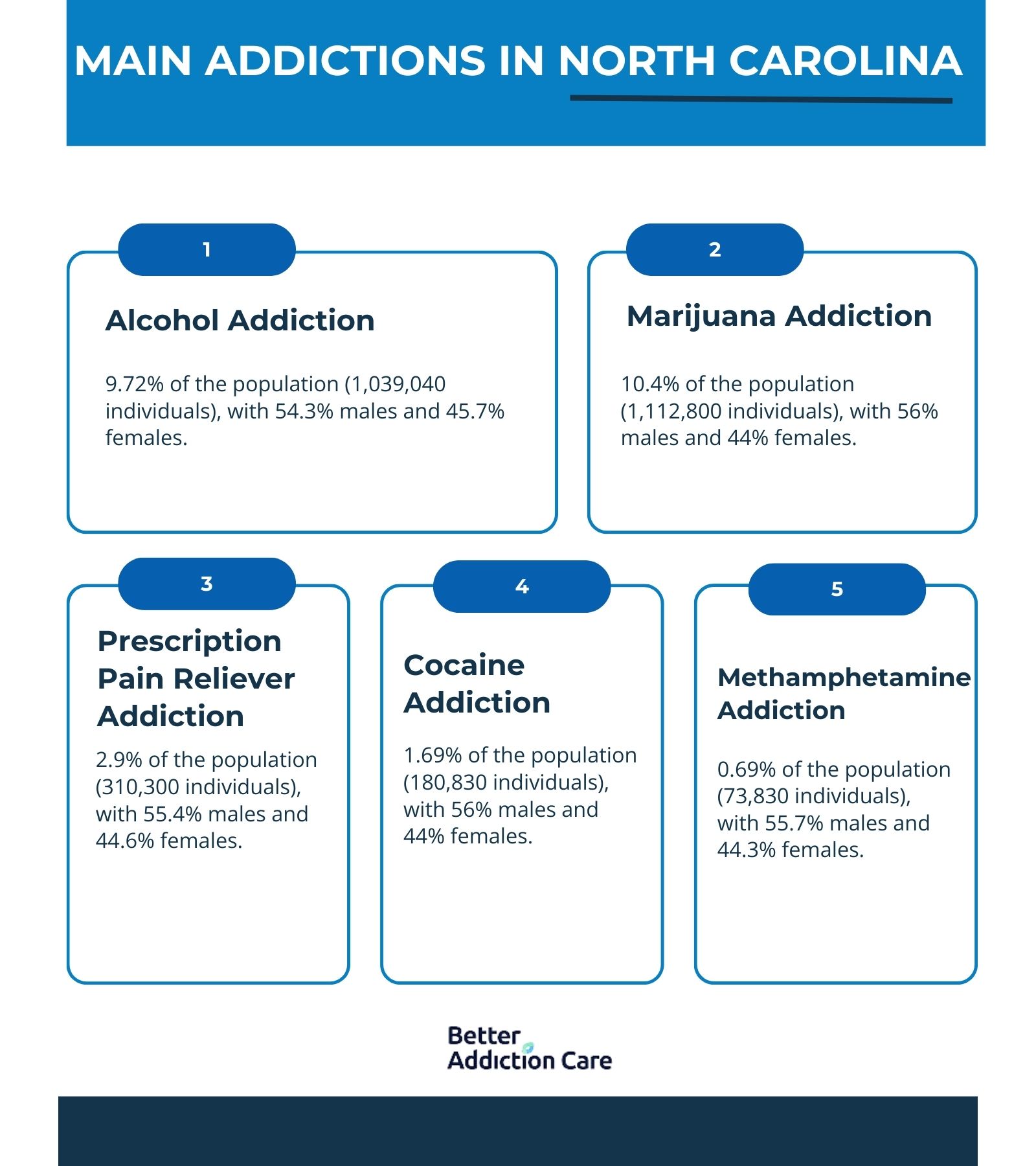
The main addictions people in North Carolina suffer from include: 

  • Alcohol Addiction: 1,039,040 individuals (9.72% of the population) have been affected with alcohol addiction. 563,682 males (54.3%) are higher in number as compared to 475,358 females (45.7%) facing alcohol addiction. 
  • Marijuana Addiction: 1,112,800 individuals (10.4% of the population) have used marijuana in the past year. 622,854 males (56%) as compared to 489,946 (44%) females affected from marijuana addiction.
  • Prescription Pain Reliever Addiction: 310,300 individuals (2.9% of the population) misuse Prescription Pain Relievers.  171,873 (55.4%) males are affected from Pain reliever addiction, while females are 138,427 (44.6%).
  • Cocaine Addiction: 180,830 individuals (1.69% of the population) used cocaine in the past year. 101,248 (56%) males as compared to 79,582 (44%) females facing Cocaine Addiction.
  • Methamphetamine Addiction: 73,830 individuals (0.69% of the population) misuse methamphetamine. 41,171 (55.7%) males as compared to 32,659 (44.3%) females facing methamphetamine addiction.
Main Addictions in North Carolina

What is the cost of rehab centers in North Carolina?

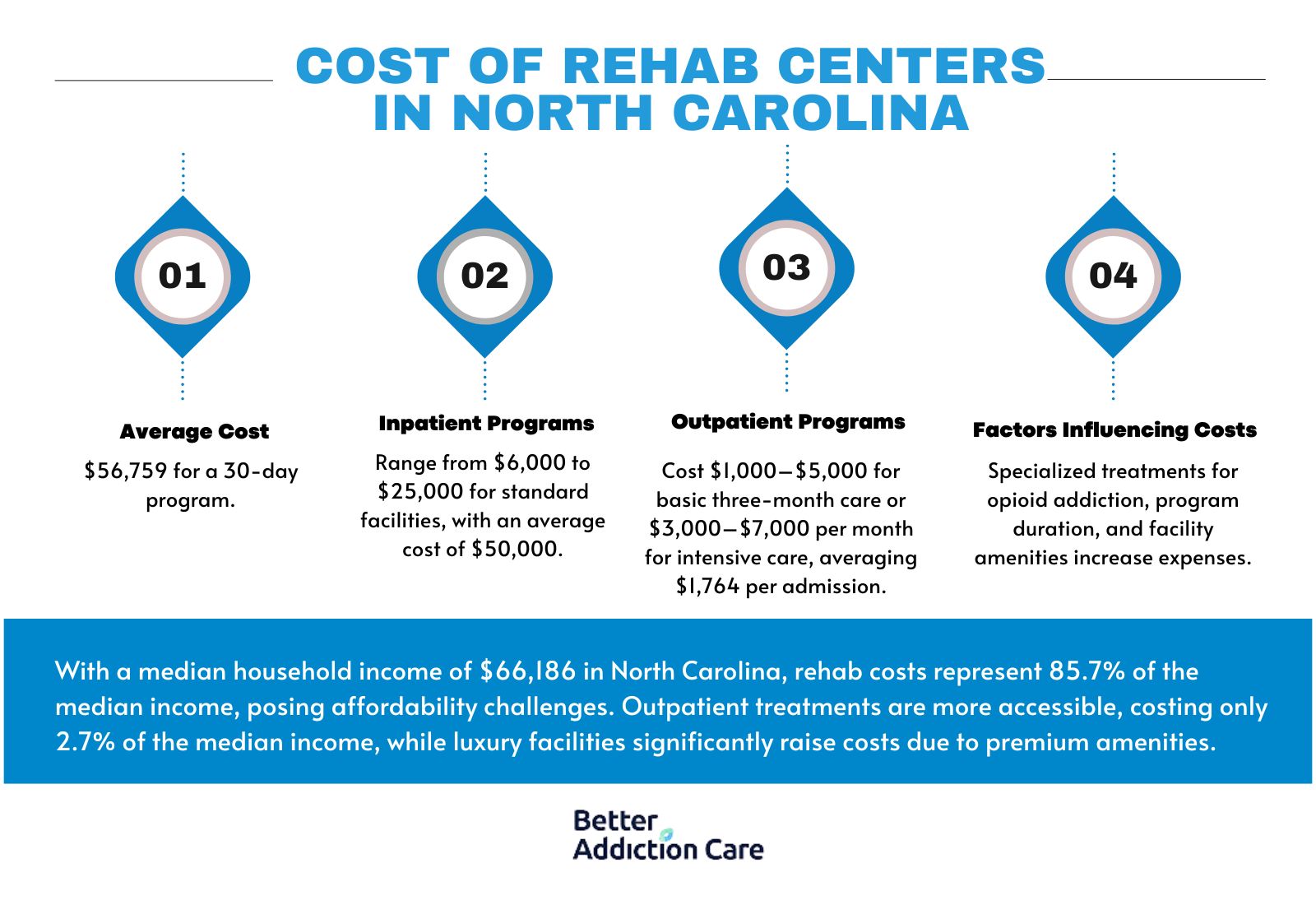
The cost of rehab centers in North Carolina is $56,759. Inpatient rehab programs cost $50,000 for a standard 30-day treatment, while outpatient programs are more affordable, averaging around $1,764 per admission. In North Carolina, the cost of rehab for substance addictions varies significantly depending on the type of treatment program and the addiction being addressed.
Cost of Rehab Centers in North Carolina

Factors influencing these costs of rehab centers in North Carolina include the type of addiction, with treatments for substances like opioids requiring specialized medications and therapies, and the program’s intensity and duration, as more intensive or longer programs increase expenses. Inpatient treatments range from $6,000 to $25,000 depending on the facility’s amenities, while outpatient programs cost $1,000 to $5,000 for basic three-month programs or $3,000 to $7,000 per month for intensive outpatient care.

North Carolina's median household income is $66,186. The cost of rehab centers constitutes 85.7% of the median income, making it a significant financial burden for many families. The affordability of these treatments varies greatly, outpatient treatment at $1,764 per admission is accessible, representing only 2.7% of the median household income. Costs of rehab centers increase depending on the type of rehab center chosen, with luxury or private facilities charging substantially more due to enhanced amenities and personalized care. These factors underscore the importance of carefully evaluating treatment options to balance cost with the necessary level of care.

What is the cost of LGBTQ+ rehab centers in North Carolina?

The cost of LGBTQ+ rehab centers in North Carolina is $56,000. Inpatient rehab programs cost $50,000 for a standard 30-day treatment, while outpatient programs are more affordable, averaging $1,764 per admission. In North Carolina, the cost of LGBTQ+ rehab for substance addictions varies significantly depending on the type of treatment program and the addiction being addressed.

Factors influencing these costs of LGBTQ+ rehab centers in North Carolina include the type of addiction, with treatments for substances like opioids requiring specialized medications and therapies, and the program’s intensity and duration, as more intensive or longer programs increase expenses. Inpatient treatments range from $6,000 to $25,000 depending on the facility’s amenities, while outpatient programs cost $1,000 to $5,000 for basic three-month programs or $3,000 to $7,000 per month for intensive outpatient care.

North Carolina's median household income is $66,186. The cost of LGBTQ+ rehab centers constitutes 84.6% of the median income, making it a significant financial burden for many families. The affordability of these treatments varies greatly, outpatient treatment at $1,764 per admission is accessible, representing only 2.7% of the median household income. Costs of LGBTQ+ rehab centers increase depending on the type of rehab center chosen, with luxury or private facilities charging substantially more due to enhanced amenities and personalized care. These factors underscore the importance of carefully evaluating treatment options to balance cost with the necessary level of care.

What is the cost of Faith-Based rehab centers in North Carolina?

The cost of Faith-Based rehab centers in North Carolina is $55,490. Inpatient rehab programs cost $50,000 for a standard 30-day treatment, while outpatient programs are more affordable, averaging $1,764 per admission. In North Carolina, the cost of Faith-Based rehab for substance addictions varies significantly depending on the type of treatment program and the addiction being addressed.

Factors influencing these costs of Faith-Based rehab centers in North Carolina include the type of addiction, with treatments for substances like opioids requiring specialized medications and therapies, and the program’s intensity and duration, as more intensive or longer programs increase expenses. Inpatient treatments range from $6,000 to $25,000 depending on the facility’s amenities, while outpatient programs cost $1,000 to $5,000 for basic three-month programs or $3,000 to $7,000 per month for intensive outpatient care.

North Carolina's median household income is $66,186. The cost of Faith-Based rehab centers constitutes 83.8% of the median income, making it a significant financial burden for many families. The affordability of these treatments varies greatly, outpatient treatment at $1,764 per admission is accessible, representing only 2.7% of the median household income. Costs of Faith-Based rehab centers increase depending on the type of rehab center chosen, with luxury or private facilities charging substantially more due to enhanced amenities and personalized care. These factors underscore the importance of carefully evaluating treatment options to balance cost with the necessary level of care.

Common Drug Addictions

Opioids, meth, cocaine and alcohol are some of the most commonly abused substances. If you or someone you know is struggling with an addiction, help is available.

Alcohol

Alcohol addiction, also known as alcoholism, is a chronic disease where individuals lose control over their drinking habits despite harmful consequences. Alcohol use disorder is marked by both physical and psychological dependence, which causes significant damage to one’s health...

Continue Reading
Begin Your Recovery Journey and Call Today!
(866) 567-3138 Sponsored Helpline
Cocaine

Cocaine addiction is a chronic and relapsing disorder that involves an uncontrollable craving for cocaine, a powerful drug derived from coca plant leaves. Cocaine gives a powerful release of dopamine, which creates a quick but short tip of euphoria, which makes the drug highly ad...

Continue Reading
Begin Your Recovery Journey and Call Today!
(866) 567-3138 Sponsored Helpline
Heroin

Heroin addiction is a chronic condition where people become dependent on heroin, an opioid that affects the brain's reward system, leading to intense cravings and compulsive drug use. The main causes of heroin addiction include genetic factors, mental health issues like depressio...

Continue Reading
Begin Your Recovery Journey and Call Today!
(866) 567-3138 Sponsored Helpline
Methamphetamine

Crystal meth addiction is a severe substance use disorder that involves the abuse of methamphetamine, a powerful stimulant that affects the central nervous system. Crystal meth addiction starts with casual and fun use but quickly escalates due to the drug’s highly addictive natur...

Continue Reading
Begin Your Recovery Journey and Call Today!
(866) 567-3138 Sponsored Helpline
Fentanyl

Fentanyl addiction is driven by its extreme potency and rapid dependence potential, poses severe dangers, including high overdose risk and fatal respiratory depression, and is treated through medication-assisted therapy, behavioral counseling, and comprehensive support programs....

Continue Reading
Begin Your Recovery Journey and Call Today!
(866) 567-3138 Sponsored Helpline
Prescription Opioids

Opioid use disorder (OUD), or opioid addiction, is the problematic pattern of opioid use leading to major issues and psychological distress in lives. Opioid use disorder usually begins with prescribed opioid medications or illicit drugs, such as heroin.The main types of opioid us...

Continue Reading
Begin Your Recovery Journey and Call Today!
(866) 567-3138 Sponsored Helpline

Common Questions About Rehab

In North Carolina, rehab includes outpatient programs in cities like Charlotte and Raleigh, residential retreats in the Blue Ridge Mountains, and detox services at major hospitals such as Duke University Medical Center and UNC Health. Families often weigh I-40 and I-85 access when comparing care. Touring centers helps compare metro, suburban, and rural options.
Outpatient rehab is usually less costly, while residential programs in mountain or coastal settings cost more due to lodging and intensive services. Some providers offer scholarships.
Most facilities accept private insurance and NC Medicaid. University and employer health plans are also common.
Dual diagnosis tracks often treat depression, trauma, and PTSD, conditions common among veterans, students, and industrial workers. Programs cost more but are partly covered.

Continue Reading

View more Articles