Our directory lists 617 rehab centers in North Carolina across 140 cities and towns. Of these, 297 accept Medicaid and 235 accept Medicare. Outpatient care is the most common level of care, offered at 340 facilities. For more structure, 36 facilities run intensive outpatient programs, 80 offer day treatment or partial hospitalization (PHP), 34 provide residential care and 15 offer detox. In addition, 175 facilities treat co-occurring mental health conditions.
NC Medicaid pays for drug rehab in North Carolina for people who qualify, and eligibility depends on income. Since the expansion on December 1, 2023, NC Medicaid covers adults earning up to 138% of the federal poverty level. The NCDHHS Division of Mental Health, Developmental Disabilities and Substance Use Services oversees addiction services, and the NCDHHS Division of Health Service Regulation licenses treatment facilities. If you have no insurance, your regional LME/MCO (local management entity/managed care organization) manages state-funded treatment, and each one runs a 24-hour access line. To see which facilities accept public coverage, visit our page of free and Medicaid programs in North Carolina.
Charlotte has the most listings in the state, with 65 facilities. Raleigh has 41, Asheville has 31 and Wilmington has 25. If you live outside these cities, use the level of care filter above to narrow the rehab centers in North Carolina to the type of program you need. If the nearest facility is far away, 33 programs provide drug rehab in North Carolina through virtual or in-home care.
For families, North Carolina law allows involuntary commitment for substance use in some circumstances under N.C. Gen. Stat. Chapter 122C. For peer support, our North Carolina meetings page lists 1,576 AA meetings and 645 NA meetings. To talk with someone about treatment options, you can call the sponsored Better Addiction Care helpline at 866-567-3138.
Alcoholism, Drug Abuse, Mental Health, and Treatment in North Carolina
What are the main addictions people in North Carolina suffer from?
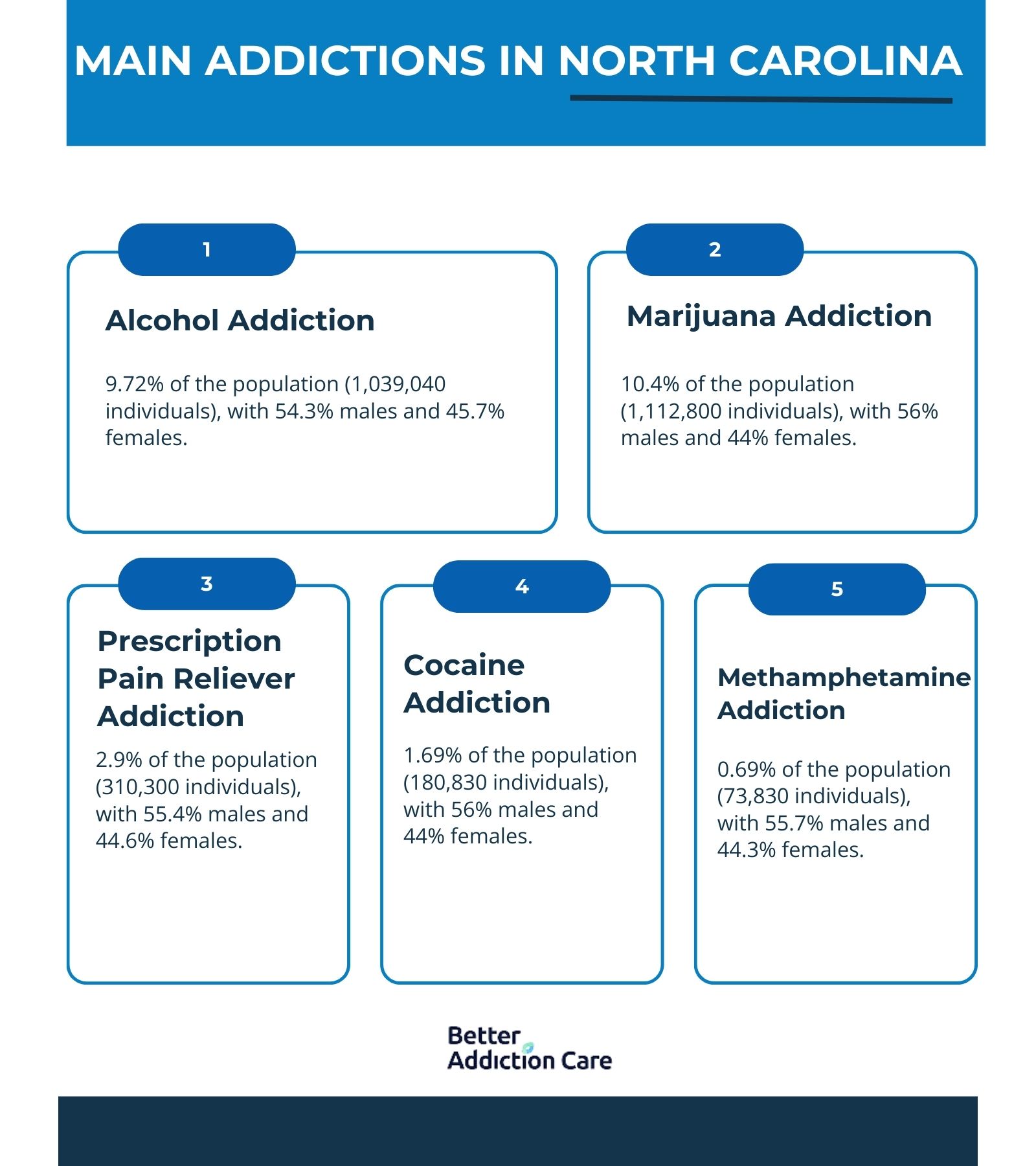
The main addictions people in North Carolina suffer from include:
- Alcohol Addiction: 1,039,040 individuals (9.72% of the population) have been affected with alcohol addiction. 563,682 males (54.3%) are higher in number as compared to 475,358 females (45.7%) facing alcohol addiction.
- Marijuana Addiction: 1,112,800 individuals (10.4% of the population) have used marijuana in the past year. 622,854 males (56%) as compared to 489,946 (44%) females affected from marijuana addiction.
- Prescription Pain Reliever Addiction: 310,300 individuals (2.9% of the population) misuse Prescription Pain Relievers. 171,873 (55.4%) males are affected from Pain reliever addiction, while females are 138,427 (44.6%).
- Cocaine Addiction: 180,830 individuals (1.69% of the population) used cocaine in the past year. 101,248 (56%) males as compared to 79,582 (44%) females facing Cocaine Addiction.
- Methamphetamine Addiction: 73,830 individuals (0.69% of the population) misuse methamphetamine. 41,171 (55.7%) males as compared to 32,659 (44.3%) females facing methamphetamine addiction.
What is the cost of rehab centers in North Carolina?
The cost of rehab centers in North Carolina is $56,759. Inpatient rehab programs cost $50,000 for a standard 30-day treatment, while outpatient programs are more affordable, averaging around $1,764 per admission. In North Carolina, the cost of rehab for substance addictions varies significantly depending on the type of treatment program and the addiction being addressed.
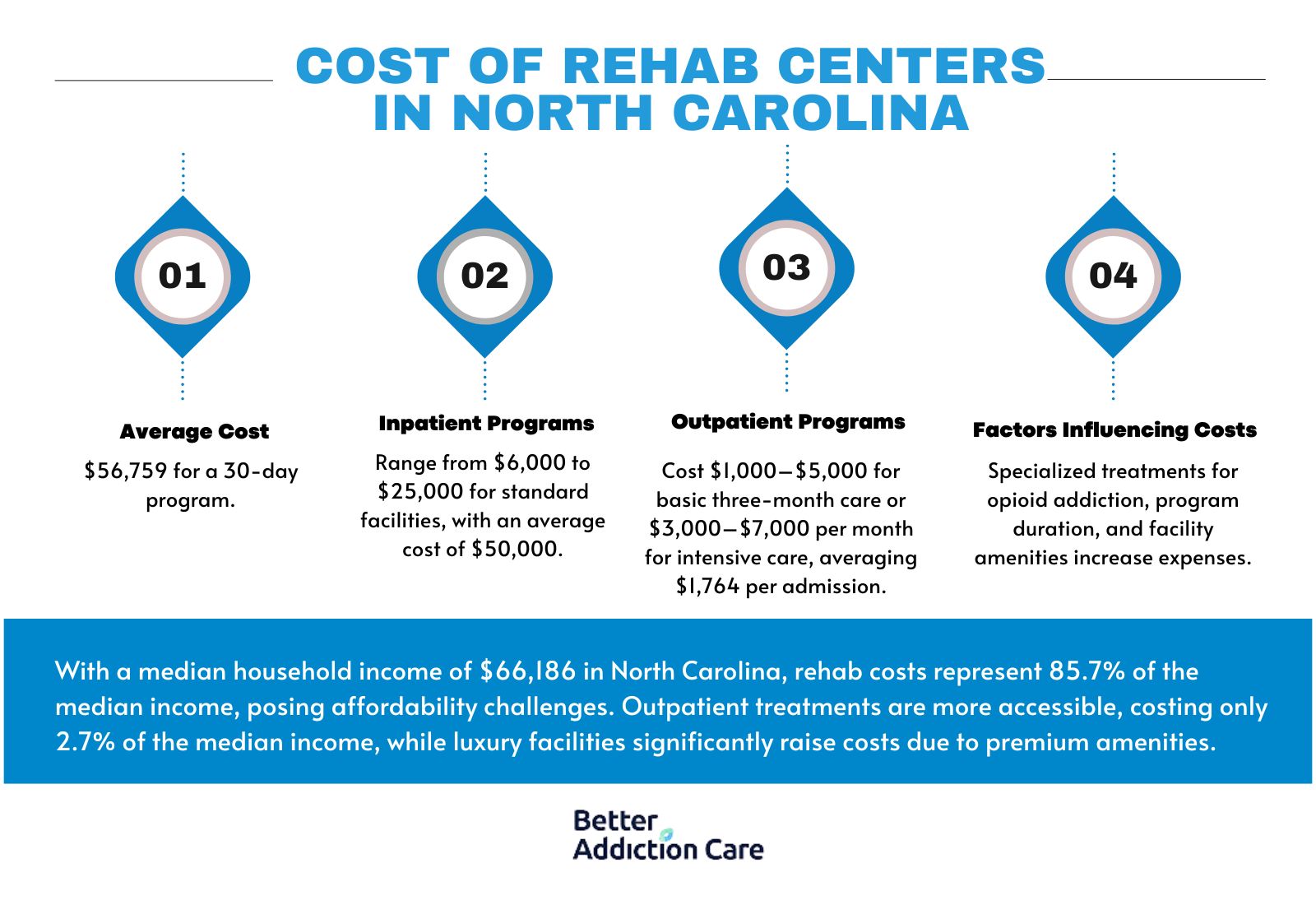
Factors influencing these costs of rehab centers in North Carolina include the type of addiction, with treatments for substances like opioids requiring specialized medications and therapies, and the program’s intensity and duration, as more intensive or longer programs increase expenses. Inpatient treatments range from $6,000 to $25,000 depending on the facility’s amenities, while outpatient programs cost $1,000 to $5,000 for basic three-month programs or $3,000 to $7,000 per month for intensive outpatient care.
North Carolina's median household income is $66,186. The cost of rehab centers constitutes 85.7% of the median income, making it a significant financial burden for many families. The affordability of these treatments varies greatly, outpatient treatment at $1,764 per admission is accessible, representing only 2.7% of the median household income. Costs of rehab centers increase depending on the type of rehab center chosen, with luxury or private facilities charging substantially more due to enhanced amenities and personalized care. These factors underscore the importance of carefully evaluating treatment options to balance cost with the necessary level of care.
What is the cost of LGBTQ+ rehab centers in North Carolina?
The cost of LGBTQ+ rehab centers in North Carolina is $56,000. Inpatient rehab programs cost $50,000 for a standard 30-day treatment, while outpatient programs are more affordable, averaging $1,764 per admission. In North Carolina, the cost of LGBTQ+ rehab for substance addictions varies significantly depending on the type of treatment program and the addiction being addressed.
Factors influencing these costs of LGBTQ+ rehab centers in North Carolina include the type of addiction, with treatments for substances like opioids requiring specialized medications and therapies, and the program’s intensity and duration, as more intensive or longer programs increase expenses. Inpatient treatments range from $6,000 to $25,000 depending on the facility’s amenities, while outpatient programs cost $1,000 to $5,000 for basic three-month programs or $3,000 to $7,000 per month for intensive outpatient care.
North Carolina's median household income is $66,186. The cost of LGBTQ+ rehab centers constitutes 84.6% of the median income, making it a significant financial burden for many families. The affordability of these treatments varies greatly, outpatient treatment at $1,764 per admission is accessible, representing only 2.7% of the median household income. Costs of LGBTQ+ rehab centers increase depending on the type of rehab center chosen, with luxury or private facilities charging substantially more due to enhanced amenities and personalized care. These factors underscore the importance of carefully evaluating treatment options to balance cost with the necessary level of care.
What is the cost of Faith-Based rehab centers in North Carolina?
The cost of Faith-Based rehab centers in North Carolina is $55,490. Inpatient rehab programs cost $50,000 for a standard 30-day treatment, while outpatient programs are more affordable, averaging $1,764 per admission. In North Carolina, the cost of Faith-Based rehab for substance addictions varies significantly depending on the type of treatment program and the addiction being addressed.
Factors influencing these costs of Faith-Based rehab centers in North Carolina include the type of addiction, with treatments for substances like opioids requiring specialized medications and therapies, and the program’s intensity and duration, as more intensive or longer programs increase expenses. Inpatient treatments range from $6,000 to $25,000 depending on the facility’s amenities, while outpatient programs cost $1,000 to $5,000 for basic three-month programs or $3,000 to $7,000 per month for intensive outpatient care.
North Carolina's median household income is $66,186. The cost of Faith-Based rehab centers constitutes 83.8% of the median income, making it a significant financial burden for many families. The affordability of these treatments varies greatly, outpatient treatment at $1,764 per admission is accessible, representing only 2.7% of the median household income. Costs of Faith-Based rehab centers increase depending on the type of rehab center chosen, with luxury or private facilities charging substantially more due to enhanced amenities and personalized care. These factors underscore the importance of carefully evaluating treatment options to balance cost with the necessary level of care.