(866) 567-3138
Sponsored Helpline
Verify Insurance
Drug testing is often encountered during moments of stress—when a loved one is entering treatment, facing legal or workplace requirements, or when families are searching for clarity after concerning behavior.
Understanding how drug testing works, what different tests detect, and how long substances remain detectable can help families respond calmly, protect health and safety, and make informed care decisions.
 Expert Verified
Drug testing is a clinical tool, not a verdict. Results help identify recent or past substance exposure so families and professionals can make informed medical, safety, or treatment decisions—never to label, shame, or punish a loved one.
Test type, panel, and timing all matter. Urine, blood, saliva, and hair tests each provide different answers to different questions. Detection windows and panel contents vary, so understanding what was tested and why is essential before interpreting results.
Accurate interpretation protects families and recovery. Screening tests require confirmatory follow-up, prescribed medications can affect results, and early professional support after a positive test improves safety, outcomes, and long-term recovery potential.
This guide explains drug testing in clear, medically accurate terms. It is designed for families and individuals navigating substance use concerns and focuses on practical understanding, not judgment.
Drug testing looks for specific drugs or their metabolites—the chemical byproducts created when the body processes a substance—in biological samples such as urine, blood, saliva, or hair.
Results depend on the type of test, the panel of substances tested, and the detection window, which varies based on use patterns and individual biology.[1]
What to Do First If a Drug Test Is Involved?
If drug testing is part of your loved one’s situation right now, these steps can reduce confusion and unnecessary distress:
Confirm which type of test is being used (urine, saliva, blood, hair)
Ask which substances are included in the test panel
Clarify whether confirmatory testing is performed for positive results
Gather a complete list of prescribed and over-the-counter medications
If safety is a concern (overdose risk, withdrawal symptoms), seek medical care immediately
Drug test results are medical data—not final judgments—and should always be interpreted within context.
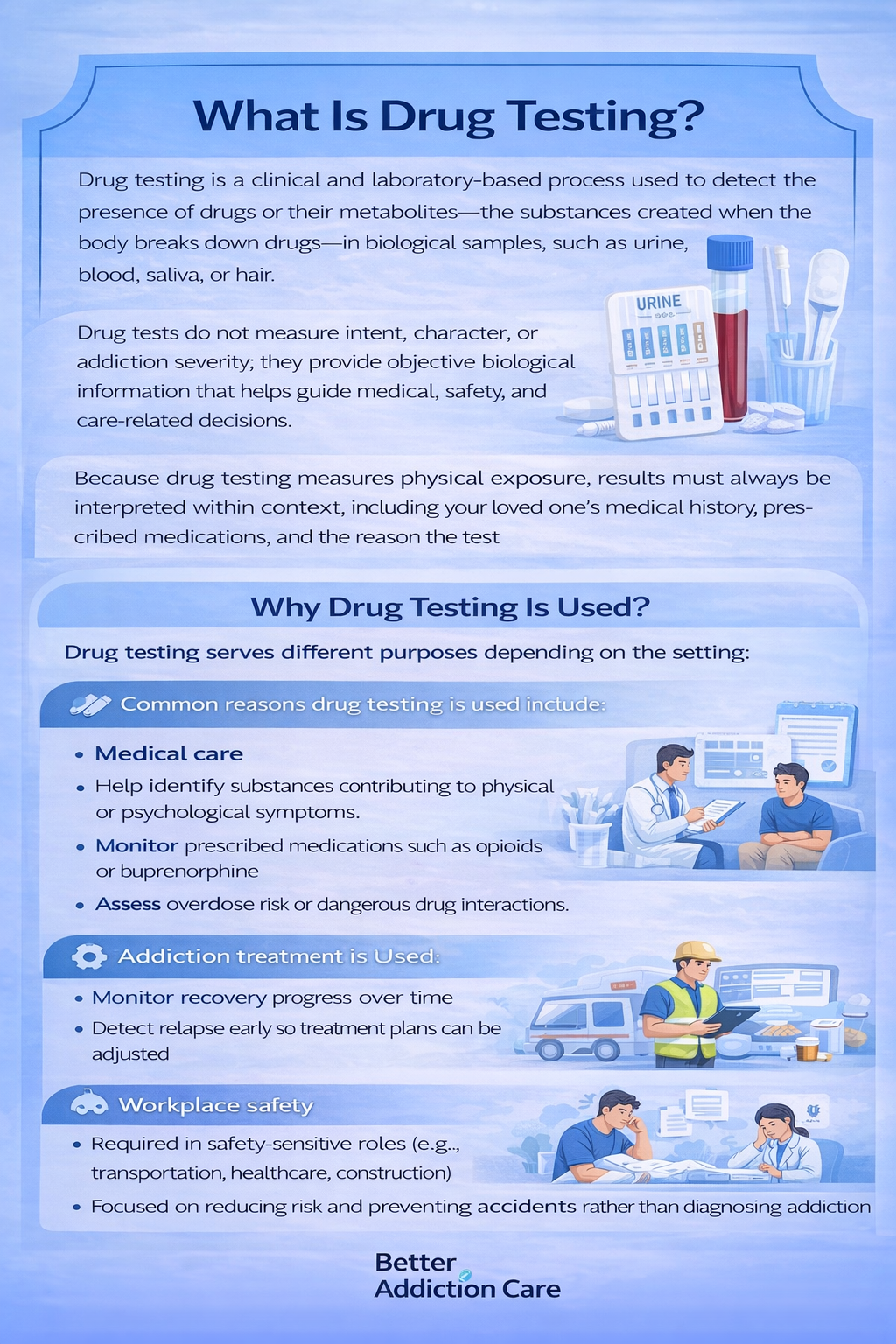
Drug testing is a clinical and laboratory-based process used to detect the presence of drugs or their metabolites—the substances created when the body breaks down drugs—in biological samples, such as urine, blood, saliva, or hair.
Drug tests do not measure intent, character, or addiction severity; they provide objective biological information that helps guide medical, safety, and care-related decisions.
Because drug testing measures physical exposure, results must always be interpreted within context, including your loved one’s medical history, prescribed medications, and the reason the test was ordered.
Why Drug Testing Is Used?
Drug testing serves different purposes depending on the setting:
Common reasons drug testing is used include:
Medical care
Help identify substances contributing to physical or psychological symptoms
Monitor prescribed medications such as opioids or buprenorphine
Assess overdose risk or dangerous drug interactions
Addiction treatment
Monitor recovery progress over time
Detect relapse early so treatment plans can be adjusted
Support accountability within a structured care program
Workplace safety
Required in safety-sensitive roles (e.g., transportation, healthcare, construction)
Focused on reducing risk and preventing accidents rather than diagnosing addiction
Legal or court-ordered monitoring
Used in probation, parole, custody cases, or diversion programs
Often requires strict collection procedures and confirmatory testing
Emergency and acute care situations
Used when substance exposure may explain altered mental status, injury, or overdose
Helps clinicians make rapid, life-saving decisions
Each of these purposes directly affects:
Which test is selected? (urine, blood, saliva, hair)
Which substances are included in the test panel?
How long substances remain detectable and how results should be interpreted?
For Individuals, knowing why a test is being done is often the first step toward understanding what the results truly mean and what actions, if any, are needed next.
Drug testing occurs in two distinct stages, which families should clearly understand.
Screening tests are usually the first step in drug testing. Most screening tests use immunoassay technology, which relies on antibodies designed to react to specific drug classes rather than individual substances.
Fast and cost-effective
Results are often available within minutes to hours
Useful for initial assessments and large-scale testing programs
Designed for broad detection
Identify categories of drugs (e.g., opioids, benzodiazepines)
Do not always distinguish between similar substances
Commonly used in
Workplace testing
Emergency departments
Initial intake for treatment programs
Screening tests can produce false positives
A substance is detected even though the specific drug was not used
Can occur due to cross-reactivity with medications or other compounds
Screening tests can produce false negatives
Especially if a substance is outside the test panel
Or if use occurred outside the detection window
Because of these limitations, a positive screening result alone does not confirm drug use. It should always be considered a preliminary finding.
Confirmatory testing is the second and most critical stage of drug testing. These tests use advanced laboratory techniques such as:
Gas Chromatography–Mass Spectrometry (GC-MS)
Liquid Chromatography–Tandem Mass Spectrometry (LC-MS/MS)
These methods separate and precisely identify individual substances at a molecular level.
Highly specific and accurate
Identify the exact drug and its metabolites
Greatly reduce the risk of false positives
Required for high-stakes decisions
Medical treatment changes
Legal or court-related actions
Employment or licensing decisions
Able to distinguish between similar substances
For example, differentiating prescribed medications from illicit drugs
Important medical, legal, or professional decisions should never be based on screening results alone. Confirmatory testing provides the level of certainty required for fair and appropriate action. [2]
Drug test results are reported as positive or negative based on predefined concentration thresholds, known as cutoff levels.
Why are cutoff levels used?
To reduce false positives from:
Trace environmental exposure
Incidental contact with substances
To standardize interpretation across laboratories
To balance sensitivity (detecting use) with fairness
Key points families should know:
Cutoff levels vary by:
Substance
Test type (screening vs confirmatory)
Testing authority (clinical, workplace, legal)
A result below the cutoff is reported as negative, even if a very small amount of a substance is present
Understanding cutoff levels helps families recognize why:
A test may be negative despite past use
A positive result reflects exposure above a meaningful threshold
When results carry significant consequences, families can and should ask:
What cutoff level was used?
Whether confirmatory testing was performed automatically
This clarity supports accurate interpretation and informed next steps.
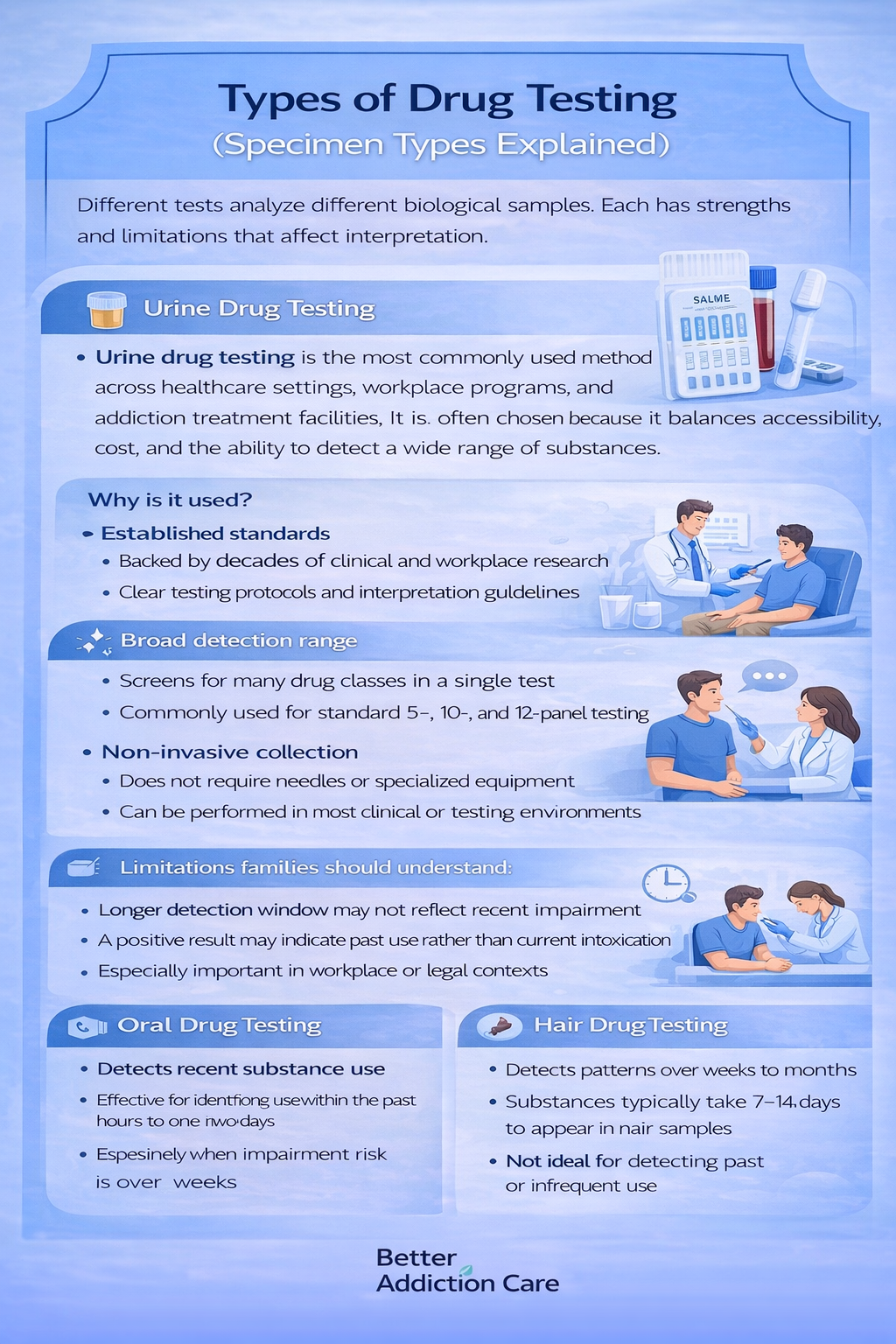
Different tests analyze different biological samples. Each has strengths and limitations that affect interpretation.
Urine drug testing is the most commonly used method across healthcare settings, workplace programs, and addiction treatment facilities. It is often chosen because it balances accessibility, cost, and the ability to detect a wide range of substances.
Why is it used?
Established standards
Backed by decades of clinical and workplace research
Clear testing protocols and interpretation guidelines
Broad detection range
Screens for many drug classes in a single test
Commonly used for standard 5-, 10-, and 12-panel testing
Non-invasive collection
Does not require needles or specialized equipment
Can be performed in most clinical or testing environments
Limitations families should understand:
Longer detection window may not reflect recent impairment
A positive result may indicate past use rather than current intoxication
Especially important in workplace or legal contexts
Potential for tampering if unsupervised
Dilution or adulteration can occur without observed collection
Most programs use validity checks to reduce this risk
Typical detection timeframe:
Urine testing generally detects substances from several hours up to a few days after use. With repeated or chronic use, some substances may remain detectable for weeks or longer. [1]
Blood drug testing is used primarily in medical, hospital, or emergency settings, where immediate clinical decisions are required.
Reflects current or very recent use
Indicates substances actively circulating in the bloodstream
More closely related to impairment at the time of testing
Helpful for assessing toxicity or overdose
Guides urgent medical treatment
Useful when symptoms are severe or life-threatening
Short detection window
Many substances are detectable for hours to a day
Not suitable for long-term monitoring
Invasive collection
Requires a blood draw
Less comfortable than other testing methods
Less practical for monitoring abstinence
Not commonly used in treatment or compliance programs
Oral fluid testing is increasingly used in roadside testing, workplace programs, and some clinical settings, particularly when recent use is the primary concern.
Why is it used?
Detects recent substance use
Effective for identifying use within the past hours to one or two days
Often used when impairment risk is a concern
Difficult to adulterate
Collection is typically observed
Reduces opportunities for tampering
Simple and quick collection
Non-invasive
Can be performed without specialized facilities
Short detection window
Substances clear from oral fluid relatively quickly
Not ideal for detecting past or infrequent use
Limited for long-term use assessment
Cannot reliably reflect patterns of use over weeks or months
Understanding these differences helps anticipate what a test result can—and cannot—reveal, depending on the testing method used.
Hair drug testing is used when a longer-term picture of substance use is needed rather than recent or current impairment. It is most often applied in legal, employment, or monitoring situations where historical patterns matter.
Detects patterns over weeks to months
Identifies repeated or ongoing use rather than single episodes
Useful for understanding long-term behavior and trends
Harder to manipulate
Collection is directly observed
Washing, dyeing, or styling hair does not reliably remove drug markers
Does not detect very recent use
Substances typically take 7–14 days to appear in hair samples
Not appropriate for identifying immediate or recent impairment
Results can vary slightly
Differences in hair type, growth rate, and cosmetic treatments may influence concentrations
Laboratories account for these factors using standardized methods
Scalp hair grows at an average rate of approximately 1 centimeter per month. Testing a standard hair sample reflects substance exposure over the previous weeks to months, depending on the length analyzed.[3]
A drug test panel refers to the specific list of substances a test is designed to detect. Panels are selected based on why the testing is being done, such as medical care, addiction treatment, workplace screening, or legal monitoring.
There is no single universal panel, and the same panel name can include different substances depending on the laboratory or testing program.
The 5-panel drug test is the most widely used standard, particularly in workplace and basic screening settings.
Typically includes:
Marijuana (THC)
Detects the psychoactive component of cannabis
Identifies use of cocaine and its primary metabolites
Includes heroin, morphine, and codeine
Does not reliably detect synthetic opioids
Amphetamines
Covers amphetamine and methamphetamine
Can cross-react with some prescription medications
Phencyclidine (PCP)
Less commonly used today but still included in standard panels
This panel is designed for broad screening, not for detailed or treatment-focused monitoring.
10-panel drug tests build on the 5-panel by adding substances that are commonly prescribed or misused.
Common additions include:
Benzodiazepines
Such as alprazolam, diazepam, and clonazepam
Barbiturates
Older sedative medications are still detected in some cases
Methadone
Used in opioid treatment programs
MDMA (Ecstasy)
A stimulant with hallucinogenic properties
A prescription opioid not reliably detected in basic opiate screens
Expanded panels are often used in treatment programs, healthcare settings, and monitoring situations where prescription and illicit drug use must be differentiated.
12-panel and comprehensive drug tests are designed for clinical and addiction care settings, where detailed substance information is essential.
May include:
Synthetic opioids
Such as fentanyl and its analogs
Buprenorphine
Commonly used in medication-assisted treatment
Prescription adherence monitoring
Confirms whether prescribed medications are being taken as directed
Alcohol biomarkers
Such as ethyl glucuronide (EtG) for recent alcohol use
These panels provide a more complete picture of substance exposure, especially for individuals in recovery or under medical supervision.
Detection windows depend on:
Frequency of use
Amount used
Body composition and metabolism
Test sensitivity
Specimen type
Below are practical, evidence-based ranges, not guarantees. [1,2]
General Detection Window Table
Chronic use almost always extends detection windows.
Alcohol is metabolized quickly, but special biomarkers extend detection.
EtG (Urine)
Detects alcohol use within the last 1–3 days
Highly sensitive
Used in abstinence monitoring programs
PEth (Blood)
Indicates repeated alcohol consumption
Detectable for approximately 2–4 weeks
Not affected by incidental exposure
Understanding which alcohol test is used prevents misinterpretation.[3]
False Positives and Cross-Reactivity
Screening tests are designed to be sensitive, which means they sometimes react to substances that are not illicit drugs.
Some prescription medications, over-the-counter drugs, or supplements can trigger screening positives
Certain foods or compounds may rarely cause cross-reactivity
Screening tests identify drug classes, not specific substances
Because of this, a screening positive is not a diagnosis of drug use.
Confirmatory tests precisely identify the substance present
They eliminate most false positives caused by cross-reactivity
Discrepancies between screening and confirmatory results are resolved at this stage
This two-step process protects individuals from unfair conclusions and supports accurate decision-making.
Metabolites Matter
Drug tests often detect metabolites, which are the chemical byproducts created when the body processes a substance.
The original drug (called the parent drug) may no longer be present
Metabolites can remain detectable longer than the drug itself
A result may reflect prior use rather than current effects
For families, this means:
Absence of the parent drug does not mean absence of use
Presence of a metabolite does not always indicate recent impairment
Understanding metabolites helps clarify why detection windows vary and why timing matters.
Adulteration and Validity Checks
Modern laboratories routinely perform specimen validity testing to ensure samples are authentic and reliable.
Common checks include:
Temperature
Confirms the sample was freshly provided
Dilution markers
Measures creatinine and specific gravity to detect excess water intake
Chemical adulterants
Screens for substances added to alter test results
Attempts to “beat” tests often worsen outcomes.

Practical steps families can take:
Prepare medication documentation
Keep an updated list of all prescription and over-the-counter medications
Include supplements and recent medical treatments
Share this information with the testing provider when appropriate
Avoid unverified detox or “cleansing” products
Many products marketed to alter drug test results are ineffective
Some may interfere with validity checks or pose health risks
Use of these products can raise additional concerns during testing
Ask about observed vs. unobserved collection
Understand whether sample collection will be directly observed
Clarify how privacy and dignity are maintained
This helps set expectations and reduce anxiety
Encourage honesty and medical support
Honest disclosure allows clinicians to interpret results correctly
Medical context matters more than secrecy
Supportive conversations reduce fear-driven decisions
A positive drug test can trigger strong emotional reactions. Pausing before acting allows families to respond in ways that protect health, dignity, and long-term recovery.
Immediate steps to take:
Pause emotional reactions
Avoid confrontation or accusations
Strong emotional responses can shut down communication
Request confirmatory testing
Ensure results are verified with definitive laboratory methods
This step is especially important for screening positives
Seek clinical interpretation
Ask a healthcare professional to explain what the result means
Clarify detection windows, metabolites, and cutoff levels
Understand whether the result reflects recent use or past exposure
Focus on safety and next steps, not blame
Assess medical or overdose risk if relevant
Discuss treatment adjustments or additional support
Keep conversations centered on health and protection
A positive test result is a clinical signal, not a moral judgment or personal failure. When handled with care, it can become an entry point for appropriate support and meaningful change.
Seek immediate medical care if there are signs of:
Overdose symptoms:
Trouble breathing, loss of consciousness, extreme confusion, or seizures
Severe withdrawal:
Uncontrolled shaking, vomiting, dehydration, or dangerous changes in heart rate
Mental health crisis:
Suicidal thoughts, psychosis, extreme agitation, or sudden behavioral changes
Seek addiction care when:
Substance use continues despite consequences:
Legal, health, family, or work-related harm
Drug tests repeatedly show relapse:
Especially after periods of abstinence or treatment
Safety is compromised:
Driving under the influence, unsafe living conditions, or risk to others.
Drug testing carries medical, legal, and ethical responsibilities, especially when families are involved.
Key considerations to address before testing:
Confirm consent requirements
In most non-emergency settings, informed consent is required
Special rules may apply for minors, workplaces, or court-ordered testing
Request written testing policies
Ask who ordered the test, what panel is used, and how results are handled
Written policies clarify rights, obligations, and next steps
Protect privacy and confidentiality
Results are considered protected health or employment information
Access should be limited to authorized parties only
Use testing as a health tool, not a punishment
Ethical testing supports safety, diagnosis, and recovery
Punitive use can damage trust and reduce treatment engagement
When used appropriately, drug testing can support care decisions and early intervention rather than fear or control. Legal and ethical safeguards exist to ensure testing serves health, safety, and dignity, not stigma or blame. [2]
Final Perspective: Using Drug Testing to Support Recovery
Drug testing provides objective information that can guide care, protect safety, and support recovery. When understood correctly, it becomes a tool for early intervention and informed decision-making—not fear or punishment.
Resources for Families
SAMHSA Helpline: 1-800-662-HELP
Medical providers and addiction specialists
Certified laboratories for confirmatory testing
Families who stay informed and compassionate play a critical role in long-term outcomes.
Drug tests are highly accurate when a two-step process is used. Initial screening tests are designed for speed and sensitivity, while confirmatory tests like GC-MS or LC-MS/MS precisely identify substances, greatly reducing false positives and ensuring reliable, defensible results.
Yes. Many prescription and even over-the-counter medications can trigger positive screening results due to cross-reactivity. This is why providing complete medication documentation is essential. Confirmatory testing can accurately distinguish prescribed medications from illicit substances.
No. Home drug tests are screening tools only. They can indicate possible substance exposure but lack the specificity and legal or medical reliability of laboratory confirmatory testing. Important health, legal, or employment decisions should always rely on certified lab results.
Detection windows vary by substance, frequency of use, metabolism, and test type. Some drugs are detectable for hours or days, while others—especially with chronic use—may be detected for weeks. No test can determine the exact timing or level of impairment.
Incidental or environmental exposure rarely reaches laboratory cutoff levels. Cutoffs are designed to prevent positives from passive exposure. When concerns arise, confirmatory testing and clinical review help ensure results reflect meaningful substance use, not accidental contact.
Excessive water intake or unverified detox products do not reliably eliminate drugs and may result in diluted or invalid samples. Laboratories routinely check for dilution. Attempts to manipulate results often raise additional concerns rather than resolving them.
By calling us, you agree to our Terms & Conditions
For those seeking addiction treatment for themselves or a loved one, our calls are confidential and are available for 24/7 help.
Any treatment center receiving calls from the site is a paid advertiser.
Calls to numbers on a specific treatment center listing will be routed to that treatment center.
Calls to any general helpline will be answered by treatment providers, each of which is a paid advertiser.
By calling the helpline you agree to the terms of use. These calls are offered at no cost to you and with no obligation to enter into treatment. Neither this site nor anyone who answers the call receives a commission or fee dependent upon which treatment provider a visitor may ultimately choose.
If you wish to explore additional treatment options or connect with a specific rehab center, you can: browse top-rated listings, visit our homepage, or visit SAMHSA, or by calling 800-662-HELP. You may also contact The Florida Department of Children and Family Services