(866) 567-3138
Sponsored Helpline
Verify Insurance
The EtG (ethyl glucuronide) test is used to detect recent alcohol exposure by identifying a biomarker that remains in the body after alcohol itself is no longer present.
Because EtG can be detected for days rather than hours, understanding its detection window is especially important in settings such as workplace testing, probation monitoring, and medical or addiction treatment programs.
 Expert Verified
Detection times vary among individuals and can be influenced by factors such as usage patterns, metabolism, health status, and the sensitivity of the laboratory. The information provided here is for educational purposes only, helping individuals and families understand how EtG testing works — not to avoid or manipulate testing outcomes.
An EtG test is a laboratory test used to detect recent alcohol exposure by measuring ethyl glucuronide (EtG) in the body.
Ethyl glucuronide is a metabolite, meaning a substance created when the body breaks down alcohol (ethanol). After alcohol is consumed, most of it is metabolized and eliminated within hours. A tiny portion is converted into EtG in the liver and then excreted in urine.
EtG importance?
EtG stays in the body much longer than alcohol itself
It allows detection of drinking after blood or breath alcohol is gone
It is commonly used to verify abstinence, not impairment
Common sample type:
Urine is the most commonly used sample for EtG testing
Blood, hair, and nails may also be used in specific settings
Why is EtG favored over other alcohol tests?
Detects alcohol use days later, not just hours
Non-invasive and cost-effective
Useful for monitoring compliance in recovery and legal programs
EtG tests do not measure intoxication, impairment, or how much alcohol was consumed. They only confirm that alcohol entered the body at some point within the detection window.
An EtG test detects ethyl glucuronide (EtG), which is a biomarker created when the body processes alcohol. It does not detect alcohol itself. Instead, it identifies a substance that remains in the body after alcohol has already been metabolized and eliminated.
What does this mean in simple terms?
Alcohol is short-lived in the body
EtG is alcohol’s long-lasting “footprint.”
A helpful way to understand this is to imagine walking across wet sand. The water disappears quickly, but faint footprints remain long after. EtG functions in the same way — it is the remaining trace that confirms alcohol was present, even when the person no longer feels any effects and blood alcohol levels have returned to zero.
Presence vs. intoxication
Presence: A positive EtG result confirms that alcohol entered the body within the detection window
Intoxication: EtG cannot determine impairment, level of intoxication, or the exact time alcohol was consumed
This distinction is critical for families, clinicians, and legal programs. A positive EtG test does not mean someone was drunk at the time of testing, nor does it prove current impairment. It simply indicates that alcohol exposure occurred at some point during the detection period.
Why EtG lasts longer than alcohol
EtG remains detectable longer because of how the body processes it:
EtG is water-soluble and chemically stable
The kidneys eliminate it gradually through urine
Even small amounts of alcohol can create measurable EtG
This extended detectability makes EtG useful for monitoring abstinence in treatment, workplace, and probation settings. At the same time, it requires careful and humane interpretation, since sensitivity alone does not explain how or why alcohol exposure occurred.
The EtG detection window depends on how much alcohol was consumed, how often, and individual biology.
Typical EtG detection window (urine)
*Ranges vary by metabolism, dose, age, health, hydration, frequency of use, and lab sensitivity.
Why do detection windows vary so widely?
There is no single timeline that applies to everyone. Two people can drink the same amount and test differently days.
Factors include:
Liver function
Body water content
Frequency of drinking
Test cutoff level
Lab equipment sensitivity
If your loved one drank heavily or repeatedly, EtG may remain detectable for several days. This does not mean the body is “holding onto alcohol” — it means the metabolite is slowly clearing.
Planning for at least 3–5 alcohol-free days is the safest assumption when testing matters.
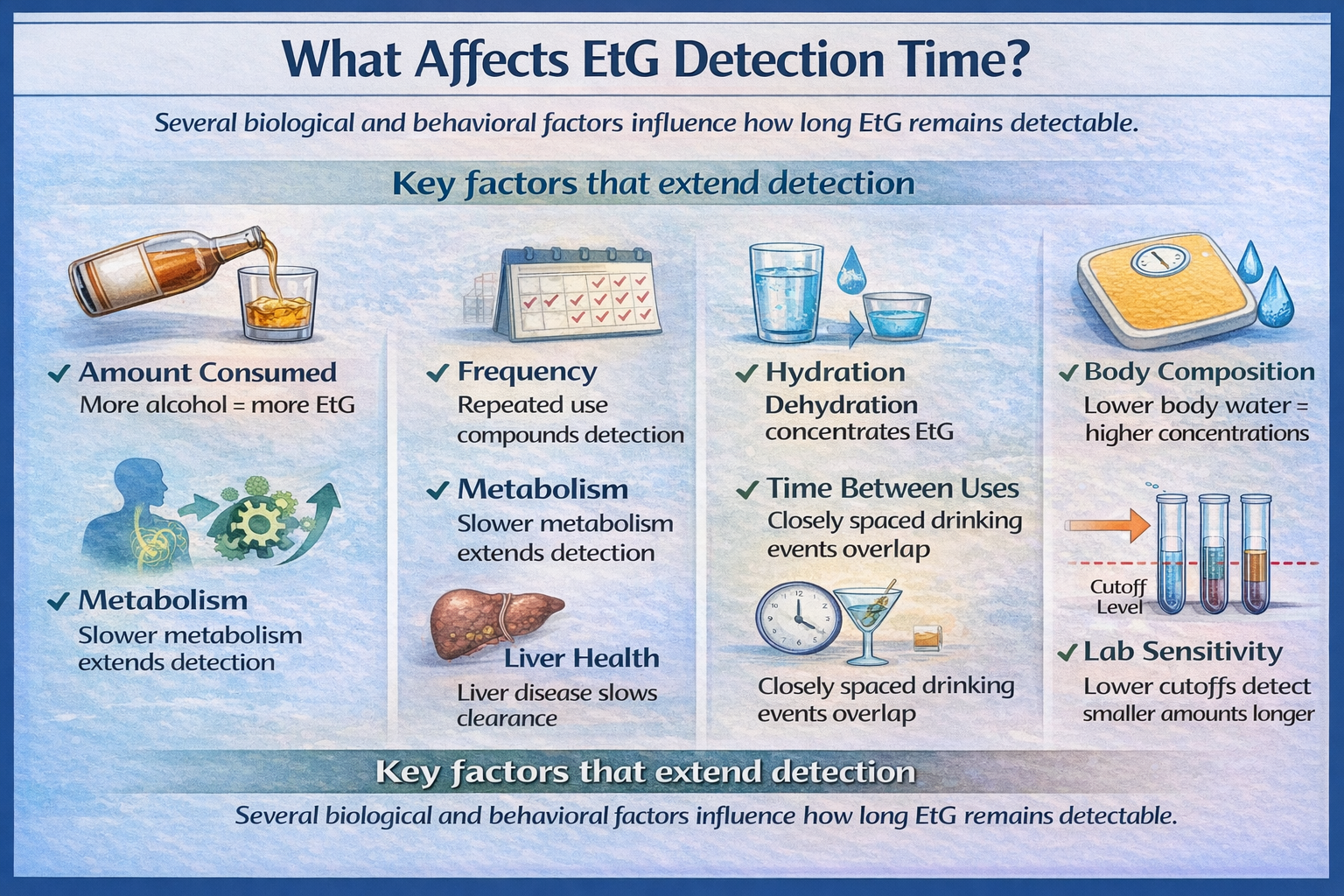
Several biological and behavioral factors influence how long EtG remains detectable.
Key factors that extend detection
Amount consumed: More alcohol = more EtG
Frequency: Repeated use of compound detection
Metabolism: Slower metabolism extends detection
Liver health: Liver disease slows clearance
Hydration: Dehydration concentrates EtG
Body composition: Lower body water = higher concentrations
Time between uses: Closely spaced drinking events overlap
Lab sensitivity: Lower cutoffs detect smaller amounts longer
Why do calculators struggle with accuracy?
No calculator can fully account for:
Liver enzyme differences
Kidney efficiency
Urine concentration
Repeated exposure patterns
Lab-specific cutoffs
This is why professional programs never rely on calculators to interpret test results.
A cutoff level is the minimum EtG concentration required for a test to be reported as positive.
Why do cutoffs exist?
Reduce false positives
Account for incidental exposure
Standardize interpretation
Common U.S. EtG cutoffs
How are cutoffs interpreted?
100 ng/mL: Very sensitive; may detect incidental exposure
500 ng/mL: Common standard; balances sensitivity and fairness
1,000 ng/mL: Strongly suggests drinking
Most U.S. probation and treatment programs use 500 ng/mL for confirmation to reduce unintended positives.
Individuals cannot control or influence cutoff levels. Drinking water, exercising, or timing does not change how labs interpret results.
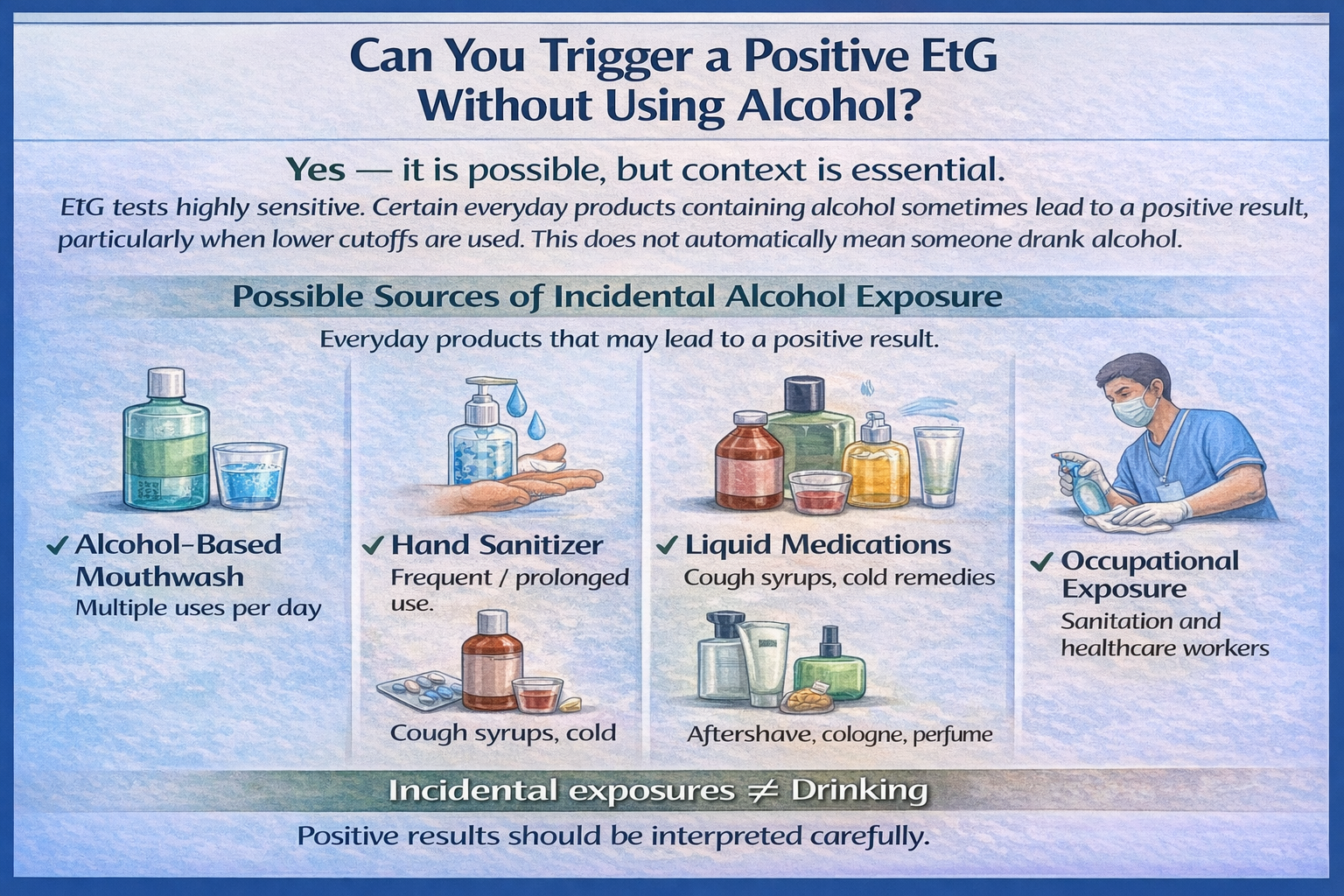
Yes — it is possible, but context is essential.
Because EtG testing is highly sensitive, certain everyday products that contain alcohol can sometimes lead to a positive result, particularly when lower cutoff levels are used. This does not automatically mean someone consumed alcoholic beverages.
Possible sources of incidental alcohol exposure
Common non-beverage sources of alcohol include:
Alcohol-based mouthwash, especially when used multiple times per day
Hand sanitizer, particularly with frequent or prolonged use
Certain medications, such as liquid cough syrups or cold remedies
Cosmetic and personal care products, including aftershave, cologne, or perfumes
Occupational exposure, most often seen in healthcare or sanitation settings
For individuals under strict monitoring, repeated daily exposure to these products can accumulate and affect test results.
What research shows?
Scientific studies have found that:
Heavy and repeated hand sanitizer use can raise urinary EtG levels
Frequent mouthwash use may produce low-level positive results
Most incidental exposures remain below 500 ng/mL, which is why this cutoff is commonly used in U.S. programs
These findings explain why higher cutoff thresholds are often selected and why EtG results should never be interpreted in isolation.
Retesting and clinical review
Reputable testing programs typically:
Confirm positive screens using advanced laboratory methods
Review possible exposure explanations before making determinations
Avoid punitive action based solely on low-level or borderline results
This review process helps protect individuals from unfair consequences while preserving the integrity of alcohol monitoring programs.
EtG Test Calculator — Are They Accurate?
EtG calculators can be helpful for general understanding, but they should never be treated as precise or predictive tools. These calculators provide estimates only, not definitive answers about whether an EtG test will be positive or negative.
Why do calculators fall short?
EtG calculators rely on simplified assumptions and cannot account for many real-world factors, including:
Individual metabolism, which varies significantly from person to person
Liver and kidney health, both of which influence how EtG is processed and eliminated
Urine dilution, affected by hydration, diet, and timing of the sample
Repeated or overlapping alcohol exposures, which can extend detection beyond estimates
Laboratory-specific cutoff thresholds, which differ between testing programs
Because these variables are unpredictable and interconnected, calculator results can be misleading.
When used appropriately, EtG calculators can help with:
Educational understanding, by explaining how alcohol metabolites are detected over time
General timeline awareness, offering a broad idea of how long EtG may remain detectable after alcohol use
Risk awareness, helping individuals recognize that detection windows often extend longer than expected
EtG calculators cannot:
Predict guaranteed test results, regardless of the information entered
Replace laboratory testing or professional medical interpretation
Ensure a negative outcome, even if the estimate suggests low risk
Most common method used in the United States
Detects alcohol use for several days after consumption
Widely used in probation, workplace monitoring, and addiction treatment programs
Urine testing is preferred because it balances sensitivity, reliability, and practicality. It is non-invasive and provides a longer detection window than blood or saliva testing.
Has a short detection window, typically hours rather than days
Rarely used for EtG detection
More useful for identifying recent use or impairment, not abstinence monitoring
Saliva testing is generally not appropriate when the goal is to confirm long-term abstinence.
Detects long-term patterns of alcohol use over weeks or months
Not effective for identifying recent drinking or short-term abstinence
Results can be influenced by cosmetic treatments such as dyeing, bleaching, or chemical processing
Hair testing may be used to evaluate chronic alcohol use, but should not be used alone to assess recent sobriety.
Has a very short detection window
Typically used in medical or forensic settings
Not practical for routine monitoring or recovery programs
Blood EtG testing may help confirm very recent exposure, but it is rarely used outside of clinical or investigative contexts.
EtG testing is analytically accurate, meaning laboratories can precisely measure the presence of ethyl glucuronide. However, test results are context-dependent, and proper interpretation is essential for fair and clinically sound decisions.
Laboratories are considered reliable because;
Reputable laboratories follow strict procedures to ensure accuracy, including:
Using GC-MS or LC-MS confirmation methods, which are highly specific and reduce the risk of analytical error
Maintaining chain-of-custody protocols to protect sample integrity from collection to reporting
Testing EtG alongside EtS, a companion biomarker that helps validate results and identify potential sample issues
These safeguards ensure that the reported EtG level accurately reflects what was present in the sample.
An EtG value by itself does not explain how, when, or why alcohol exposure occurred. Ethical and evidence-based programs evaluate results within a broader clinical and situational context, including:
Exposure history, such as use of alcohol-containing products
Test timing in relation to reported behaviors
Patterns of results across multiple tests rather than a single data point
Clinical behavior, including engagement in treatment and observed functioning
Professional guidelines caution against using EtG results as the sole evidence of alcohol consumption, emphasizing the need for confirmation and contextual review [1][2].
EtG testing is widely used in the United States to monitor alcohol abstinence in situations where drinking could pose legal, medical, or safety-related risks. The purpose of testing is accountability and risk reduction — not punishment or moral evaluation.
EtG testing is commonly required in the following settings:
Probation and court monitoring, particularly in cases involving alcohol-related offenses
DUI and diversion programs, where abstinence is a condition of participation or reinstatement
Addiction treatment programs, to support recovery and identify the need for additional care
Workplace safety programs, especially in safety-sensitive industries
Professional licensing and monitoring, including healthcare providers, pilots, and commercial drivers
Child custody and family court cases, where sobriety may be required to protect child welfare
In all cases, EtG testing is used to verify abstinence, not moral judgment.
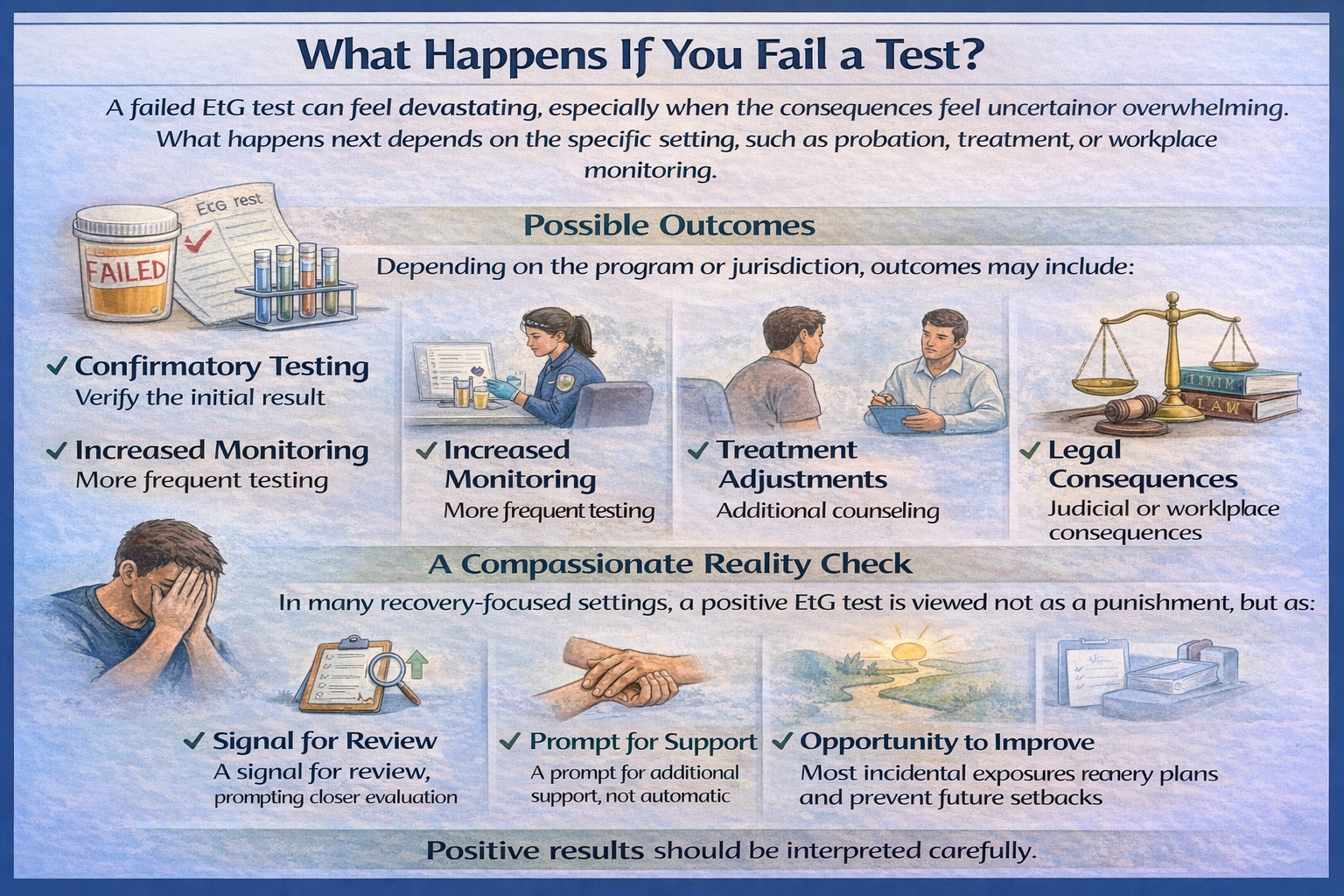
A failed EtG test can feel devastating, especially when the consequences feel uncertain or overwhelming. What happens next depends on the specific setting, such as probation, treatment, or workplace monitoring.
Possible outcomes
Depending on the program or jurisdiction, outcomes may include:
Confirmatory testing to verify the initial result
Increased monitoring or more frequent testing
Treatment adjustments, such as additional counseling or support
Legal or administrative consequences, which vary by jurisdiction and program rules
A compassionate reality check
In many recovery-focused settings, a positive EtG test is viewed not as a punishment, but as:
A signal for review, prompting closer evaluation
A prompt for additional support, not automatic discipline
An opportunity to strengthen recovery plans and prevent future setbacks
If EtG testing is causing fear or repeated stress, it may be time to seek support.
Evidence-based support options
Depending on individual needs, evidence-based care may include:
Medical detox, when withdrawal symptoms or health risks are present
Outpatient or inpatient rehabilitation, providing structured treatment and monitoring
Individual counseling, to address triggers, stress, and coping skills
Medication-assisted treatment, which can help reduce cravings or relapse risk
Family therapy, to improve communication and shared understanding
Peer support groups, offering connection, accountability, and encouragement
For families and loved ones
Families play a critical role in recovery. Helpful approaches include:
Learning about relapse prevention and realistic recovery timelines
Avoiding shame-based responses, which can increase secrecy and stress
Supporting accountability with compassion, combining boundaries with care
Recovery is not a straight line. Long-term success is built through consistent support, structure, and science-based care, even when setbacks occur.
Conclusion
The EtG test detects recent alcohol use by identifying ethyl glucuronide
Detection windows vary based on frequency of use, amount consumed, individual metabolism, and overall health
Cutoff levels are used to reduce false positives and ensure a fairly consistent interpretation of results
EtG calculators provide estimates only and cannot predict guaranteed test outcomes
Professional support and treatment are available if struggling with alcohol use and testing stress
An EtG (ethyl glucuronide) test detects EtG, a direct metabolite of alcohol that remains in the body after alcohol itself has been eliminated. Unlike standard breath or blood alcohol tests, which detect active alcohol, an EtG test identifies recent alcohol exposure, making it useful for monitoring abstinence, compliance programs, or clinical evaluations.
EtG can typically be detected in urine for 24 to 80 hours after alcohol consumption, depending on factors such as the amount consumed, frequency of drinking, metabolism, hydration, and the sensitivity of the test. Heavy or repeated drinking may extend the detection window, while light or single-use drinking may be detectable for a shorter period.
EtG cutoff levels (commonly 100, 300, or 500 ng/mL) determine how sensitive a test is to alcohol exposure. Lower cutoffs are more sensitive and may detect incidental exposure (such as from hand sanitizer or mouthwash), while higher cutoffs are more specific to intentional drinking. EtG calculators estimate detection likelihood based on intake and timing, but they are approximations only and cannot guarantee a negative or positive result due to individual variability.
By calling us, you agree to our Terms & Conditions
For those seeking addiction treatment for themselves or a loved one, our calls are confidential and are available for 24/7 help.
Any treatment center receiving calls from the site is a paid advertiser.
Calls to numbers on a specific treatment center listing will be routed to that treatment center.
Calls to any general helpline will be answered by treatment providers, each of which is a paid advertiser.
By calling the helpline you agree to the terms of use. These calls are offered at no cost to you and with no obligation to enter into treatment. Neither this site nor anyone who answers the call receives a commission or fee dependent upon which treatment provider a visitor may ultimately choose.
If you wish to explore additional treatment options or connect with a specific rehab center, you can: browse top-rated listings, visit our homepage, or visit SAMHSA, or by calling 800-662-HELP. You may also contact The Florida Department of Children and Family Services