(866) 567-3138
Sponsored Helpline
Verify Insurance
Like any medication, the duration depends on many personal factors — but we can look at averages to create a clearer, calmer picture.
 Expert Verified
Benadryl leaves the body gradually, and the timing varies from person to person based on dose, frequency, and metabolism.
Its half-life is about 7–12 hours, so most of it clears within 1.5–2.5 days, though it may last longer in older adults or those with slower metabolism.
Factors like age, liver and kidney function, hydration, mental state, and other medications all influence how quickly your body processes Benadryl.
Even after the drowsiness fades, small traces can still show up in urine, blood, saliva, or hair — which is completely normal.
Benadryl (diphenhydramine) is an antihistamine, widely used for allergies, cold symptoms, motion sickness, itching, hives, and short-term sleep assistance. For many families, it’s one of the first medications used in moments of discomfort or distress — which makes understanding its effects deeply important.
Benadryl works by blocking histamine, the chemical your body releases during allergic reactions. [1] But unlike some newer antihistamines, Benadryl crosses the blood–brain barrier.
This is why it causes sleepiness, slowed thinking, and a “heavy” feeling in the body. For someone who is already emotionally or physically overwhelmed, these effects can feel soothing — or, at times, too strong.
Because Benadryl impacts the central nervous system, your body must metabolize and process it fully before the effects fade. Even after the drowsiness wears off, your system may still be clearing the medication internally.
This is especially meaningful for individuals who use Benadryl to cope with anxiety, insomnia, or emotional overload; the body’s processing time affects both the physical and emotional experience of taking it.
Like any medication, the duration depends on many personal factors — but we can look at averages to create a clearer, calmer picture.
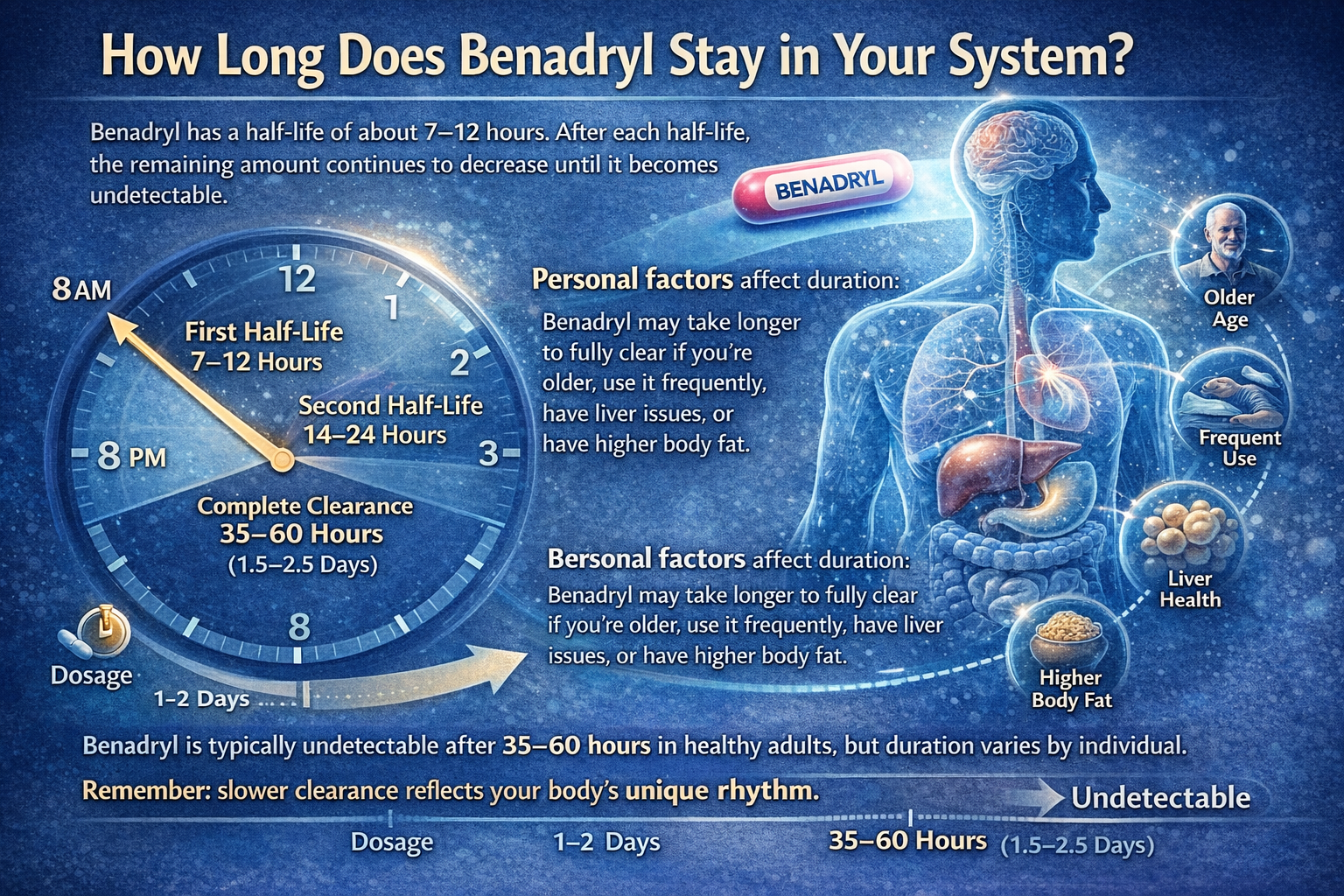
Benadryl has a half-life of about 7–12 hours, which is the time your body needs to get rid of half the dose. [2] After each half-life, the remaining amount continues to decrease until it becomes undetectable.
Complete clearance usually takes 35–60 hours, or roughly 1.5–2.5 days for most healthy adults.
However, for individuals who take it frequently — especially for sleep or emotional calming — it can take longer to fully clear. The body may store it temporarily in fat cells or metabolize it slowly if the liver is under stress.
Older adults metabolize diphenhydramine more slowly, which is why they often experience prolonged drowsiness or confusion after even a standard dose. Meanwhile, younger or physically active individuals may clear it more quickly.
It’s important to remember: slower clearance is not a medical failure or a sign of harm — it simply reflects your body’s natural rhythm.
Drug tests rarely look for Benadryl specifically. But because diphenhydramine affects the same biological pathways as certain medications, it can sometimes trigger false positives, which may cause fear or confusion.
Here is a closer look at detection times:
A false positive does not mean wrongdoing or misuse — it simply means the test reacted to a compound with a similar structure. If this happens, confirmatory testing usually clears up the confusion.

How much you take — and how often — has one of the biggest impacts on clearance time. A single 25 mg dose may move through the body in one to two days, while multiple doses taken close together can accumulate.
People who use Benadryl nightly for sleep, emotional numbing, or anxiety relief may find that the medication lingers longer because the body is constantly working to clear the previous dose while processing the next. [3]
This isn’t unusual, and it isn’t a sign of dependency in itself — it simply means the body has a steady workload. Over time, regular use can slightly saturate the system, causing prolonged grogginess, slower reaction times, or foggy thinking the next morning.
For individuals in behavioral health recovery, even small doses can feel amplified because the nervous system is already sensitive or overwhelmed. Recognizing how dose patterns affect clearance allows people to make safer choices and plan for the natural variations in how the body responds.
Age plays a profound role in how the body processes medications. As we get older, liver and kidney function naturally slow down — not because of illness, but because the body changes with time.
This means older adults may experience longer-lasting sedation, confusion, or dizziness after taking Benadryl. Sometimes the medication can linger for more than two days, simply because the metabolic pathways are less efficient.
On the other hand, younger people with faster metabolisms often clear Benadryl more quickly, though this isn’t guaranteed. Stress, genetics, sleep quality, and even emotional burnout can influence metabolism at any age.
In recovery settings, people often underestimate how much emotional and psychological strain slows physical processes. The body and mind are deeply interconnected, and when the mind is under pressure, the body may process medications at a different pace than expected.
The liver is responsible for breaking diphenhydramine down into smaller compounds, and the kidneys remove those compounds from the body.
When either organ is functioning below its full capacity — whether due to temporary issues like dehydration, illness, or chronic conditions — the clearance time increases.
This doesn’t mean the medication becomes dangerous; it simply stays around longer. People with liver or kidney concerns may notice extended drowsiness or mental fog after taking even a standard dose.
This is your body’s way of saying it needs more time. In the context of behavior-health recovery, this insight is extremely important: individuals may mistake prolonged grogginess for emotional relapse, when in reality it’s just slower medication processing. Understanding your body’s pace can bring reassurance and prevent unnecessary fear.
Benadryl is lipophilic, meaning small amounts dissolve into fat cells. [4] People with higher body fat percentages may store trace amounts a bit longer than individuals with lower body fat levels.
This doesn’t change the medication’s effectiveness, but it slightly slows how quickly the body reaches complete clearance. Similarly, people with lower body mass may feel Benadryl more intensely, because the same dose is distributed through a smaller overall volume.
None of these differences is “good” or “bad” — they simply highlight how individual physiology shapes the medication’s journey. In recovery situations, understanding these differences helps remove shame or confusion. If you feel the effects longer than someone else, it’s not because something is wrong with you. It’s because your body processes the medication in its own way.
Benadryl uses the same metabolic pathways in the liver (primarily CYP2D6 and related enzymes) that many common medications rely on — including antidepressants, antipsychotics, mood stabilizers, and anti-anxiety medications.
When these medications overlap, they essentially “share the same highway.” This can slow down how quickly Benadryl is broken down, causing stronger or longer-lasting drowsiness. In some cases, interactions may intensify confusion or impair coordination.
For individuals already taking psychiatric medications, this prolonged sedation can be emotionally unsettling, especially if they are trying to rebuild stability or reduce reliance on sedating substances.
Understanding these interactions early empowers individuals and families to have informed conversations with their healthcare providers and avoid surprises.
Your general well-being — including your hydration, sleep pattern, emotional state, and daily stress — profoundly influences how the body handles Benadryl. Dehydration slows kidney filtration, making clearance less efficient.
High stress or chronic anxiety increases cortisol levels, which can disrupt digestion, liver function, sleep cycles, and overall metabolism. Poor sleep weakens the body’s natural rhythm of processing medications, causing diphenhydramine to linger longer.
Even emotional exhaustion affects how the nervous system responds to sedating substances.
The encouraging part is that small improvements in hydration, rest, or stress management can noticeably support your body’s ability to eliminate medications at a healthier pace. In recovery or behavioral-health healing, this can help individuals feel more in control and less fearful of how their bodies respond.
As Benadryl starts to leave your system, the strong calming and sedating effects begin to fade. For many people, this transition feels like slowly coming back online — your mind feels a bit clearer, your senses feel sharper, and you may notice you’re more awake or alert than before.
But for others, especially anyone who used Benadryl consistently for sleep or to “take the edge off,” the shift can feel abrupt or uncomfortable. Your body has gotten used to the antihistamine’s steady presence, and once it’s gone, your nervous system has to quickly rebalance itself.
During this adjustment period, it’s common to feel mild, withdrawal-like sensations. These are not signs of dependence — they’re simply the body reacting to the sudden absence of a sedating medication. You may notice:
A return of insomnia, vivid dreams, or restless sleep
Irritability or stronger emotional reactions to stress
Low energy, daytime fatigue, or difficulty getting motivated
Mild anxiety or a sense of internal restlessness
Head pressure, fogginess, or slowed thinking
Nausea or a sensitive stomach
These symptoms can feel frustrating, especially if you relied on Benadryl to calm your body at night. But they typically don’t last long, and they’re not dangerous.
What you’re experiencing is your nervous system readjusting — shifting from a “sedated” state back to its natural rhythm. Most people notice steady improvement within a few hours to a couple of days.
The emotional side of this transition can feel more noticeable for people involved in behavior-health recovery. When your body suddenly feels tense, anxious, or unsettled, it can trigger old fears or memories of difficult moments. This does not mean relapse is happening. It does not mean you’ve done anything wrong. What you’re feeling is a temporary physiological rebound, not a setback in your recovery.
Understanding this difference can make the process much easier. Your body is simply recalibrating after losing the calming “blanket” Benadryl provides. With time, rest, hydration, and emotional support, these sensations fade as your system finds its balance again.
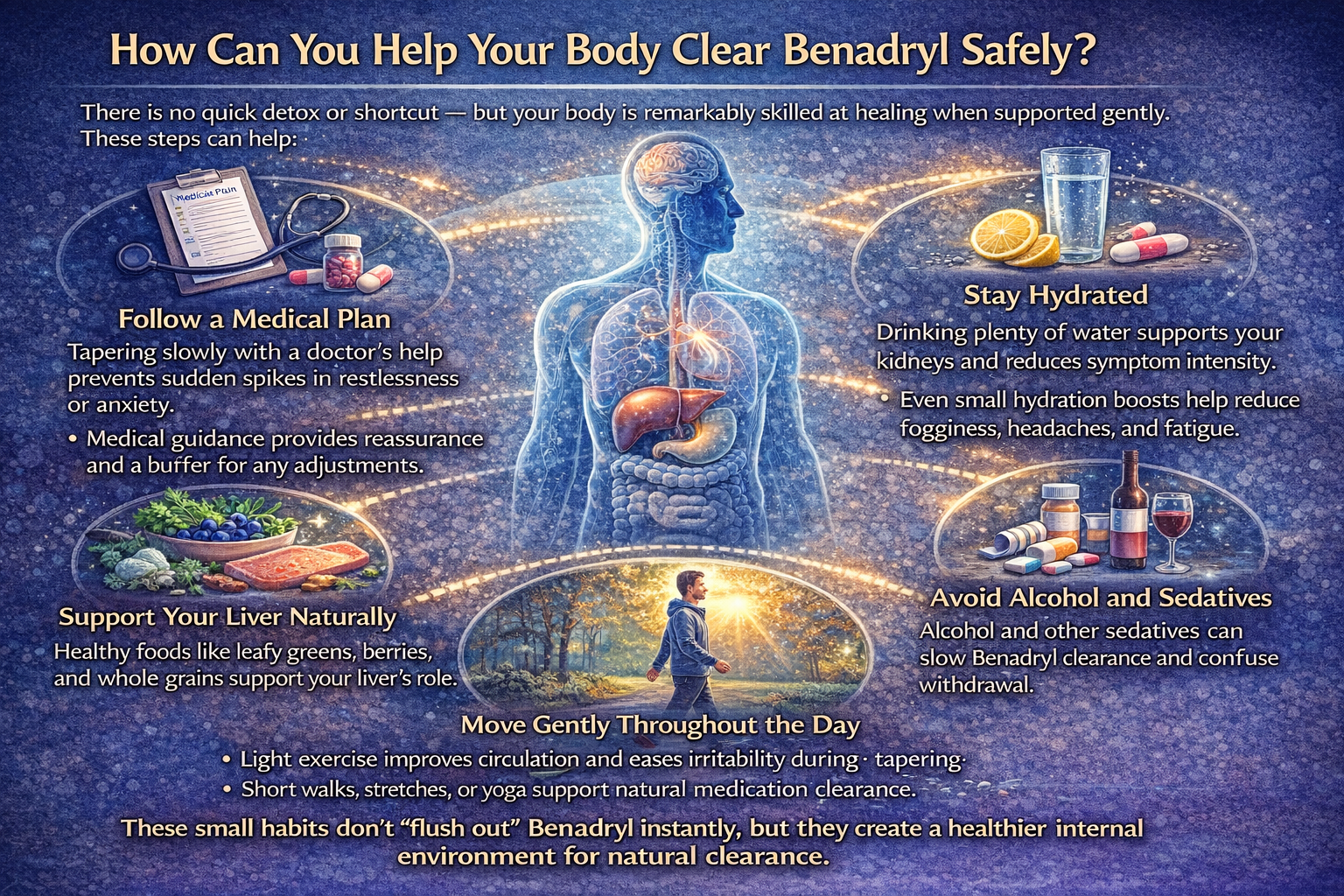
There is no quick detox or shortcut — but your body is remarkably skilled at healing when supported gently. These steps can help:
A slow, guided reduction is safer than stopping Benadryl suddenly, especially if you’ve used it for sleep or emotional comfort.
Your body adapts to its calming effects, so tapering prevents sudden spikes in restlessness or anxiety.
Working with a medical provider gives you structure, reassurance, and someone to adjust the plan based on how you’re feeling.
Water helps your kidneys and overall metabolism work more steadily as Benadryl leaves your system.
Even one or two extra glasses a day can reduce grogginess, headaches, and brain fog.
Hydration keeps your body grounded and supported during a time when internal changes may feel more noticeable.
Your liver processes Benadryl, so giving it nutrient-dense foods helps it function smoothly.
Leafy greens, berries, whole grains, and lean proteins provide steady support without needing a complicated diet.
These foods also help stabilize energy, which can wobble during medication changes.
Light movement increases circulation and helps the body clear medications more efficiently.
Short walks, stretching, or simple standing breaks keep your nervous system active and balanced.
Gentle movement boosts mood and reduces restlessness, especially during withdrawal-like transitions.
Alcohol slows down metabolism and can intensify sedation or confusion during a taper.
Other sedating medications can interfere with your emotional stability and make side effects harder to interpret.
Avoiding these substances helps the body regulate itself more naturally and predictably.
These small habits don’t “flush out” Benadryl instantly, but they create a healthier internal environment for natural clearance.
Reach out to a healthcare provider if you or a loved one:
Experience confusion, extreme drowsiness, or difficulty waking
Notice heart palpitations or breathing difficulties
Have taken Benadryl regularly and want to stop
Take other medications that may interact
Have liver or kidney conditions
Need guidance before a medical or employment drug test
Asking for help is a sign of strength, not weakness. Medical professionals can provide clarity and reassurance, helping you feel safer and more confident.
Benadryl usually stays in the body for 1–3 days, but your personal experience may vary.
What matters most is understanding that your body is doing exactly what it’s designed to do — filter, process, and restore balance over time.
If you’ve relied on Benadryl for sleep or emotional escape, it’s okay to feel unsure or overwhelmed as you transition away from it. Healing is not linear, and learning about your body is a meaningful step toward long-term well-being.
With compassion, clarity, and the right guidance, you can move through this process with confidence and hope.
Most people feel relief within 15–30 minutes, with peak drowsiness around 1–2 hours. The onset can feel even faster on an empty stomach because absorption happens more quickly. Many users describe the “wave of sleepiness” as suddenly hitting once the medication reaches peak levels. For most, this calming effect continues for several hours.
It isn’t usually tested for, but in rare instances, it may cause a false positive for certain medications. This happens because some tests detect chemical structures similar to Benadryl’s. Confirmatory tests usually resolve this and show that no actual substance of concern is present. If you take Benadryl regularly, it’s okay to mention it before testing to avoid confusion.
Hydration and healthy movement help the body function well, but they do not dramatically speed up the medication’s clearance. Your liver and kidneys still need time to process the drug naturally. Staying hydrated may reduce grogginess, and light exercise can boost clarity once the sedation wears off. But neither option can eliminate Benadryl instantly.
Yes. Higher doses take longer to metabolize and may intensify next-day grogginess. Larger doses can saturate the liver’s processing pathways, so the drug lingers longer than expected. People may also feel more mentally slow or foggy the morning after. If you notice extended sedation after higher doses, it’s a sign your body needs more time to clear it.
You may notice temporary emotional or sleep-related discomfort. These symptoms usually fade within a few days as your body resets. Some people describe feeling unusually alert or restless because the nervous system is adjusting to the loss of Benadryl’s sedating effects. The good news is that these sensations are short-lived and not harmful.
Yes — when taken frequently or in high amounts. This can prolong sedation and slow memory or reaction time. Over time, the body may metabolize the medication less efficiently, causing more intense drowsiness after each dose. This is why regular or high-dose use should be approached cautiously, especially for sleep.
By calling us, you agree to our Terms & Conditions
For those seeking addiction treatment for themselves or a loved one, our calls are confidential and are available for 24/7 help.
Any treatment center receiving calls from the site is a paid advertiser.
Calls to numbers on a specific treatment center listing will be routed to that treatment center.
Calls to any general helpline will be answered by treatment providers, each of which is a paid advertiser.
By calling the helpline you agree to the terms of use. These calls are offered at no cost to you and with no obligation to enter into treatment. Neither this site nor anyone who answers the call receives a commission or fee dependent upon which treatment provider a visitor may ultimately choose.
If you wish to explore additional treatment options or connect with a specific rehab center, you can: browse top-rated listings, visit our homepage, or visit SAMHSA, or by calling 800-662-HELP. You may also contact The Florida Department of Children and Family Services