(866) 567-3138
Sponsored Helpline
Verify Insurance
Illicit GHB manufacture carries serious health risks and legal consequences. Because illegal production is unregulated, the resulting substance is often unpredictable in strength, contaminated with toxic residues, and far more dangerous than pharmaceutical-grade alternatives.
 Expert Verified
Gamma-hydroxybutyrate (GHB) is classified as a strictly controlled substance because of its high potential for abuse, overdose, and dependency. Outside of tightly regulated medical use, GHB is illegal to manufacture, possess, or distribute in many countries, including the United States.
Most people searching for information about how GHB is made are not looking to recreate it. They are trying to understand why it is so dangerous, how illicit versions differ from medical ones, and what risks their loved one may be facing. GHB is frequently involved in emergency room admissions related to overdose, loss of consciousness, and respiratory depression, often after nightlife or party settings.
Illicit GHB manufacture carries serious health risks and legal consequences. Because illegal production is unregulated, the resulting substance is often unpredictable in strength, contaminated with toxic residues, and far more dangerous than pharmaceutical-grade alternatives.
Full chemical name: Gamma-hydroxybutyrate
GHB is a central nervous system (CNS) depressant, meaning it slows down brain activity, breathing, and heart rate. In tiny amounts, GHB occurs naturally in the human brain and plays a minor role in neurotransmitter activity. However, when consumed in external, concentrated amounts, it produces powerful and sometimes life-threatening effects.
Legitimate medical context
A pharmaceutical form of GHB, known as sodium oxybate, is approved by the U.S. Food and Drug Administration for the treatment of narcolepsy, particularly in patients experiencing cataplexy and excessive daytime sleepiness.
This medication is manufactured under pharmaceutical standards and distributed through a tightly controlled risk-management program to prevent misuse and diversion[2].
Patients prescribed sodium oxybate:
Receive precise dosing instructions
Are closely monitored by healthcare providers
Must enroll in restricted distribution programs
Are warned extensively about overdose and interaction risks
Difference between pharmaceutical-grade vs. illegal versions
Pharmaceutical sodium oxybate is produced with strict quality control, standardized concentration, and medical supervision.
Illegal GHB, by contrast, is unregulated, inconsistently concentrated, and often contaminated. This lack of control dramatically increases overdose risk and toxicity[1].
Reputation as a “club drug” / “date-rape drug”
GHB became known in nightlife settings because of its ability to cause euphoria, relaxation, and disinhibition at low doses, followed by sedation and memory loss at slightly higher doses. These effects have led to its misuse in drug-facilitated sexual assault, contributing to its reputation and strict legal classification[1].
Understanding why GHB is produced illegally helps families recognize how exposure often occurs.
Misuse in nightlife environments
GHB is commonly associated with nightlife settings such as clubs, parties, and private gatherings. One reason for this is its rapid onset, which can produce noticeable effects within a short period of time.
In addition, GHB is often colorless and odorless when mixed into drinks, making it difficult to detect — especially in crowded or low-light environments.
These settings frequently involve alcohol use, which significantly increases risk. Alcohol and GHB are both central nervous system depressants, and when taken together, they can dangerously slow breathing and heart rate.
High dependency risk
Repeated use of GHB can lead to physical dependence, meaning the body begins to rely on the substance to function normally. Over time, users may feel compelled to take GHB more frequently or in higher amounts just to avoid feeling unwell.
Unlike many other substances, GHB withdrawal can be severe and medically dangerous. Symptoms may include intense anxiety, tremors, confusion, rapid heart rate, hallucinations, and in some cases, seizures or delirium.
Because withdrawal symptoms can begin quickly and worsen rapidly, some individuals continue using GHB to avoid these effects, creating a cycle that is difficult to break without medical support[2].
Rapid onset of sedative and euphoric effects
GHB takes effect quickly, often producing feelings of relaxation, lowered inhibitions, or mild euphoria within minutes of use. This fast-acting effect can make the substance seem controllable or predictable, especially to someone unfamiliar with its risks.
In reality, GHB has a very narrow margin between intoxication and overdose. Small increases in amount can lead to extreme sedation, memory loss, slowed breathing, or loss of consciousness.
The rapid onset also makes it easier to unintentionally take more before the full effects are felt. When combined with alcohol — a common scenario in social settings — the risk of accidental overdose increases substantially[3].
Illegal GHB production is dangerous not because of intent alone, but because of unpredictability.
Illicit GHB is often derived from industrial chemical analogues that are never intended for human consumption. These substances are designed for manufacturing or cleaning purposes, yet they are sometimes diverted into the illegal drug market. Once ingested, they convert into GHB in the body.
Commonly referenced precursors include:
Gamma-butyrolactone (GBL)
1,4-butanediol (BDO)
These chemicals may contain industrial impurities, stabilizers, or solvents that are safe for machinery but toxic to the human body. Because there is no regulatory oversight, users have no way of knowing what additional substances may be present in the final product[3].
Unlike pharmaceutical medications, illicit GHB is not purified or tested before use. As a result, residual solvents, reaction by-products, and chemical impurities may remain in the substance.
These residues can irritate the mouth, throat, and gastrointestinal tract and place added stress on vital organs such as the liver and kidneys, which are responsible for filtering toxins from the body.
Over time or at higher exposures, this added toxic burden increases the risk of organ damage and worsens overdose outcomes.
Illegal GHB is frequently produced by individuals without formal chemical training or access to proper safety equipment. This lack of expertise significantly increases the risk that the final substance is inconsistently mixed, contaminated, or chemically unstable.
For families, this means that even when the substance is referred to by the same name, its actual content may be completely different from one batch to another.
Without laboratory controls or quality standards, illicit GHB batches may contain:
Toxic chemical residues
Incorrect or unstable chemical salts
Caustic or corrosive by-products
These contaminants can cause internal irritation, chemical burns, nausea, vomiting, or poisoning, even before the drug’s sedative effects take hold. In some cases, physical symptoms such as burning sensations may be early warning signs of dangerous contamination.
Illicit GHB varies widely in concentration from batch to batch. Because there is no consistency, the amount that produces mild effects on one occasion may cause severe respiratory depression or loss of consciousness on another.
This extreme variability is one of the primary reasons accidental overdoses are so common with illicit GHB[3].
Users and families often describe this as the drug being “unpredictable,” but the root cause is the absence of any quality control.
Some illicit formulations cause burning or stinging sensations in the mouth, throat, or stomach shortly after ingestion. These sensations may indicate the presence of corrosive residues or improperly neutralized chemicals, which can damage tissue and worsen toxicity.
There is no testing, labeling, or verification involved in illegal GHB production. No two batches are guaranteed to be the same.
Small differences in volume can mean the difference between intoxication and coma, especially when combined with alcohol or other depressants.
This unpredictability is a leading cause of GHB-related overdoses and fatalities, particularly in social settings where people may unknowingly take more than their body can tolerate [1].
Unpredictable strength → overdose risk
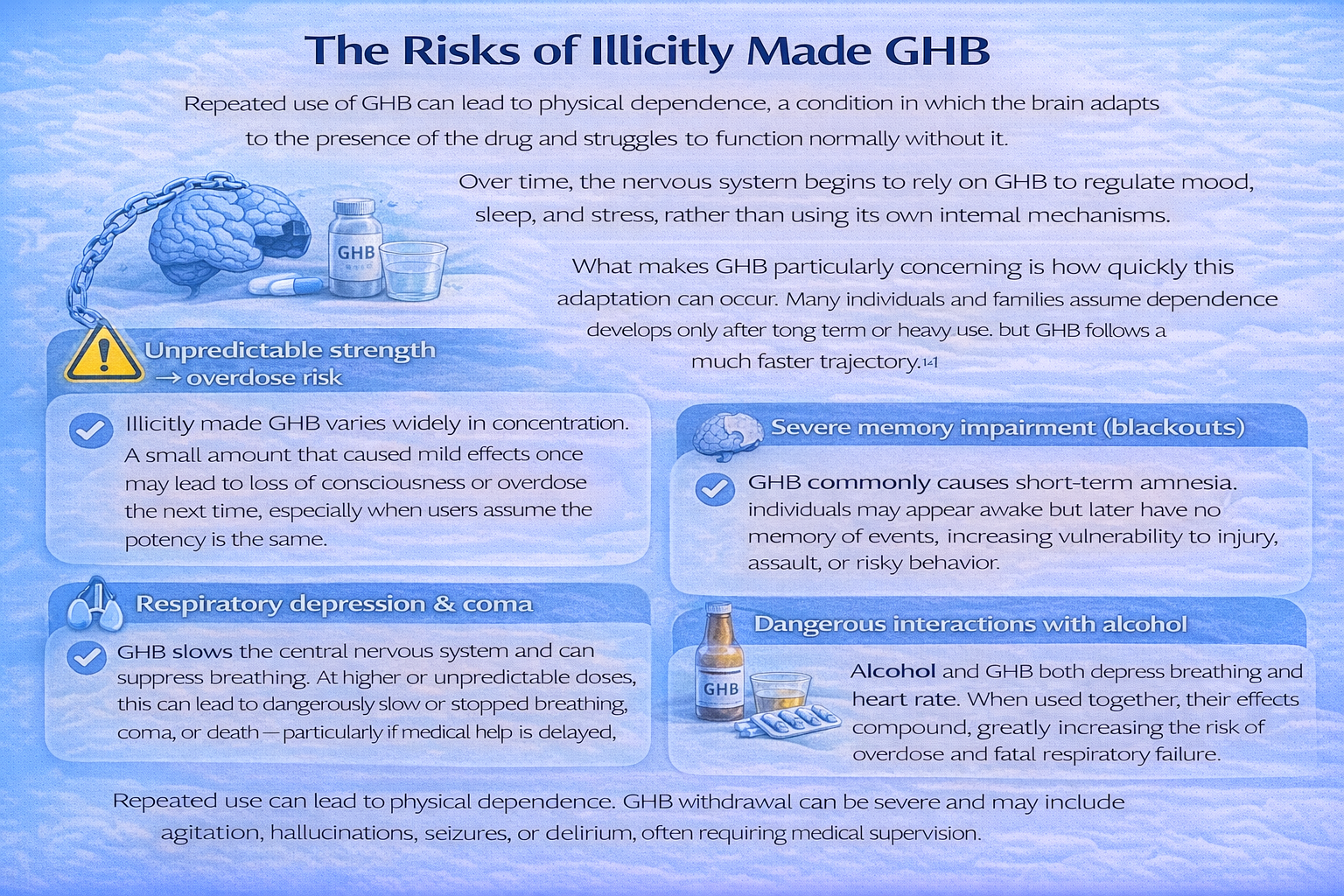
Illicitly made GHB varies widely in concentration. A small amount that caused mild effects once may lead to loss of consciousness or overdose the next time, especially when users assume the potency is the same.
Respiratory depression & coma
GHB slows the central nervous system and can suppress breathing. At higher or unpredictable doses, this can lead to dangerously slow or stopped breathing, coma, or death — particularly if medical help is delayed.
Severe memory impairment (blackouts)
GHB commonly causes short-term amnesia. Individuals may appear awake but later have no memory of events, increasing vulnerability to injury, assault, or risky behavior.
Dangerous interactions with alcohol
Alcohol and GHB both depress breathing and heart rate. When used together, their effects compound, greatly increasing the risk of overdose and fatal respiratory failure.
Risk of addiction and withdrawal complications
Repeated use can lead to physical dependence. GHB withdrawal can be severe and may include agitation, hallucinations, seizures, or delirium, often requiring medical supervision.
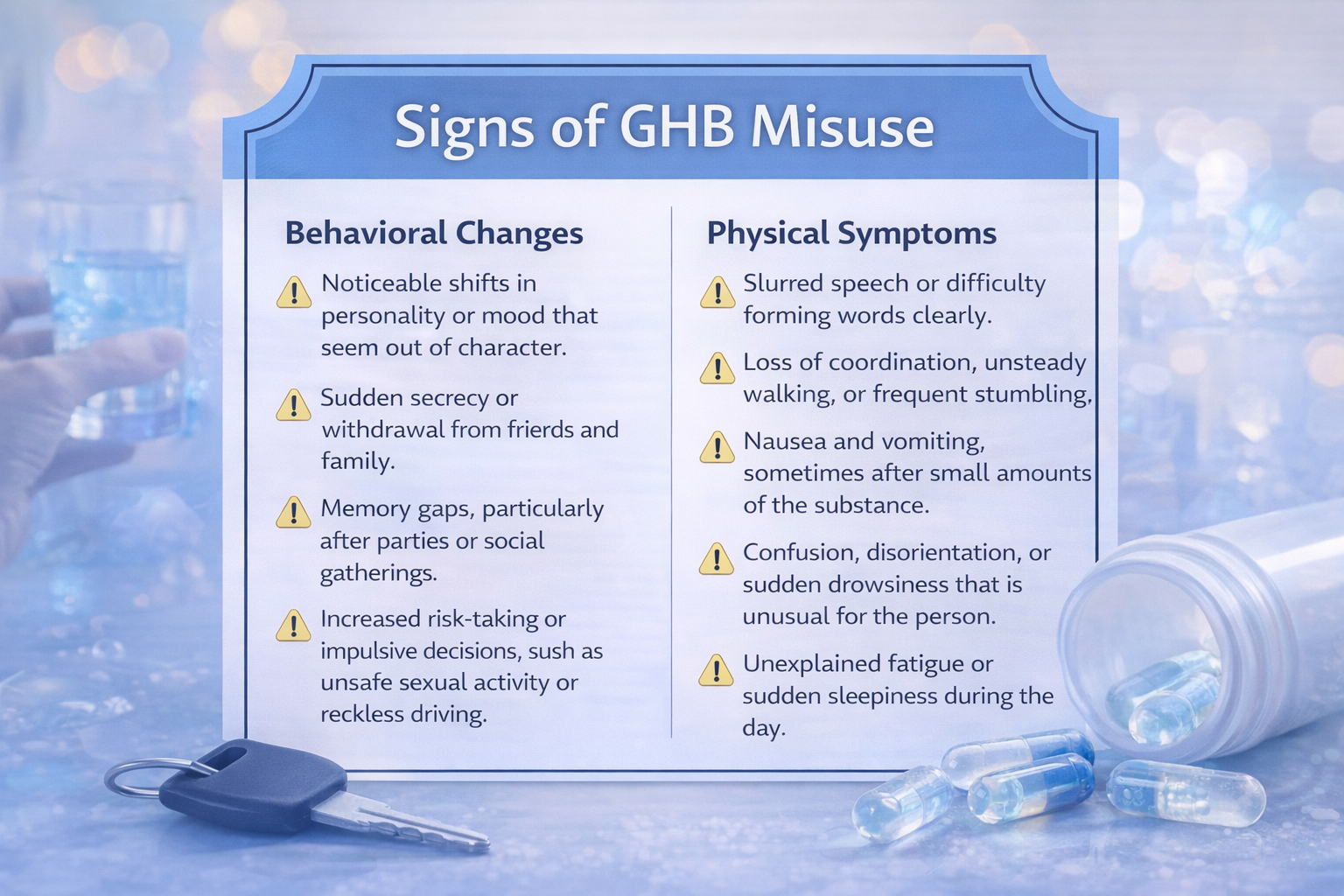
Noticeable shifts in personality or mood that seem out of character.
Sudden secrecy or withdrawal from friends and family.
Memory gaps, particularly after parties or social gatherings.
Increased risk-taking or impulsive decisions, such as unsafe sexual activity or reckless driving.
Gradual social withdrawal and loss of interest in previously enjoyed activities.
Slurred speech or difficulty forming words clearly.
Loss of coordination, unsteady walking, or frequent stumbling.
Nausea and vomiting, sometimes after small amounts of the substance.
Confusion, disorientation, or sudden drowsiness that is unusual for the person.
Unexplained fatigue or sudden sleepiness during the day.
Immediate medical attention is critical if someone shows any of these signs:
Difficult or impossible to wake, even after repeated attempts.
Breathing that is unusually slow, irregular, or labored.
Vomiting while unconscious, which increases the risk of choking.
Seizures or convulsions.
GHB withdrawal can escalate quickly and may become dangerous.
Inpatient medical detox with 24/7 monitoring is often necessary to manage severe symptoms safely.
Medical staff can intervene immediately if complications arise, such as seizures or extreme confusion.
Symptoms can be intense and sometimes life-threatening without professional care.
Common withdrawal effects include:
Severe anxiety or agitation
Tremors or shaking
Hallucinations or perceptual disturbances
Delirium (confusion, disorientation)
Seizures or convulsions
Close medical supervision is essential to reduce risks and ensure safety.
Medically supervised detox to stabilize the patient before therapy begins.
Cognitive-behavioral therapy (CBT) to address triggers, coping strategies, and harmful thought patterns.
Relapse-prevention planning tailored to individual patterns of misuse.
Dual-diagnosis treatment when underlying mental health conditions, like depression or anxiety, are present.
Family involvement strengthens recovery outcomes and emotional support.
National and local helplines can provide crisis assistance, treatment referrals, and ongoing guidance.
Peer support groups offer community and accountability during early recovery stages.
How to Stay Safe & Help Someone in Danger?
Signs of overdose
Unresponsiveness
Slow or stopped breathing
Pale or bluish skin
Vomiting while unconscious
Emergency steps
Call emergency services immediately
Stay with the person
Place them on their side if vomiting
Share all known information with responders
Importance of not leaving an unconscious person alone
Many GHB-related deaths occur when individuals are left unattended during overdose[1].
GHB is not dangerous because it exists — it is dangerous because illegal production removes every safety boundary. Families confronting GHB exposure are not alone, and help is available. With timely medical care, professional treatment, and family support, recovery is achievable.
GHB is tightly controlled in most countries due to its high risk of misuse, overdose, and dependence. Because legal access is extremely limited and regulated, most GHB circulating outside medical settings is produced illegally, without oversight, quality control, or safety standards—making it far more dangerous than people realize.
Illicit GHB is not manufactured under standardized conditions. Potency can vary widely from batch to batch, and even small differences in concentration can dramatically increase the risk of overdose. A dose that seemed “manageable” once can become life-threatening the next time.
GHB has a very narrow margin between an intoxicating dose and a toxic dose. When illegally produced, this margin becomes even smaller. Its depressant effects on breathing and consciousness can escalate rapidly, often without warning, especially when mixed with alcohol or other sedatives.
By calling us, you agree to our Terms & Conditions
For those seeking addiction treatment for themselves or a loved one, our calls are confidential and are available for 24/7 help.
Any treatment center receiving calls from the site is a paid advertiser.
Calls to numbers on a specific treatment center listing will be routed to that treatment center.
Calls to any general helpline will be answered by treatment providers, each of which is a paid advertiser.
By calling the helpline you agree to the terms of use. These calls are offered at no cost to you and with no obligation to enter into treatment. Neither this site nor anyone who answers the call receives a commission or fee dependent upon which treatment provider a visitor may ultimately choose.
If you wish to explore additional treatment options or connect with a specific rehab center, you can: browse top-rated listings, visit our homepage, or visit SAMHSA, or by calling 800-662-HELP. You may also contact The Florida Department of Children and Family Services