(866) 567-3138
Sponsored Helpline
Verify Insurance
For families watching a loved one struggle with addiction or severe mental health challenges, the search for answers can feel urgent—and overwhelming.
When conventional treatments don’t seem to work fast enough, many people begin looking beyond standard options.
Ibogaine often appears in these searches, described online as a powerful, alternative approach to addiction recovery.
 Expert Verified
This growing interest is driven by desperation, hope, and the desire for lasting change. But alongside curiosity comes an important—and unavoidable—question: Is ibogaine legal and safe in the United States?
Understanding the legal status and medical risks is essential before anyone considers it as an option.
Ibogaine is a psychoactive alkaloid derived from the root bark of the iboga plant, which is native to parts of Central Africa. Traditionally, the iboga plant has been used in ceremonial and spiritual contexts. Ibogaine, however, is a concentrated compound that has powerful effects on the nervous system.
In modern discussions, ibogaine is often described as affecting neurotransmitter systems related to addiction and mood. [1] However, it is important to emphasize that ibogaine is not a medically accepted treatment in the United States.
It is not standardized, not regulated, and not administered under U.S. medical protocols. The effects can vary widely between individuals, and the substance can place significant stress on the heart and other vital systems.
People who seek ibogaine are rarely looking for an easy escape. Most have already tried multiple approaches—detox programs, therapy, medication-assisted treatment, or rehabilitation centers—without achieving the stability they hoped for.
In this context, ibogaine is often perceived as something that might address addiction or psychological pain at a deeper level.
Family members may also be searching out of desperation, especially when they fear losing a loved one to overdose or self-harm. These emotions are valid. But vulnerability also makes people more susceptible to overstated claims and incomplete information, especially online. Understanding why ibogaine is sought helps explain its appeal—but it does not eliminate the need for caution.
The most important factor shaping access to ibogaine in the U.S. is its legal status. Ibogaine is illegal under U.S. federal law and is not approved for medical use.[2]
This means there is no licensed clinic, physician, or pharmacy in the United States legally allowed to provide ibogaine as a treatment. Regardless of how it is framed—spiritual, alternative, or therapeutic—ibogaine remains prohibited under federal law.
Ibogaine is classified as a Schedule I controlled substance under the Controlled Substances Act. Schedule I substances are defined as having no accepted medical use in the U.S. and a high potential for abuse or harm.
For individuals, this classification has serious implications. Possession, purchase, sale, or distribution of ibogaine can lead to criminal charges, even if the intent is personal healing or helping a loved one. There are no recognized legal exemptions for personal use, addiction treatment, or alternative therapy.
Is Ibogaine FDA-Approved?
Ibogaine has not been approved by the U.S. Food and Drug Administration (FDA) for any medical purpose. The FDA has repeatedly warned about ibogaine’s safety risks, particularly its association with life-threatening cardiac complications.
Unlike FDA-approved medications, ibogaine has:
No standardized dosing
No regulated manufacturing process
No established safety protocols
No post-treatment monitoring requirements
This lack of oversight significantly increases risk, especially for individuals with underlying health conditions or complex substance use histories.
There is currently no legal pathway to purchase ibogaine within the United States. Under federal law, ibogaine is classified as a controlled substance, meaning it cannot be legally manufactured, sold, prescribed, or distributed for personal or therapeutic use.
Any domestic source claiming to offer ibogaine—whether openly or discreetly—is operating outside the law. This legal reality often comes as a shock to families who assume that availability implies legitimacy, particularly when ibogaine is marketed using medical or wellness language.
Illegal domestic sources take many forms. These include private sellers operating through word-of-mouth networks, so-called “wellness” or “detox” providers who frame ibogaine as a natural or spiritual remedy, and online retailers claiming to exploit legal loopholes or alternative classifications.
Some products are even marketed as “ibogaine alternatives” while still containing ibogaine itself or other controlled, pharmacologically active substances. These tactics are designed to confuse consumers and reduce hesitation, but they do not change the underlying legal status.
Engaging with any of these sources exposes individuals and families to serious consequences. From a legal perspective, purchasing or possessing ibogaine can result in criminal charges, seizure of funds or shipments, and long-term legal repercussions.
From a health standpoint, the absence of regulation, medical oversight, and quality control dramatically increases the risk of severe injury or death.
What is often framed as a shortcut to healing instead places people in a legally and medically vulnerable position with little protection or recourse.
Many people searching for ibogaine encounter online listings that suggest it is readily available, which can be deeply misleading. Online availability does not equal legality, legitimacy, or safety.
The internet allows sellers to present polished websites, testimonials, and medical-sounding claims that create a false sense of credibility, particularly for families urgently seeking solutions. In reality, online ibogaine sales operate entirely outside U.S. law and regulatory oversight.
Online sellers frequently operate anonymously, using encrypted messaging apps, temporary websites, or offshore payment systems to avoid accountability. They typically provide no verifiable laboratory testing, no reliable information about sourcing or purity, and no transparency about dosing or pharmacological risk.
Claims are often exaggerated, incomplete, or selectively framed to minimize known dangers while emphasizing dramatic recovery stories. In many cases, sellers simply disappear after receiving payment, leaving buyers with no product, no refund, and no way to pursue recourse.
Beyond the legal risks, online purchasing introduces profound medical uncertainty. Buyers have no way to confirm whether the substance they receive is actually ibogaine, whether it is contaminated with other compounds, or whether the dosage is accurate.
Cases of adulterated products, mislabeled substances, and outright fraud are common in unregulated markets. For a compound already associated with serious cardiac and neurological risks, this lack of verification can turn an already dangerous situation into a life-threatening one.
For individuals and families navigating recovery decisions, the presence of ibogaine online should be understood not as an opportunity but as a warning sign. The ease of access masks a landscape defined by legal exposure, medical danger, and ethical exploitation of vulnerability.
Purchasing ibogaine online or through illegal channels exposes individuals to multiple, overlapping layers of risk that extend far beyond the substance itself. From a legal standpoint, ibogaine remains a controlled substance in the United States, meaning possession, distribution, or importation can result in serious criminal charges, fines, and long-term legal consequences.
These risks often catch families off guard, especially when decisions are made during moments of desperation or crisis. What may begin as a search for hope can quickly escalate into legal complications that further destabilize an already fragile situation.
Medically, the dangers are even more severe. Illegally obtained ibogaine is not subject to quality control, accurate dosing standards, or contamination screening. Individuals have no reliable way to verify purity, potency, or safety.
More critically, unsupervised use removes essential medical safeguards such as cardiac screening, electrolyte monitoring, and emergency preparedness. This dramatically increases the likelihood of life-threatening events, including cardiac arrest, seizures, respiratory distress, or acute psychological destabilization.
Families also face lasting consequences if a medical emergency occurs. When healthcare providers are unaware of ibogaine exposure—either because the substance was obtained illegally or because individuals are afraid to disclose use—diagnosis and treatment become more complicated and delayed.
This lack of transparency can worsen outcomes and, in extreme cases, cost valuable time during emergencies. The ripple effects of illegal ibogaine use often extend far beyond the individual, affecting loved ones emotionally, financially, and medically for years to come.
Ibogaine exerts profound effects on the body, particularly on the cardiovascular and nervous systems. One of the most documented and concerning risks involves dangerous disruptions to heart rhythm, including prolonged QT intervals and fatal arrhythmias.[3]
These cardiac events have been reported even in individuals with no known history of heart disease, making the risk difficult to predict without comprehensive medical screening. The strain ibogaine places on the heart underscores why it is considered medically high-risk and unsuitable for casual or unsupervised use.
Beyond cardiac concerns, ibogaine frequently causes severe gastrointestinal distress, including prolonged nausea and vomiting, which can quickly lead to dehydration and electrolyte imbalances. These imbalances further increase the risk of cardiac complications and neurological instability.
Additionally, the intense psychoactive effects of ibogaine can provoke severe anxiety, confusion, dissociation, or emotional overwhelm. While some individuals describe these effects as transformative, others experience them as traumatic or destabilizing, particularly without professional psychological support.
Ibogaine’s complexity lies in its simultaneous action on multiple neurotransmitter systems, including serotonin, dopamine, and NMDA receptors. This broad neurological impact makes individual responses highly unpredictable.
Even small variations in health status, medication use, or dosage can significantly alter outcomes. Without medical oversight, these unpredictable reactions can escalate rapidly from discomfort to medical crisis.
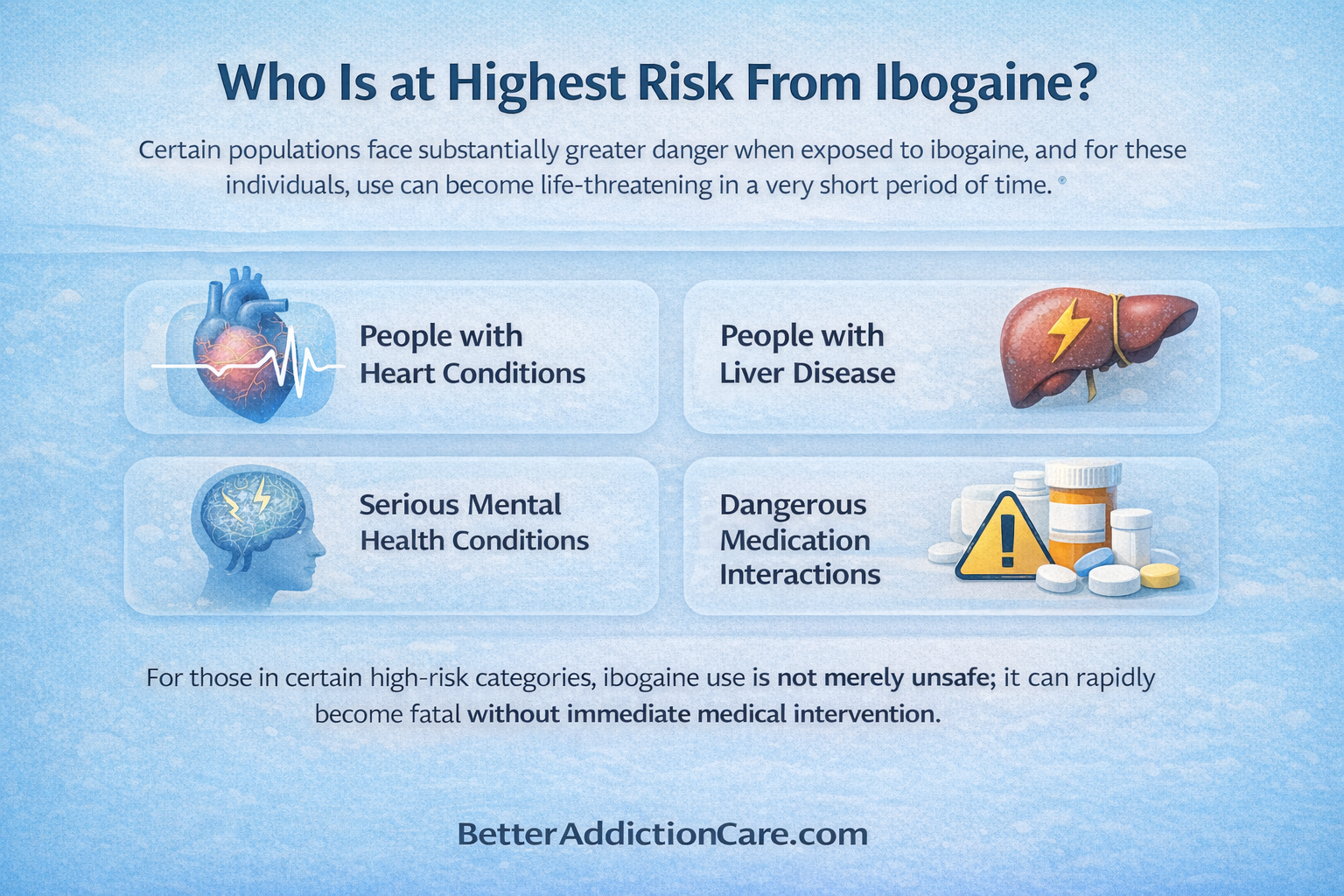
Certain populations face substantially greater danger when exposed to ibogaine, and for these individuals, use can become life-threatening in a very short period of time.
People with existing heart conditions—diagnosed or undiagnosed—are at particularly high risk due to ibogaine’s effects on cardiac conduction and rhythm. [4] Similarly, individuals with liver disease may be unable to metabolize the substance safely, leading to prolonged toxicity and accumulation in the body.
Electrolyte imbalances, which are common among individuals experiencing substance use disorders, eating disorders, or chronic illness, further amplify risk. Even mild imbalances can interact dangerously with ibogaine’s cardiac effects.
People with serious mental health conditions, such as bipolar disorder, schizophrenia, or a history of psychosis, may experience worsening symptoms, severe psychological distress, or lasting destabilization following ibogaine exposure.
Medication interactions represent another critical danger. Many commonly prescribed drugs—particularly antidepressants, antipsychotics, methadone, and other medications affecting heart rhythm or brain chemistry—can interact unpredictably with ibogaine. For individuals in these higher-risk categories, ibogaine use is not merely unsafe; it can rapidly become fatal without immediate medical intervention.
The risks associated with ibogaine are not hypothetical or rare—they are well-documented and require constant medical vigilance to manage safely.
Proper supervision includes pre-treatment cardiac evaluations such as ECGs, comprehensive blood work to assess liver function and electrolyte balance, and continuous monitoring throughout the experience. These measures are designed to identify early warning signs before they escalate into irreversible emergencies.
During ibogaine exposure, even seemingly minor symptoms—such as dizziness, palpitations, or vomiting—can signal serious underlying complications.
Without trained medical professionals present to interpret these signs and intervene immediately, the margin for error becomes dangerously thin. Emergency readiness, including access to advanced cardiac life support, is essential and cannot be replicated in informal or underground settings.
This level of comprehensive care is absent in illegal, online, or unregulated environments. As a result, major medical organizations and regulatory authorities strongly discourage ibogaine use outside of tightly controlled research contexts. The absence of supervision transforms an already high-risk substance into an uncontrolled medical gamble.
Within the United States, ibogaine research exists only in extremely limited, highly regulated contexts. These studies require strict federal approval, institutional oversight, and adherence to rigorous safety protocols.
Importantly, these research initiatives are designed to study pharmacology and safety—not to provide treatment or therapeutic access for the general public.
There are currently no legally sanctioned ibogaine treatment programs available to U.S. residents. Participation in research studies is rare, highly selective, and not a pathway for individuals actively seeking recovery services. This distinction is critical, as many online claims blur the line between legitimate research and unauthorized treatment, creating false hope and confusion for families seeking help.
Some Americans travel abroad in search of ibogaine because of its unavailability within the U.S., often driven by frustration with relapse, limited access to care, or dissatisfaction with existing treatment options.
This decision frequently reflects deep pain and a desire for relief rather than recklessness. However, international travel for ibogaine introduces additional layers of risk that are often underestimated.
Medical standards, regulatory oversight, and emergency infrastructure vary widely between countries and even between individual facilities. Continuity of care is frequently disrupted, meaning follow-up support, medication management, and integration therapy may be inconsistent or nonexistent upon return home.
In the event of complications, families may have limited legal recourse, unclear accountability, and few options for resolution.
Language barriers, unfamiliar healthcare systems, and the physical strain of travel can further compound medical vulnerability. What may appear to be a last resort solution can inadvertently expose individuals to new forms of instability at a critical moment in recovery.
Seeking ibogaine can place U.S. residents and their families in legally precarious positions. Criminal liability may arise not only from possession or importation, but also from financial transactions, facilitation, or association with unlicensed providers. These legal consequences can persist long after the initial decision, affecting employment, custody, immigration status, and overall stability.
Ethical concerns also deserve serious attention. Vulnerable individuals are often targeted with emotionally charged marketing, exaggerated success stories, or pressure tactics that minimize risk while promising rapid or guaranteed outcomes.
Families may feel coerced into making urgent decisions without adequate time or information. Exploiting hope during moments of crisis raises profound ethical questions and can lead to emotional trauma when expectations are not met or harm occurs.
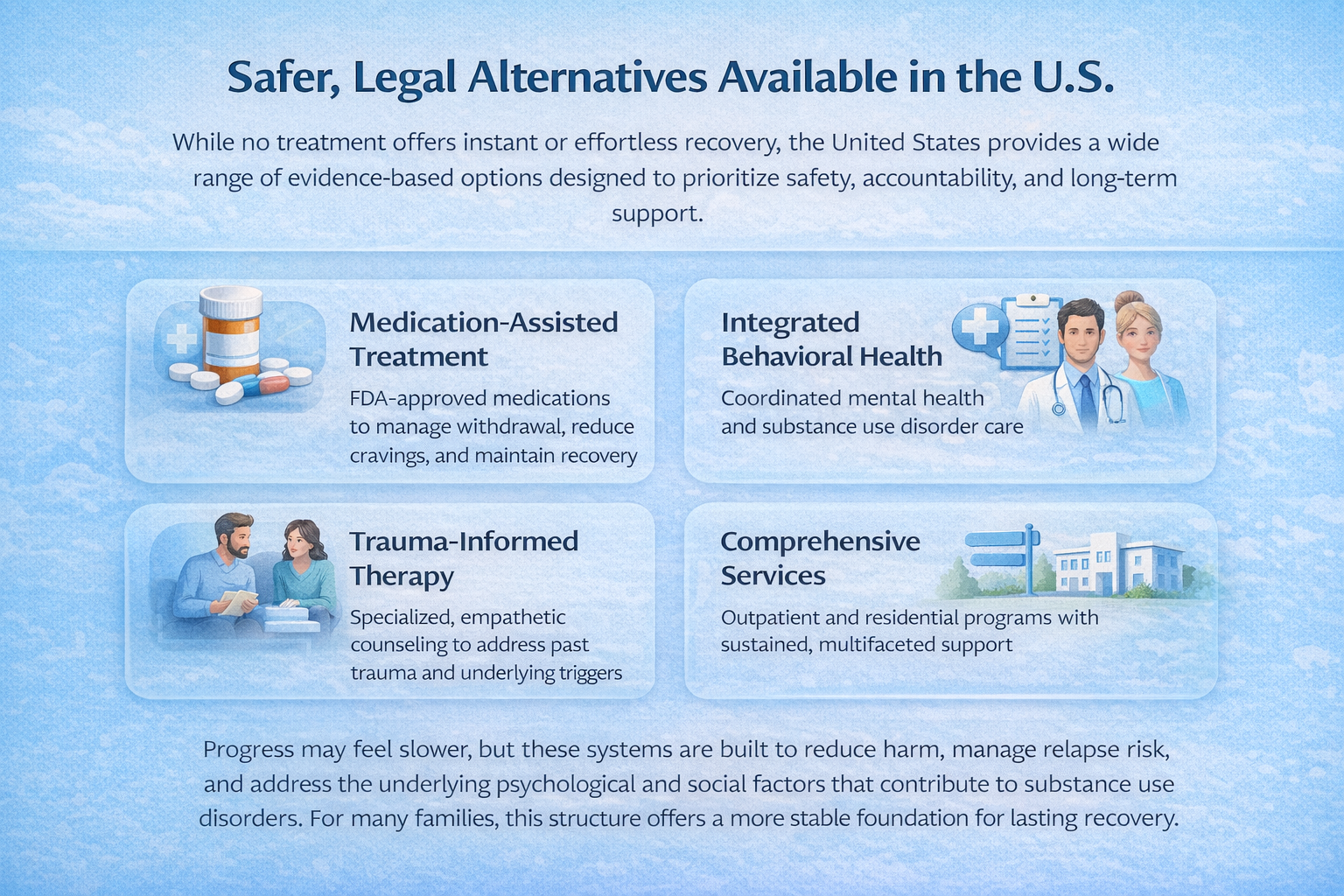
While no treatment offers instant or effortless recovery, the United States provides a wide range of evidence-based options designed to prioritize safety, accountability, and long-term support.
Medication-assisted treatment, integrated behavioral health programs, trauma-informed therapy, and comprehensive outpatient or residential services have strong research backing and established safety protocols.
These approaches emphasize medical monitoring, individualized care planning, and sustained support rather than dramatic, one-time interventions. Progress may feel slower, but these systems are built to reduce harm, manage relapse risk, and address the underlying psychological and social factors that contribute to substance use disorders. For many families, this structure offers a more stable foundation for lasting recovery.
When evaluating information about ibogaine, skepticism is not cynicism—it is a form of protection. Claims that promise guaranteed outcomes, dismiss documented medical risks, or frame ibogaine as a “miracle cure” should raise immediate concern. Responsible sources acknowledge uncertainty, variability in outcomes, and the very real potential for harm.
Trustworthy guidance prioritizes informed consent, transparent discussion of risks, and respect for individual medical complexity. Families deserve information that empowers thoughtful decision-making rather than emotional urgency.
In recovery, safety and sustainability matter more than speed, and any claim that suggests otherwise should be carefully questioned.
Ibogaine is often discovered at a moment of deep urgency—when hope feels fragile, and options feel limited. While some people are drawn to it as a potential breakthrough, in the United States, it remains illegal, unapproved, and medically high-risk.
These realities cannot be separated from the decision to pursue it.
Lasting recovery is rarely the result of a single substance or dramatic intervention. It is built through informed choices, medical safety, emotional support, and sustained care. Progress may not always be fast or linear, but legal, evidence-based treatment provides something ibogaine cannot in the U.S.: protection, continuity, and accountability.
Choosing a safer, regulated path is not a sign of giving up on hope—it is often the most responsible way to protect life while continuing to move toward healing.
No. Ibogaine is illegal at the federal level and is not approved for medical or therapeutic use in the United States.
No. Importing ibogaine into the U.S. violates federal drug laws and may result in legal penalties.
Yes. Purchasing ibogaine online does not make it legal and can lead to criminal charges.
It is restricted due to safety concerns, reported adverse effects, and the lack of FDA approval.
Yes. Some clinics offer legal therapies such as ketamine-assisted treatment or medically supervised detox programs that aim to support recovery without violating federal law.
Yes, some individuals travel to countries where ibogaine is permitted, but this carries medical, legal, and ethical risks and should only be considered with thorough medical screening and professional guidance.
By calling us, you agree to our Terms & Conditions
For those seeking addiction treatment for themselves or a loved one, our calls are confidential and are available for 24/7 help.
Any treatment center receiving calls from the site is a paid advertiser.
Calls to numbers on a specific treatment center listing will be routed to that treatment center.
Calls to any general helpline will be answered by treatment providers, each of which is a paid advertiser.
By calling the helpline you agree to the terms of use. These calls are offered at no cost to you and with no obligation to enter into treatment. Neither this site nor anyone who answers the call receives a commission or fee dependent upon which treatment provider a visitor may ultimately choose.
If you wish to explore additional treatment options or connect with a specific rehab center, you can: browse top-rated listings, visit our homepage, or visit SAMHSA, or by calling 800-662-HELP. You may also contact The Florida Department of Children and Family Services