(866) 567-3138
Sponsored Helpline
Verify Insurance
Meloxicam (generic: meloxicam) is a nonsteroidal anti-inflammatory drug (NSAID) prescribed to relieve pain and inflammation caused by arthritis, including osteoarthritis, rheumatoid arthritis, and juvenile rheumatoid arthritis.
Both brand and generic tablets contain the same active ingredient. For example, DailyMed (NIH) notes that “Each pastel yellow Meloxicam tablet USP contains 7.5 mg or 15 mg meloxicam”, and regardless of the manufacturer, meloxicam tablets are usually a light yellow color and available in two strengths.
 Expert Verified
Meloxicam is an NSAID used to treat pain and inflammation from arthritis. Official sources describe meloxicam tablets as pale or pastel yellow in color, typically in 7.5 mg and 15 mg strengths. It reduces prostaglandins to ease joint pain and swelling.
Pill appearance varies by manufacturer. Generic versions and different brands (e.g., Mobic, Vivlodex) may look different – round vs. oval, dull yellow vs. bright yellow. Always compare your pill’s color, shape, and imprint to a trusted reference each time.
Correct identification is crucial. Checking the imprint, shape, and color ensures dosing accuracy and safety. Misidentifying a pill can lead to taking the wrong dose or the wrong medication entirely, which is dangerous.
Counterfeits are a serious risk. Fake pills (sometimes laced with fentanyl) are on the rise. The FDA warns that counterfeit drugs may contain the wrong or no active ingredient. In 2024, the DEA seized over 60 million illicit pills hidden as prescription meds[1].
Identifying your medication by appearance is not just a precaution; it’s safety. Here’s why it’s important:
Ensuring the pill matches your prescription prevents accidental underdose or overdose. Meloxicam doses (7.5 mg vs 15 mg) differ by strength, so taking the wrong pill can greatly change how much drug you get. Checking color/shape/imprint helps you confirm you have the correct strength.
This is perhaps the most urgent issue today. The FDA warns that “Counterfeit (fake or falsified) medicines may be harmful… [they] may contain the wrong ingredients… too much, too little or no active ingredient at all”.
In practice, people have bought fake pills off the street or online that looked like pharmaceuticals but were deadly.
The DEA reports that millions of counterfeit pills laced with fentanyl or other toxic substances are circulating.
By carefully examining each pill’s imprint, shape, and color, you reduce the chance of accidentally taking a fake.
Your pharmacy might switch suppliers. One refill, you get a tablet from Manufacturer A (round, pale yellow, imprint “XYZ”), and the next, a tablet from Manufacturer B (oval, slightly brighter yellow, imprint “ABC”).
These visual changes don’t mean the drug is different – but if you weren’t expecting it, you might worry it’s wrong. Recognizing that multiple valid appearances exist prevents alarm.
If you have multiple medications in your home, or if a pill somehow got mixed, confirming appearance can prevent taking another drug by mistake.
If you or a caregiver notice a new or unusual side effect, checking the pill can verify it’s still your expected medication. For instance, if a yellow meloxicam tablet suddenly looks red, that’s a warning sign.
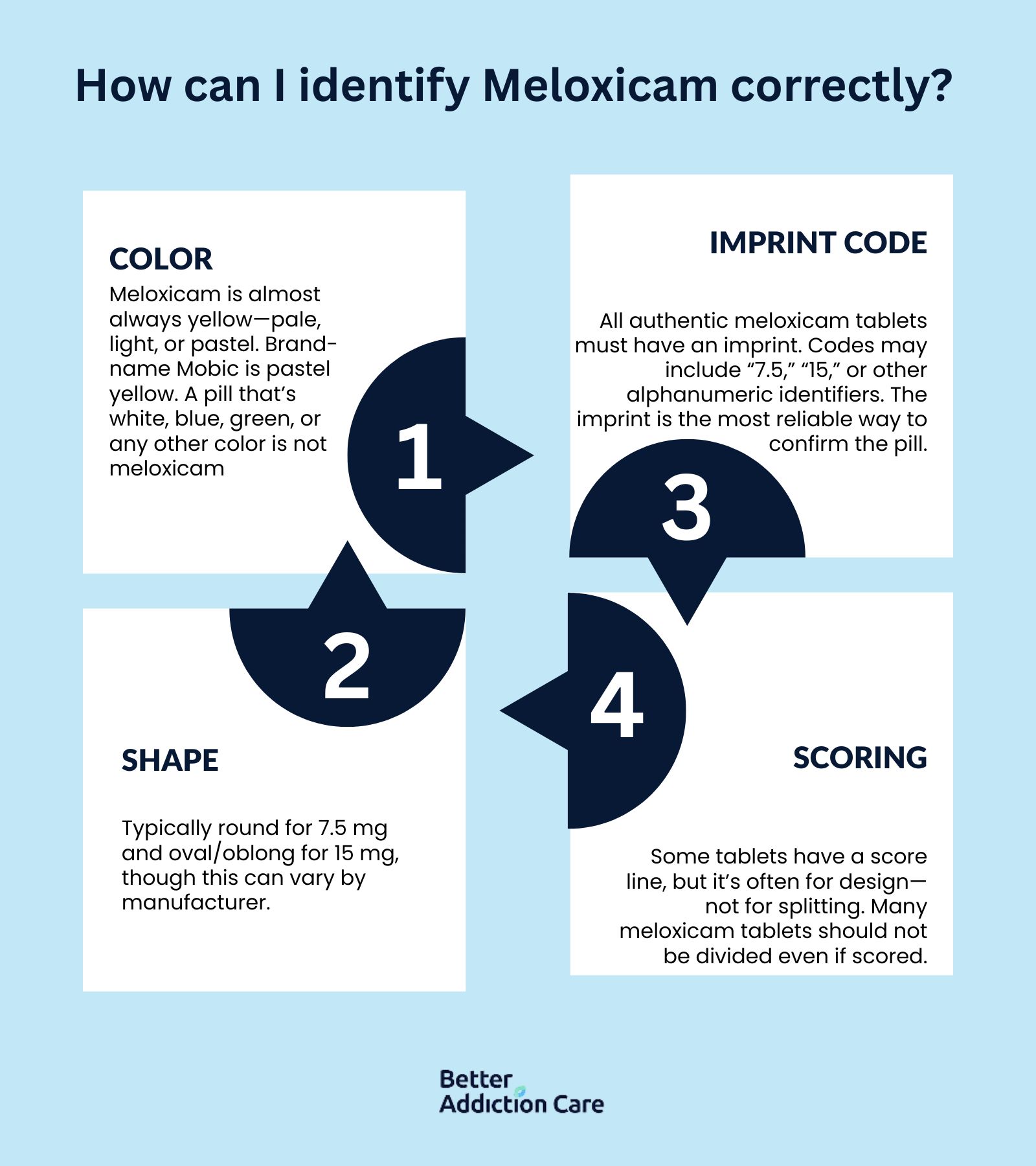
When identifying meloxicam tablets, use a systematic approach focusing on four visual identifiers: color, shape, imprint code, and scoring.
Meloxicam tablets are almost always some shade of yellow. Think “pale yellow,” “light yellow,” or “pastel yellow.” Brand-name Mobic tablets, for example, are described as pastel yellow.
Generics often call themselves “light yellow” or simply “yellow.” If a pill is pure white, blue, green, or any other color, it is not meloxicam.
Meloxicam tablets come in a few common shapes, usually round or oval/oblong. The shape can depend on the strength or the maker. For instance, many 7.5 mg tablets are round, while 15 mg ones are often oval or oblong.
Every meloxicam tablet legally must have an imprint (a code of letters and/or numbers). This imprint is your biggest clue to identification.
Meloxicam codes vary by manufacturer. Common imprints you might encounter include numeric values like “7.5” or “15” (matching the dosage in mg), and alphanumeric codes.
A score line is a groove that may run across a tablet. Some meloxicam tablets have one, but often it is not for breaking the dose. In fact, certain meloxicam tablets are manufactured with a score line solely as a design or imprint alignment, and instructions explicitly say the tablet should not be split.
In regulated labeling, meloxicam tablets have specific appearances per manufacturer. Below are examples of official descriptions and images to guide you.
Remember that at least these general traits hold:
Example meloxicam tablet (generic) showing light yellow color. Meloxicam tablets are consistently some shade of yellow.
In official prescribing information, the color is described as “pale yellow” or “pastel yellow”. Even among brands, you won’t see meloxicam in white, pink, blue, or green – it stays within the yellow spectrum.
When comparing pills, match the hue: a very pale beige or cream with a definite yellow tint is normal. A bright sunny yellow is also possible. Anything far outside yellow should raise concern.
Example meloxicam tablet (15 mg) showing oval shape with imprint. Meloxicam tablets most often come in round or oval/oblong shapes.
A meloxicam 15 mg tablet (imprint C 80), which is oval and about 12 mm long. Other meloxicam pills are round, especially the smaller 7.5 mg tablets.
Capsule-shaped (elongated with rounded ends) forms also exist.
Each approved meloxicam tablet has a distinctive imprint code engraved or debossed. Common ones include the numeric dose (7.5 or 15) and manufacturer IDs.
For example:
“15” on one side of an oval tablet (denoting 15 mg).
“7.5” on a round pill (for 7.5 mg).
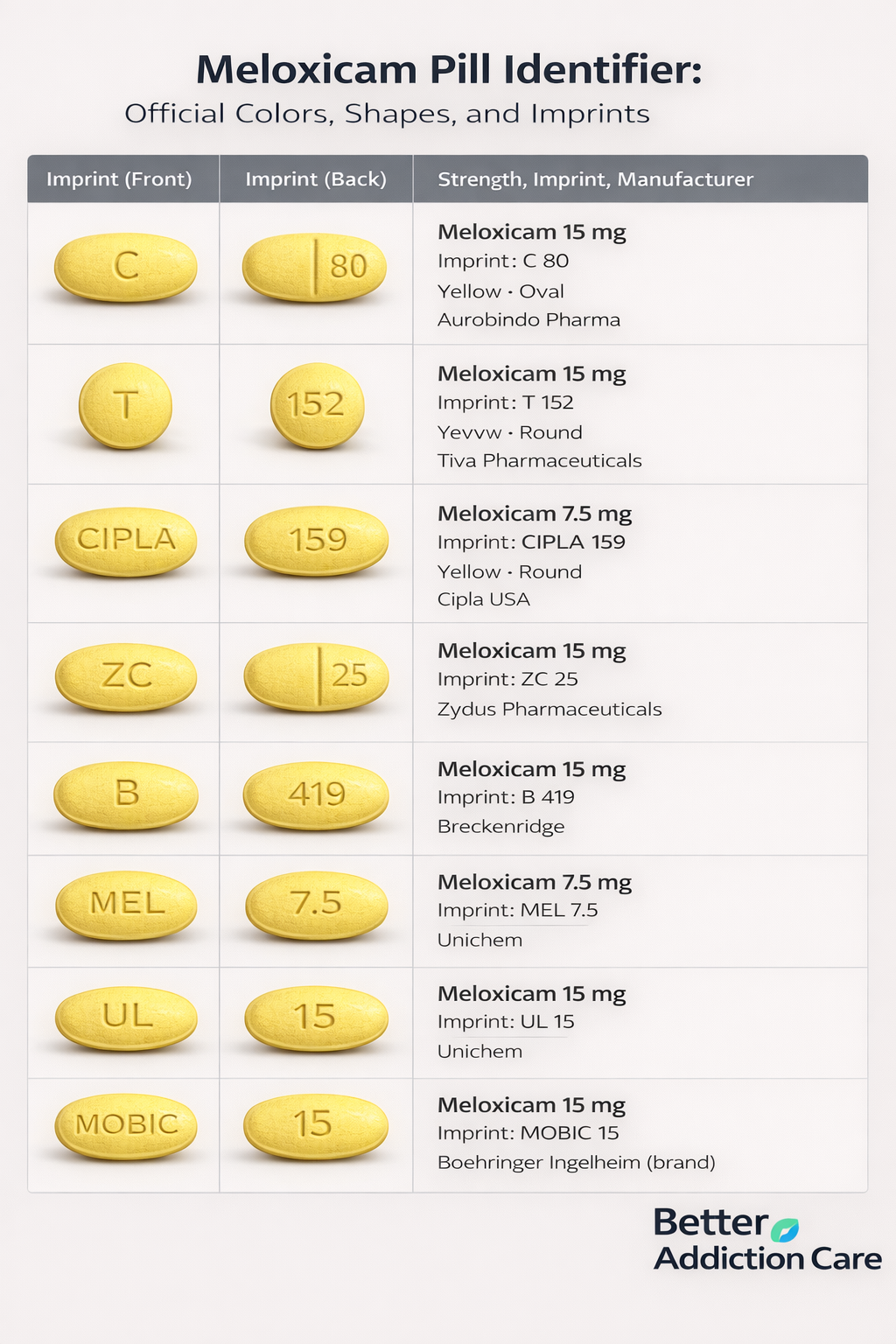
Alphanumeric codes such as CIPLA 159, ZC 25, B 419, T 152, C 80, MEL 7.5, UL 15, etc. The letters often name the company (e.g., CIPLA, or abbreviations like ZC, B, C), and the number indicates strength or product code.
The image above shows an imprint C 80 on an oval tablet. If you see C 80 on a yellow oval, that matches one official meloxicam product.
Note that “MEL” may appear on some (e.g., “MEL 7.5” for 7.5 mg) or the brand name “MOBIC” might be on older pills.
Every approved meloxicam tablet includes a unique imprint—letters, numbers, or both—that identifies the dose and manufacturer. Examples include:
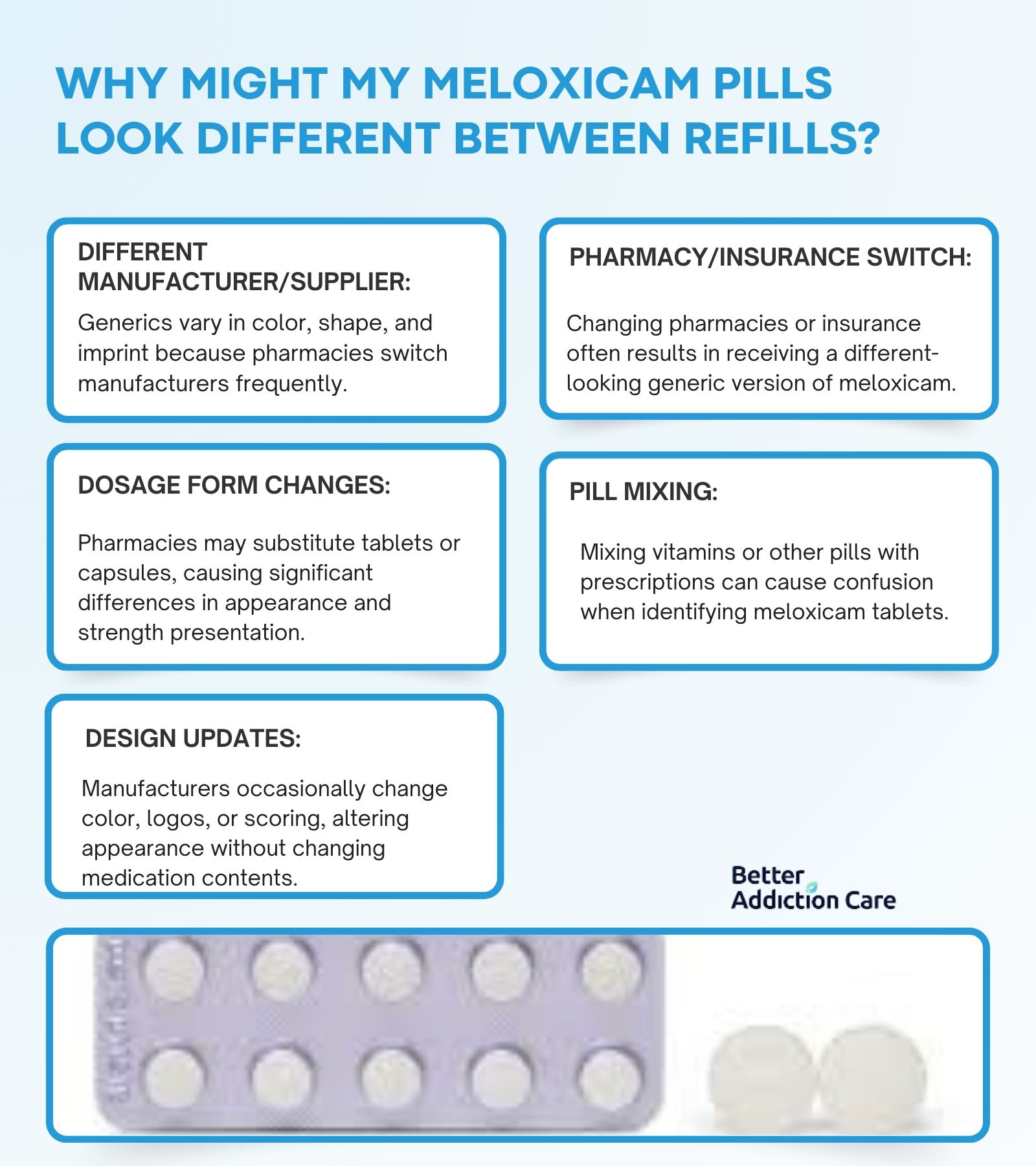
It’s common for the appearance of meloxicam to change from one refill to the next, and there are benign reasons for this:
Pharmacies source generics from multiple companies. A bottle of 15 mg tablets might be filled with one company’s product today and another’s next month.
Each manufacturer designs its own look, so one generic might make a round tablet, another an oval one. The active drug is the same, but the shape, shade of yellow, and imprint can be completely different.
Sometimes a pharmacy might substitute tablets for capsules if you only need a low dose for a few days. For example, 10 mg capsules (if available) versus 7.5 mg tablets look different. Always verify the strength and form.
On occasion, even the brand or a generic maker will update a tablet design (a new logo, a slight color tweak, or adding/removing a score line). These do not indicate a different medicine.
If you changed insurance or pharmacy, they might carry different stock.
Inadvertently buying vitamins or other pills and mixing them with your prescription is another cause of confusion (though meloxicam itself is prescription-only).
Counterfeit or misidentified pills can be life-threatening. Watch for the following red flags with any medication:
The pill’s color, shape, size, or imprint is very different from what you normally receive.
For example, if your yellow oval meloxicam suddenly shows up as greenish and round with a different code, that’s suspicious. The FDA advises consumers to ask: “Does the drug or packaging look different than what you normally receive?”.
Genuine tablets have crisp, precise imprints. Blurry, off-center, or inconsistent letters/numbers can indicate a fake. Also watch for spelling errors (no FDA-approved drug will have a misspelled imprint).
Legitimate tablets have a firm, consistent texture. Counterfeits might be crumbly, soft, or have an unusual odor. (Never cut into a pill to taste it – this is just a sensory clue.)
Check the box and bottle, too. Missing lot numbers, broken seals, poor-quality printing, or wrong stock bottle (e.g., meloxicam in a pill bottle labeled for another drug) are big red flags.
If you develop a new, unusual reaction after taking the pill (headache, severe nausea, allergic symptoms, etc.), it could be adulterated or a different drug altogether. The FDA specifically warns: “Have you experienced a new or unusual side effect after using the drug?”.
Pills bought online from unverified pharmacies, from friends, or on the street are riskier. The DEA bluntly advises that you should never trust your eyes alone and only take medication prescribed by a doctor and dispensed by a licensed pharmacy.[3]
If your pill was formerly inexpensive and now costs much more (especially without insurance changes), or if your medication is suddenly out of stock nationwide, confirm with your pharmacist whether the drug itself is in shortage.
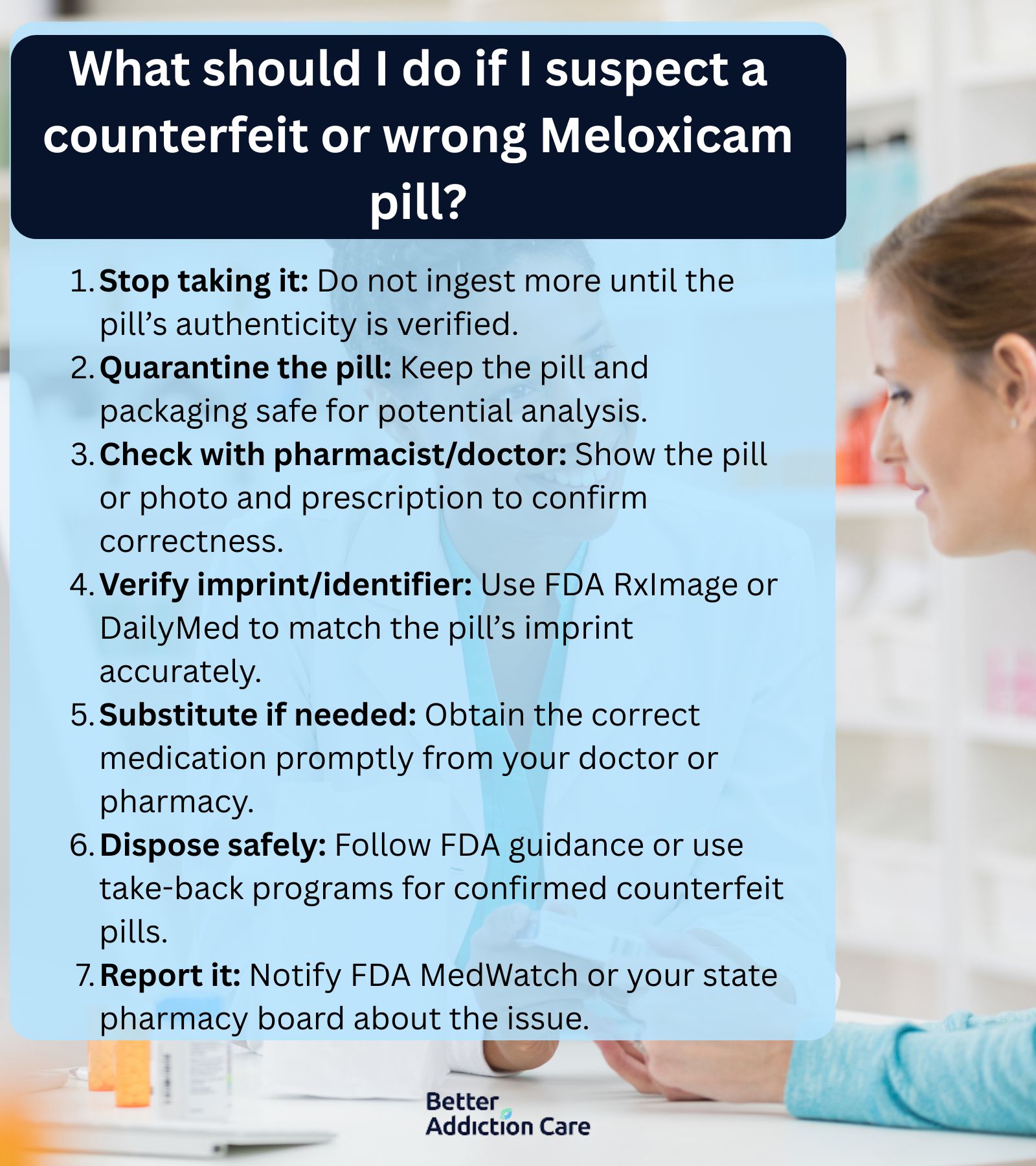
If your pill could be wrong or fake, act quickly and cautiously:
Stop taking it. Do not take any more of the questionable tablet. If you have already taken one, do not take the next dose until you verify.
Quarantine the pill. Keep the suspected pill in its bottle (or in a safe place) and do not ingest it. Save its packaging, blister, or anything that came with it. This sample may be needed for analysis.
Check with your pharmacist or doctor. Show them the pill (or a clear photo) and the prescription label. They can confirm whether the appearance matches the intended medication. Pharmacists have reference tools and experience with various generics.
Verify imprint/identifier. You or your pharmacist can use a reputable pill-identification resource (like the FDA’s RxImage or DailyMed) by entering the imprint and comparing images. Do not rely on Google image search alone.
Substitute if needed. If it’s confirmed wrong, your doctor or pharmacist should quickly provide the correct medication. This might involve calling the pharmacy or prescribing a new refill. Your health condition is the priority, so ensure you get the real drug you need.
Dispose safely. If the pill is confirmed fake, do not consume it. Check FDA guidance for drug disposal, or return it to the pharmacy. You can also use community drug take-back boxes or mix the tablet (crushed) with an undesirable substance in a sealed bag before trashing it, if no take-back is available.
Report it. Consider reporting the incident. You can inform the FDA (MedWatch, 1-800-FDA-1088) or your state board of pharmacy about the counterfeit or dispensing error. [4]
Accurately identifying your meloxicam tablet is a key part of safe medication use. By checking the color (yellow), shape (round/oval), and imprint against trusted information, you protect yourself from dosing mistakes and counterfeit risks.
Remember that legitimate meloxicam will always be some shade of yellow and carry an FDA-approved imprint code for its strength and maker. If something about the pill doesn’t match, do not hesitate to verify with a pharmacist.
Stay proactive: keep the medication bottle handy, refer to this guide or official drug databases when in doubt, and ask questions whenever you refill.
Always obtain meloxicam from a reliable pharmacy and only take medications prescribed for you.
If you ever feel uneasy about a pill’s appearance or your response to it, reach out to your healthcare provider immediately.
Your vigilance is the best safeguard. By combining this knowledge with professional advice, you can confidently take meloxicam safely and effectively. If you need further help, you can contact us and our experts at Better Addiction Care can guide you further.
Meloxicam treats pain, swelling, and stiffness from arthritis. It’s prescribed for osteoarthritis (joint wear-and-tear) and rheumatoid arthritis (autoimmune joint inflammation). It may also be used for related conditions like juvenile arthritis in children.
All three are NSAIDs. Meloxicam is similar to naproxen or high-dose ibuprofen in effect, but it is usually taken once daily due to its longer duration. It may be slightly more selective for the COX-2 enzyme, which can mean a modestly lower risk of stomach upset (though it still carries typical NSAID risks).
That usually means your pharmacy used a different generic manufacturer. Each company makes the tablet differently. As long as the drug name, dosage, and strength are correct, variation in color or shape is normal. If you’re unsure, double-check the imprint and verify with your pharmacist.
Generally, no. Most meloxicam tablets have no score line meant for splitting. In one product leaflet, a score line was explicitly stated not to be used for breaking the tablet. Always take meloxicam whole unless your doctor says otherwise. If your dose requires splitting, the doctor or pharmacist will usually provide the correctly scored tablet or a different dosing method.
Stop taking more doses. Check what you took against your prescription. If it was a meloxicam tablet but the wrong strength, call your doctor/pharmacist for advice on what to do next. If it was not meloxicam at all (e.g., you took a different medication by mistake), contact Poison Control or your doctor immediately, especially if you have symptoms.
Keep a photo or note of what your pills look like (color, shape, imprint) when you first fill the prescription. Watch for changes when you refill. Also, writing the name and strength on your pill organizer (instead of relying on color) can prevent confusion. Ultimately, always read the prescription label and confirm with the pill’s imprint each time.
Only use reputable, licensed pharmacies. Buying from unverified online sources or international pharmacies can be risky due to counterfeit medications. If you buy online, ensure the pharmacy requires a prescription and is properly licensed (look for the NABP/VIPPS seal).
By calling us, you agree to our Terms & Conditions
For those seeking addiction treatment for themselves or a loved one, our calls are confidential and are available for 24/7 help.
Any treatment center receiving calls from the site is a paid advertiser.
Calls to numbers on a specific treatment center listing will be routed to that treatment center.
Calls to any general helpline will be answered by treatment providers, each of which is a paid advertiser.
By calling the helpline you agree to the terms of use. These calls are offered at no cost to you and with no obligation to enter into treatment. Neither this site nor anyone who answers the call receives a commission or fee dependent upon which treatment provider a visitor may ultimately choose.
If you wish to explore additional treatment options or connect with a specific rehab center, you can: browse top-rated listings, visit our homepage, or visit SAMHSA, or by calling 800-662-HELP. You may also contact The Florida Department of Children and Family Services