(866) 567-3138
Sponsored Helpline
Verify Insurance
Salvia divinorum is a psychoactive plant belonging to the mint family (Lamiaceae). It is native to the cloud forests of Oaxaca, Mexico, where it has been used for generations in ceremonial and spiritual practices by the Mazatec people.
 Expert Verified
Salvia divinorum is a powerful hallucinogenic plant that causes intense but short-lasting changes in perception, identity, and awareness. Its effects are driven by salvinorin A, a compound that acts on kappa-opioid receptors rather than serotonin.
Salvia is not federally illegal in the United States, but many states restrict or ban it.
While not considered physically addictive, salvia carries real psychological and safety risks, especially for young users or those with mental health vulnerabilities.
Research on long-term effects is limited, but documented risks include anxiety, dissociation, and emotional instability.
People typically search for information about salvia because they want clear, factual answers.
Some are curious about its effects. Others want to understand potential risks before trying it. Many are confused by its legal status and online claims that frame it as “safe” or “natural.”
Salvia divinorum is often misunderstood. It is neither a mild herbal substance nor comparable to classic psychedelics like LSD or psilocybin. Its effects are intense, rapid, and often disorienting.
This content is for informational purposes only and does not replace medical or legal advice.
Salvia divinorum is a psychoactive plant belonging to the mint family (Lamiaceae). It is native to the cloud forests of Oaxaca, Mexico, where it has been used for generations in ceremonial and spiritual practices by the Mazatec people.
In traditional contexts, salvia was:
Consumed under the guidance of experienced practitioners
Used in quiet, ritualized settings
Taken in low, carefully prepared doses using fresh leaves
These conditions were designed to limit harm and manage its powerful psychological effects.
Modern recreational use differs significantly from these traditional practices, both in form and context, which alters the risk profile.
Outside of traditional settings, salvia is typically used in ways that increase intensity and unpredictability.
Most Common Methods of Use:
Smoked as dried leaves or concentrated extracts
Vaporized using high heat
Chewed (less common in modern recreational use)
Smoking or vaporizing salvia produces rapid onset and intense effects, often within seconds.
Potency and Concentration Risks
Commercial salvia products are frequently sold as concentrated extracts, labeled by strength, such as:
10x
20x
40x or higher
These labels indicate how many times stronger the product is compared to raw leaf.
Higher concentrations:
Intensify hallucinations
Increase dissociation and loss of control
Raise the risk of panic, confusion, and accidental injury
There is no standardized dosing, which makes potency especially difficult to predict.
Salvia’s psychoactive effects are caused by salvinorin A, a naturally occurring compound found in the plant’s leaves.
Salvinorin A is notable because:
It is effective at extremely low doses
It produces intense psychological effects rapidly
It behaves differently from most known hallucinogens
By weight, salvinorin A is considered one of the most potent natural hallucinogens identified.
Salvinorin A affects the brain through a unique neurological pathway. Unlike most hallucinogens, it:
Does not act on serotonin receptors, which are typically involved in classic psychedelic effects
Strongly activates kappa-opioid receptors, a system associated with perception, mood, and stress processing
Perception (how reality is interpreted)
Mood regulation (emotional responses)
Conscious awareness (sense of self and surroundings)
Stress response (fear and discomfort processing)
Because of this mechanism, salvia experiences are often described as:
Abrupt rather than gradual
Immersive rather than reflective
Difficult to control or mentally prepare for
This neurological pathway explains why salvia’s effects feel intense, disorienting, and fundamentally different from other hallucinogens (1).

Salvia affects the brain differently from most hallucinogens. Instead of gradually shifting perception, it abruptly disrupts normal brain communication, producing intense and often disorienting changes in awareness.
Its effects are driven by salvinorin A, which interferes with how the brain integrates sensory input, identity, and spatial orientation. This disruption explains why salvia experiences are frequently described as overwhelming, confusing, or difficult to control.
Salvia primarily affects brain systems involved in conscious awareness and emotional regulation, rather than systems associated with insight or reflection.
Key Neurological Effects:
Rapid onset of altered consciousness
Changes in awareness can begin within seconds, leaving little time for mental adjustment.
Disruption of spatial and self-awareness
Users may lose the ability to recognize their physical location or body position.
Reduced executive control from the prefrontal cortex
The prefrontal cortex, which governs decision-making and impulse control, becomes temporarily less active.
Temporary loss of narrative identity (“ego dissolution”)
Narrative identity refers to the sense of being a continuous, stable self. Salvia can interrupt this process abruptly.
When executive control is reduced, individuals are more likely to experience confusion, panic, or unsafe physical movement. Unlike many psychoactive substances that gradually build effects, salvia bypasses typical perceptual filtering systems in the brain.
Salvia’s time course is short but highly concentrated.
Typical Timeline (Smoked Use)
Onset: 30–60 seconds
Peak effects: 2–10 minutes
Total duration: 15–30 minutes
Although the overall duration is brief, the peak intensity is often described as extreme, particularly with concentrated extracts.
Short duration does not reduce risk—intensity during peak effects plays a larger role in adverse reactions.
Salvia produces a combination of psychological and physical effects that can impair awareness and coordination.
These effects result from altered sensory processing and disrupted self-awareness.
Visual and auditory hallucinations
Distorted sense of time (time slowing or stopping)
Loss of self-identity or personal boundaries
Dissociation from surroundings
Confusion or inability to communicate
Panic, fear, or emotional distress
These reactions are common responses, especially at moderate to high doses.
Physical effects stem from impaired motor coordination and reduced environmental awareness.
Loss of balance or coordination
Dizziness or lightheadedness
Slurred or slowed speech
Muscle weakness
Reduced awareness of surroundings
Because individuals may not recognize hazards or physical limits during intoxication, accidental injury is a documented risk, particularly when salvia is used without supervision or in unsafe environments[2].
Salvia does not typically cause physical toxicity. Instead, risk comes from a temporary disconnection between perception and reality.
During peak effects, individuals may:
Attempt to move without coordination
Misjudge distances or obstacles
Lose awareness of their physical body
This increases the likelihood of falls and other accidents, even in familiar settings.
Dissociation is a mental state in which normal integration between thoughts, emotions, identity, memory, and surroundings becomes disrupted.
In practical terms, dissociation can involve:
Feeling disconnected from the body
Losing a stable sense of self
Experiencing reality as distant, unreal, or fragmented
Salvia produces acute dissociation, meaning the disconnect occurs rapidly and intensely during intoxication rather than developing gradually.
Because salvia alters self-awareness and sensory integration simultaneously, dissociation can feel immersive and disorienting.
Users commonly report:
Detachment from the body, as if observing themselves from outside
Loss of personal identity, including forgetting their name or life context
Experiencing alternate realities, environments, or identities that feel convincing while they occur
These effects are consistent with salvia’s impact on brain systems responsible for identity and spatial awareness.
For most individuals:
Dissociation peaks during intoxication
Awareness gradually returns as effects fade
However, in some cases:
Residual dissociative symptoms may persist after the drug wears off
Individuals may feel “unreal” or disconnected for hours or days
Persistence is more commonly reported after high-dose or concentrated extract use.
Salvia experiences vary widely and are often emotionally unpredictable.
Emotional Responses During Intoxication
During peak effects, emotional reactions may include:
Intense fear or panic
Emotional overwhelm or loss of emotional control
Confusion or psychological distress
These responses are influenced by dose, environment, and individual sensitivity.
Emotional Effects After Use
Once intoxication ends, some individuals report:
Lingering anxiety or unease
Difficulty processing or understanding the experience
Emotional numbness or detachment
Post-use emotional effects may last longer than the perceptual effects, particularly following high-intensity experiences.
Why Dissociation Can Be Disturbing?
Dissociation disrupts the brain’s normal ability to:
Anchor identity
Interpret sensory input reliably
Regulate emotional responses
Because these systems are affected simultaneously, salvia-induced dissociation can feel uncontrollable and unsettling, even when the duration is short.
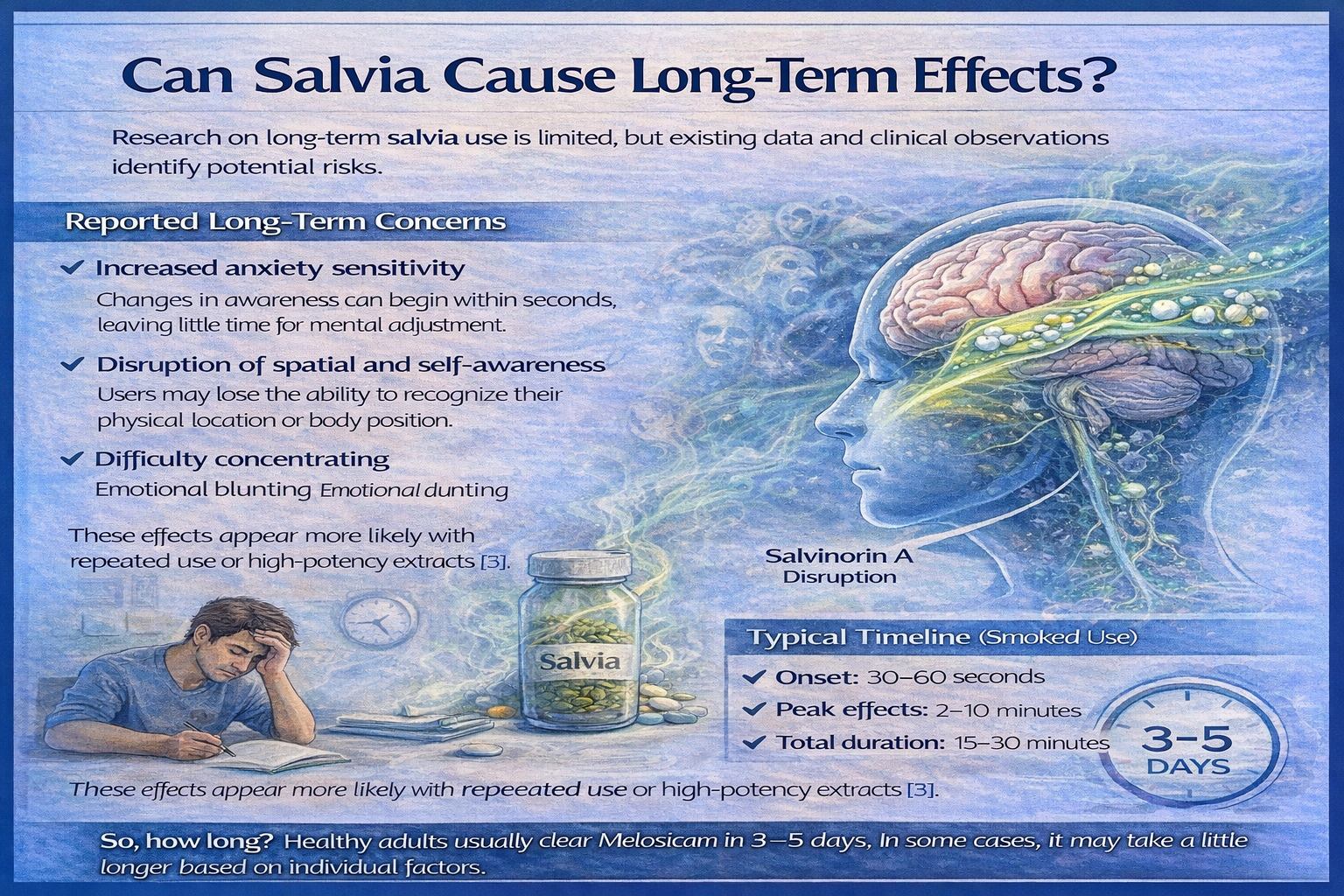
Research on long-term salvia use is limited, but existing data and clinical observations identify potential risks.
Reported Long-Term Concerns
Increased anxiety sensitivity
Mood instability
Persistent dissociative symptoms
Difficulty concentrating
Emotional blunting
These effects appear more likely with repeated use or high-potency extracts [3].
Salvia is not classified as physically addictive. It does not produce chemical dependence, tolerance-driven escalation, or withdrawal symptoms commonly associated with substances such as opioids, alcohol, or stimulants.
This means:
There is no established physical withdrawal syndrome
Use does not typically involve compulsive drug-seeking driven by bodily dependence
However, the absence of physical addiction does not mean the absence of risk.
While salvia does not cause physical dependence, psychological use patterns may develop, particularly with repeated exposure or high-potency extracts.
Documented Psychological Risk Factors
Repeated use to escape stress or emotional discomfort
Curiosity-driven escalation, especially after intense experiences
Continued use despite negative psychological reactions
Use in combination with other psychoactive substances
These patterns reflect behavioral reinforcement, not chemical addiction.
Why Salvia Can Still Be Harmful Without Addiction?
Salvia’s risk profile is driven by:
Intensity of psychological effects
Disruption of self-awareness and emotional regulation
Unpredictability of individual responses
A substance does not need to be addictive to cause meaningful psychological harm or functional impairment.
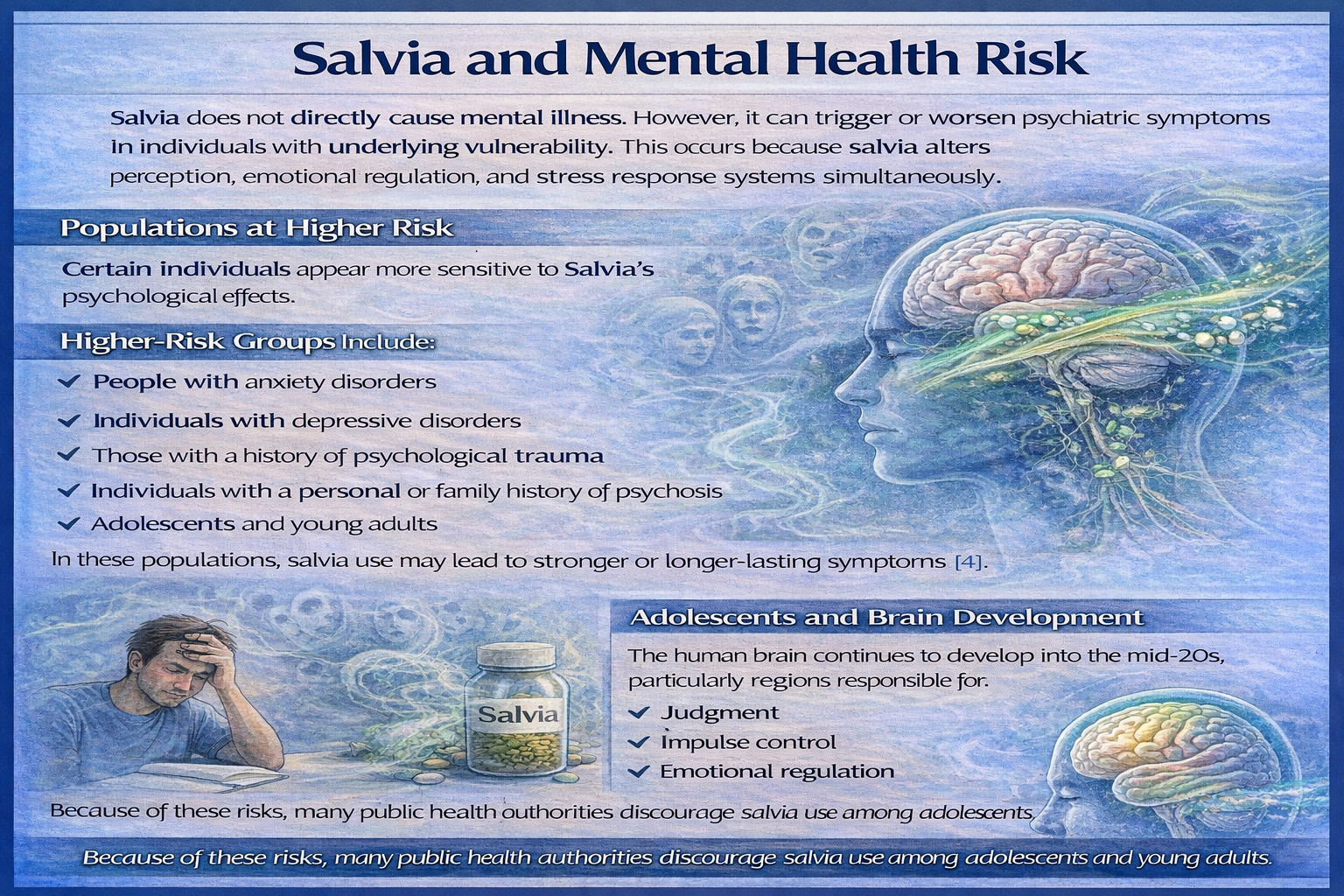
Salvia does not directly cause mental illness. However, it can trigger or worsen psychiatric symptoms in individuals with underlying vulnerability.
This occurs because salvia alters perception, emotional regulation, and stress response systems simultaneously.
Certain individuals appear more sensitive to Salvia’s psychological effects.
Higher-Risk Groups Include:
People with anxiety disorders
Individuals with depressive disorders
Those with a history of psychological trauma
Individuals with a personal or family history of psychosis
Adolescents and young adults
In these populations, salvia use may lead to stronger or longer-lasting symptoms.
Salvia use has been associated with short- and medium-term psychological symptoms, including:
Panic attacks or severe anxiety
Paranoia or heightened suspiciousness
Emotional dysregulation (rapid mood changes)
Disorganized or confused thinking
In some cases, symptoms persist beyond intoxication and require professional evaluation (4).
The human brain continues to develop into the mid-20s, particularly regions responsible for:
Judgment
Impulse control
Emotional regulation
Salvia use during this developmental period may interfere with these processes.
Increased emotional volatility
Reduced tolerance to stress
Reinforcement of dissociative coping strategies
Because of these risks, many public health authorities discourage salvia use among adolescents and young adults.
Salvia is frequently grouped with classic psychedelics such as LSD or psilocybin mushrooms, but this comparison is medically inaccurate and often misleading.
Although all three substances can alter perception, they affect the brain through very different mechanisms and produce fundamentally different subjective experiences.
Key Differences in Duration, Control, and Experience
Duration alone does not determine safety or tolerability. Salvia’s effects are short but highly concentrated, often reaching peak intensity within seconds.
Classic psychedelics typically allow for:
Gradual onset
Some degree of emotional processing
Partial awareness of being under the influence
Salvia differs in several important ways.
Abrupt onset with little time for psychological adjustment
Minimal emotional grounding, increasing confusion or fear
Reduced executive control, limiting the ability to regulate reactions
Dissociative dominance, rather than reflective or insight-oriented effects
These features explain why many individuals describe salvia experiences as overwhelming or destabilizing, even when the duration is brief.
The most immediate and well-documented danger associated with salvia is loss of environmental awareness. During intoxication, individuals may be unable to accurately perceive their surroundings or control physical movement.
Documented Safety Risks
Falls, including from standing height or stairs
Burns, particularly when smoking near heat sources
Unsafe or uncontrolled movement, such as sudden standing or walking
Impaired judgment, leading to risky behavior without awareness of consequences
Unlike substances that primarily impair coordination, salvia often disrupts situational awareness, increasing the likelihood of accidents.
Use in uncontrolled or unfamiliar environments significantly increases injury risk. Common contributing factors include:
Lack of physical supervision
Presence of sharp objects or open flames
Elevated surfaces or obstacles
Because awareness may be lost suddenly, even short exposures can result in injury.
Salvia is not detected on standard urine, blood, or saliva drug tests commonly used for employment or legal screening.
Negative drug tests do not rule out recent use
Detection requires specialized laboratory analysis
Testing is rarely performed outside of research or forensic investigations
This lack of routine detection contributes to the misconception that salvia is “undetectable” and therefore low risk, which is not an accurate assessment of its safety profile.
Salvia divinorum occupies a legally complex position in the United States. Its status depends largely on state-level regulation, not federal scheduling.
Salvia is not classified as a controlled substance under U.S. federal law
It is not listed in the Controlled Substances Act (CSA)
There is no federally approved medical use
Federal agencies continue to monitor emerging research and state policy trends
Federal non-scheduling does not indicate safety or medical acceptance.
State governments regulate salvia independently, resulting in inconsistent legal treatment.
Common regulatory approaches include:
Complete bans on possession, sale, or distribution
Age-based restrictions, often limiting sales to adults
Product limitations, such as potency or extract concentration
Unregulated status, where no explicit laws exist
Because enforcement varies, legality may differ even between neighboring states.
Salvia’s uneven legal treatment reflects broader policy uncertainty rather than consensus.
Key factors influencing state decisions include:
Limited long-term human research data
Reports of intense psychological effects
Absence of medical classification or FDA approval
Concerns related to public safety rather than addiction potential
Legal access does not mean low risk.
Important distinctions:
Legal ≠ safe
Legal ≠ , medically approved
Legal ≠ appropriate for all individuals
Many states regulate salvia as a preventive public health measure, not as recognition of harm equivalence with other controlled substances.
Salvia laws are subject to change due to:
Emerging scientific research
Public safety incidents
Legislative reevaluation of psychoactive substances
Anyone researching salvia should verify current local laws before assuming legality.
“It’s natural, so it’s safe.”
Natural origin does not equal neurological safety.
Salvia contains salvinorin A, a compound capable of rapidly altering brain signaling and perception. Many naturally occurring substances produce intense psychoactive effects and require caution regardless of plant-based origin.
“It only lasts a few minutes.”
While the acute intoxication may be brief, psychological aftereffects can last longer.
Reported post-use effects include:
Lingering anxiety
Difficulty processing the experience
Residual dissociation
Duration alone does not determine risk.
“It’s not addictive, so it’s harmless.”
Salvia is not considered physically addictive, but the lack of addiction does not eliminate potential harm.
Non-addictive substances can still:
Increase accident risk
Trigger lasting psychological distress
Harm potential exists independently of addiction classification.
Occasional experimentation does not automatically indicate a problem. Concern arises when use begins to affect psychological stability or decision-making.
Indicators That Warrant Evaluation
Consider professional assessment if salvia use is associated with:
Persistent anxiety or dissociation beyond intoxication
Emotional instability, such as mood swings or distress
Continued use despite negative experiences
Combination with other substances, increasing unpredictability
These indicators are signals for evaluation, not labels or judgments.
There is currently no salvia-specific medication or standardized treatment protocol.
Clinical care is symptom-focused and individualized.
Common Clinical Priorities
Symptom Stabilization
Reducing acute anxiety
Addressing panic or distress
Supporting emotional regulation
Psychological Support
Processing dissociative experiences
Improving coping strategies
Reducing avoidance or fear responses
Substance Use Counseling (When Needed)
Addressing patterns of repeated use
Identifying triggers or motivations
Preventing escalation or polysubstance use
Most individuals respond well to supportive, non-invasive interventions.
Available research and clinical observations indicate that most individuals do not experience permanent harm from salvia, particularly when use is discontinued.
Typical Recovery Patterns
While timelines vary, improvement often includes:
Reduced anxiety within several weeks
Improved emotional regulation over months
Return to baseline functioning with appropriate support
Recovery is influenced by dose, frequency, mental health history, and post-use support—but outcomes are generally favorable.
Salvia divinorum is a powerful psychoactive substance with effects that differ significantly from other hallucinogens. Its rapid onset, intense dissociative experience, and unpredictable psychological impact make it more disruptive than many people expect.
Although salvia is not physically addictive and remains legal in some areas, these factors do not reduce its potential risks. Short duration does not equal low intensity, and legal availability does not indicate medical safety or approval.
Most individuals do not experience permanent harm, especially when use is discontinued. However, lingering anxiety, dissociation, or emotional distress can occur and should not be ignored.
Accurate information, realistic expectations, and awareness of mental health vulnerability are essential for anyone researching Salvia. When symptoms persist or interfere with daily functioning, professional evaluation can provide clarity, stabilization, and a clear path forward.
Understanding salvia is not about alarm—it is about informed decision-making based on evidence, not myths.
No. Salvia is not detected on standard urine, blood, or saliva drug tests. Specialized laboratory testing exists but is rarely used outside of research or forensic settings.
Lower doses generally reduce intensity, but salvia’s effects remain unpredictable. Even small amounts can cause disorientation, dissociation, or panic, especially in individuals sensitive to hallucinogens.
Mixing salvia with alcohol or other substances increases safety risks. Combined use may worsen confusion, impair coordination, and heighten anxiety or dissociative reactions.
Short-term memory disruption is common during intoxication. Some users also report difficulty recalling the experience clearly afterward. Persistent memory issues are uncommon but have been reported following intense use.
Research on Salvia primarily focuses on its unique brain receptor activity. It is not currently approved or recommended for medical or therapeutic use.
Salvia does not produce traditional withdrawal symptoms. However, psychological aftereffects such as anxiety or emotional discomfort may occur after stopping use.
By calling us, you agree to our Terms & Conditions
For those seeking addiction treatment for themselves or a loved one, our calls are confidential and are available for 24/7 help.
Any treatment center receiving calls from the site is a paid advertiser.
Calls to numbers on a specific treatment center listing will be routed to that treatment center.
Calls to any general helpline will be answered by treatment providers, each of which is a paid advertiser.
By calling the helpline you agree to the terms of use. These calls are offered at no cost to you and with no obligation to enter into treatment. Neither this site nor anyone who answers the call receives a commission or fee dependent upon which treatment provider a visitor may ultimately choose.
If you wish to explore additional treatment options or connect with a specific rehab center, you can: browse top-rated listings, visit our homepage, or visit SAMHSA, or by calling 800-662-HELP. You may also contact The Florida Department of Children and Family Services