(866) 567-3138
Sponsored Helpline
Verify Insurance
At the federal level: Salvia divinorum is not classified under the Controlled Substances Act. It is not assigned to Schedule I–V. Federal law does not currently ban possession or sale
 Expert Verified
Salvia divinorum—commonly called salvia—is a psychoactive plant known for producing intense, short-lasting hallucinations that can strongly alter perception, emotions, and awareness.
While some people view it as a “legal high,” others—especially families—worry about safety, mental health effects, and legal consequences.
Salvia’s legality varies widely across the United States because there is no single federal law that governs it, leaving each state to decide how to regulate or restrict its use. These laws change frequently as new research and public health concerns emerge, making it critical to stay informed.
Legal disclaimer: This article is for informational purposes only and does not constitute legal advice. Always verify current laws through official state sources or consult with a legal professional.
Salvia divinorum is a plant in the mint family, traditionally used in spiritual ceremonies.
It is most commonly found as:
Dried leaves (smoked or chewed)
Liquid extracts (highly concentrated forms)
Living plants sold for ornamental purposes in limited states
The active compound, salvinorin A, affects brain receptors involved in perception and consciousness, leading to powerful hallucinations that can feel disorienting or overwhelming.
States regulate or ban salvia primarily due to:
Safety concerns (loss of motor control, confusion, panic)
Reports of misuse, especially among teens and young adults
Unpredictable psychological effects, including anxiety or dissociation
Lack of standardized dosing or medical supervision
From a family perspective, these risks raise concerns about accidental injury, worsening mental health, and long-term emotional impact.
Federal vs. state conflict
Salvia exists in a legal gray area:
It is not federally scheduled as a controlled substance
Individual states decide whether to ban, restrict, or allow it
This creates confusion when laws differ across state lines
A substance may be legal in one state and illegal in another, even if purchased legally elsewhere.
Medical research vs. misuse risks
Some early scientific studies have explored salvinorin A for potential therapeutic effects, such as pain modulation or addiction research.[2]
However:
No medical use is approved
Research is experimental, not clinical
Misuse risks remain significant without medical oversight
States tend to weigh public health risk more heavily than unproven scientific potential when making legal decisions.
Federal legal status[1]
At the federal level:
Salvia divinorum is not classified under the Controlled Substances Act
It is not assigned to Schedule I–V
Federal law does not currently ban possession or sale
However, federal agencies continue to monitor it due to safety concerns.
How do state laws apply in practice?
Because there is no federal ban:
State laws control enforcement
A state ban can result in arrest or penalties, even without federal involvement
States that allow salvia generally do not face federal interference
For families, this means legality depends entirely on where you live or travel.
Online purchases and shipping
Some salvia products are sold online, but:
Shipping into a state where salvia is banned may violate that state’s law
Interstate transport can raise legal risks
Sellers may not always verify state legality
There is no safe assumption that “online availability” equals legality.
The table below summarizes the laws regarding salvia in each U.S. state. We use three categories: Legal (no specific prohibition), Restricted (allowed only under specific limits, such as age 18/21 or limited use), and Banned (illegal to buy, possess, or sell).
A few states have unusual rules (for example, some allow salvia plants only for decorative purposes). Always verify with up-to-date official sources before making decisions.
Status categories:
Legal – No specific state prohibition. Adults may possess, buy, or sell salvia freely (subject to general laws).
Restricted – Legal only under limits (usually age limits or usage rules). For example, some states allow sale only to adults (18+ or 21+), or only permit salvia for “decorative or landscaping” planting.
Banned – Explicitly illegal; possession, sale, or distribution is prohibited and can lead to fines or jail.
(No state currently treats salvia as a medical- or research-only controlled substance, so we do not list a “Regulated” category here.)
States that ban salvia usually point to public health and safety concerns, not moral panic (even if media coverage sometimes amplifies fear). Lawmakers commonly cite the following reasons:
Unpredictable psychological effects: Salvia can cause sudden, intense hallucinations, confusion, or loss of control, raising concerns about accidents or dangerous behavior.
No medical oversight: Unlike prescription drugs, salvia has no standardized dosing or physician supervision. Without an approved medical use, states tend to regulate it cautiously.
Protecting minors: Many bans were driven by concerns about youth access. In some cases, highly publicized incidents—such as a 2006 teen suicide in Delaware linked to salvia—accelerated legislative action.
Federal signaling: Although salvia is not federally scheduled, it has been labeled a “drug of concern” in federal discussions, prompting some states to act preemptively.
Even in states where salvia is legal or partially restricted, rules often still apply. Common restrictions include:
Age limits: Many states regulate salvia like alcohol or tobacco, allowing sales only to adults (often 18+ or 21+).
Where it can be sold: Sales may be limited to licensed retailers, such as smoke shops. Online sales or shipping to minors may be prohibited.
Quantity limits: Some states cap how much salvia you can possess. Larger amounts can lead to more serious charges.
Public use bans: Use is often prohibited in public places, including schools, prisons, parks, or vehicles, even if private possession is allowed.
Penalties: First-time possession may be a misdemeanor with fines or short jail time, while larger quantities or intent to sell can result in felony charges. In some states, penalties can be severe.
Form-specific rules: Certain laws ban salvia extracts but not raw leaves (or vice versa). Others allow growing the plant only as an ornamental, not for consumption or distribution.
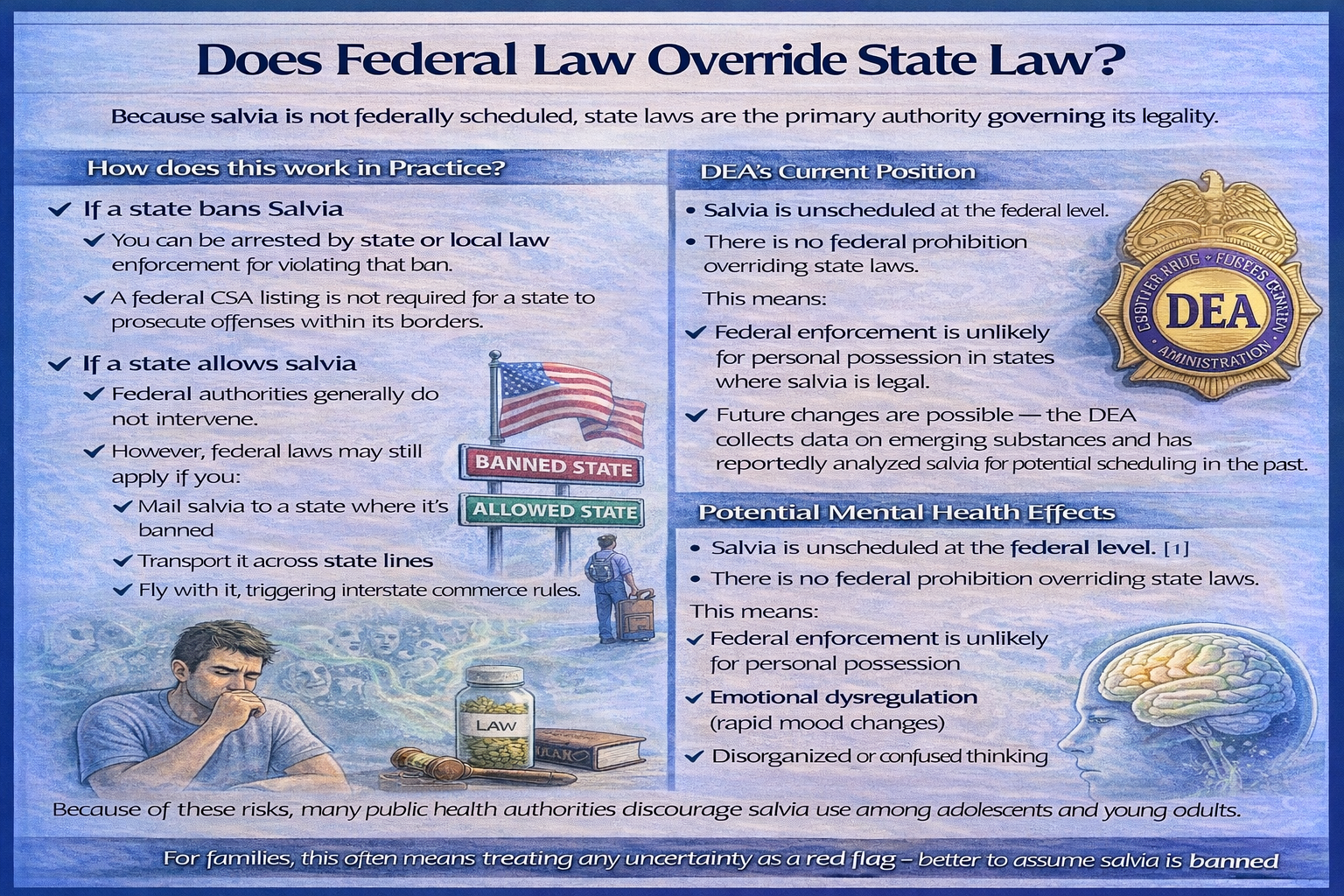
Because salvia is not federally scheduled, state laws are the primary authority governing its legality.
How does this work in Practice?
If a state bans Salvia
You can be arrested by state or local law enforcement for violating that ban.
A federal CSA listing is not required for a state to prosecute offenses within its borders.
If a state allows salvia
Federal authorities generally do not intervene.
However, federal laws may still apply if you:
Mail salvia to a state where it’s banned
Transport it across state lines
Fly with it, triggering interstate commerce rules
DEA’s Current Position
Salvia is unscheduled at the federal level. [1]
There is no federal prohibition overriding state laws.
This means:
Federal enforcement is unlikely for personal possession in states where salvia is legal.
Future changes are possible — the DEA collects data on emerging substances and has reportedly analyzed salvia for potential scheduling in the past.
Any future CSA scheduling would make salvia illegal nationwide, including in states that currently allow it.
This is ongoing regulatory analysis, not binding law.
In short, follow state law. If you possess salvia legally under state rules but transport it to a state where it’s banned, you could face charges in the banning state.
There’s no secret way around enforcement: obey the strictest applicable law. For families, this often means treating any uncertainty as a red flag – better to assume salvia is banned when in doubt.
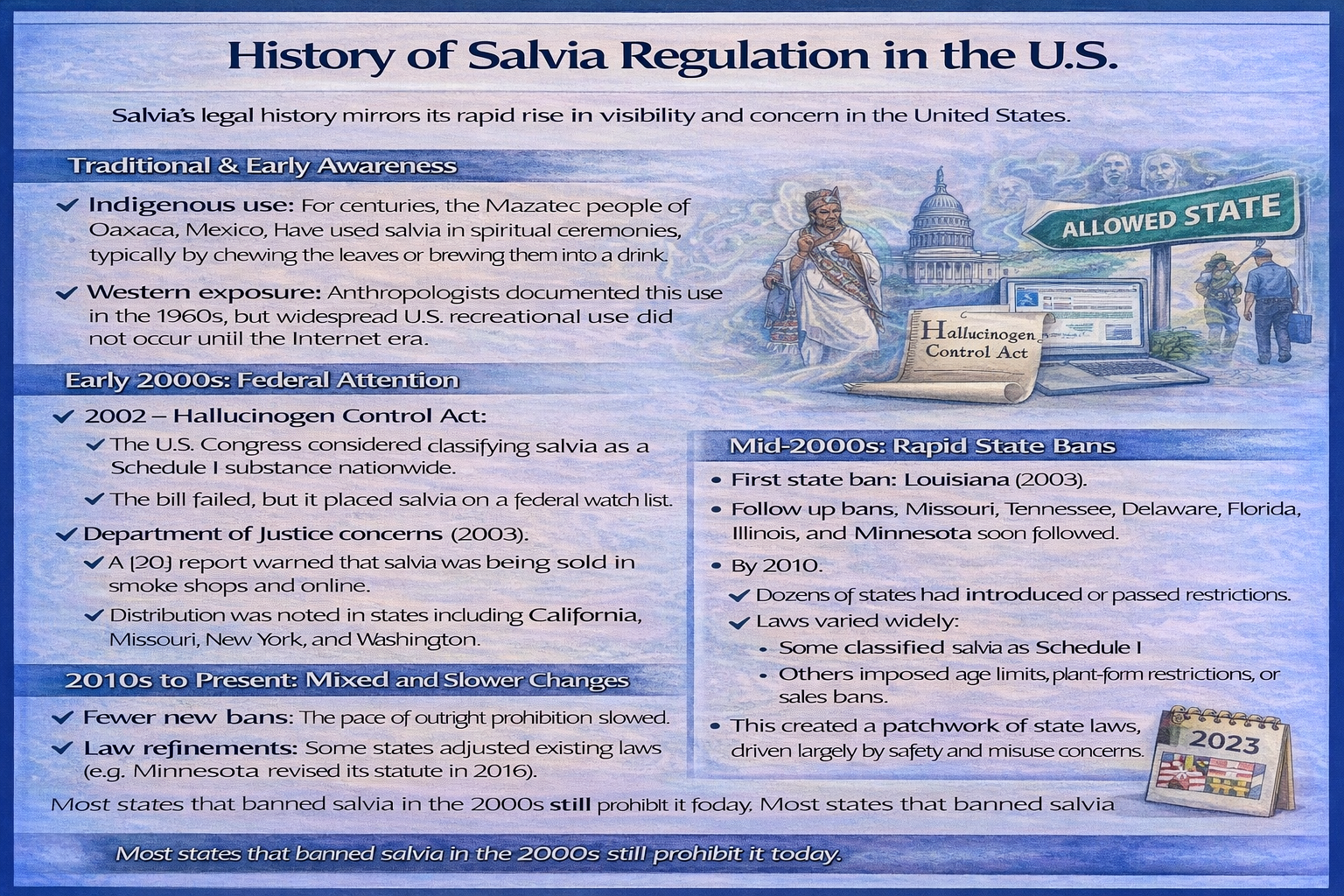
Salvia’s legal history mirrors its rapid rise in visibility and concern in the United States.
Traditional & Early Awareness
Indigenous use: For centuries, the Mazatec people of Oaxaca, Mexico, have used salvia in spiritual ceremonies, typically by chewing the leaves or brewing them into a drink.
Western exposure: Anthropologists documented this use in the 1960s, but widespread U.S. recreational use did not occur until the Internet era.
Early 2000s: Federal Attention
2002 – Hallucinogen Control Act:
The U.S. Congress considered classifying salvia as a Schedule I substance nationwide.
The bill failed, but it placed salvia on a federal watch list.
Department of Justice concerns (2003):
A DOJ report warned that salvia was being sold in smoke shops and online.
Distribution was noted in states including California, Missouri, New York, and Washington.
The report emphasized experimentation among youth, raising safety alarms.
Mid-2000s: Rapid State Bans
First state ban: Louisiana (2003).
Follow-up bans: Missouri, Tennessee, Delaware, Florida, Illinois, and Minnesota soon followed.
By 2010:
Dozens of states had introduced or passed restrictions.
Laws varied widely:
Some classified salvia as Schedule I
Others imposed age limits, plant-form restrictions, or sales bans
This created a patchwork of state laws, driven largely by safety and misuse concerns.
2010s to Present: Mixed and Slower Changes
Fewer new bans: The pace of outright prohibition slowed.
Law refinements: Some states adjusted existing laws (e.g., Minnesota revised its statute in 2016).
Selective new restrictions: Occasional additions, such as Georgia’s ornamental-plant exception (2011).
Limited loosening: Maryland (2023) legalized salvia for adults 21+, reversing a prior ban.
Most states that banned salvia in the 2000s still prohibit it today.
Many U.S. states base salvia divinorum laws on documented safety risks rather than moral judgments. While salvia is not physically addictive, its intense psychoactive effects raise concerns for users, families, and public safety officials.
Salvia is known for producing extremely intense, short-acting hallucinations.
Users commonly report:
Distorted visual patterns
Floating or falling sensations
Feeling detached from reality or “transported” elsewhere
These effects can be overwhelming and disorienting, even at low doses.
Because awareness and coordination are impaired, risks include:
Falls or injuries
Accidental self-harm
Dangerous behavior (such as attempting to stand, walk, or drive)
Even brief salvia experiences can lead to accidents, which is why many states treat it as a public safety issue.
Although salvia is not considered physically addictive, it can still affect the body.
Poison control data show that intentional salvia use[3]—especially when combined with alcohol or other drugs—has been linked to:
Neurological symptoms: confusion, dizziness, loss of coordination
Cardiovascular effects: increased heart rate, palpitations
Gastrointestinal issues: nausea, vomiting, stomach discomfort
Most effects are short-lived, but some cases require medical evaluation. [3]
Emergency departments do see patients following salvia misuse, even though large-scale incidents are rare.
States often cite these medical reports when justifying restrictions.[3]
Salvia’s powerful effects on the brain raise concerns about mental health outcomes, especially for vulnerable individuals.
Possible psychological effects include:
Anxiety or panic attacks
Persistent fear or confusion after use
Worsening depression or paranoia
People with underlying mental health conditions may face a higher risk of negative reactions.
Long-term human studies are limited, but animal research suggests potential impacts on learning and memory with repeated exposure. [2]
Reactions are unpredictable, which makes lawmakers cautious.
Unlike regulated medications or alcohol, salvia products have no standardized dosing.
Potency varies widely between:
Raw leaves
Concentrated extracts
A dose that feels mild to one person may be overwhelming to another.
Some states respond by:
Banning concentrated extracts
Classifying certain forms as Schedule I, even if the plant itself is treated differently
In some states, salvia leaf and purified salvinorin A are regulated under separate rules.
If someone you care about is using or considering salvia, harm-reduction steps matter:
Avoid using alone
Never mix with alcohol or other drugs
Choose a safe, controlled environment
Understand and follow state laws
Watch for lingering anxiety, mood changes, or confusion
For families, calm, open communication is often more effective than confrontation. If concerning symptoms persist, speaking with a healthcare professional can help.
State-by-state rules: Salvia’s legal status varies by state. Some states ban it entirely, others allow it for adults (sometimes with age or usage restrictions). Check your specific state’s law before making any decisions.
Federal status: There is no federal prohibition on Salvia right now. However, federal agencies have identified it as a concern. If federal law ever changes, it could override state laws.
Restrictions to watch: In many places that allow salvia, you’ll see age limits, limits on who can sell it, and possible possession caps. Where it’s banned, even small possession can mean fines or jail.
Health and safety: States enacted laws mainly due to safety concerns. Salvia causes intense hallucinations and physiological pubmed.ncbi.nlm.nih.gov. Families should emphasize safe practices, be aware of side effects, and seek medical help if problems arise.
Legal advice: If you’re unsure about your legal risk, as laws are changing frequently, consult official sources or a lawyer. For health worries, talk to medical professionals or counselors.
By calling us, you agree to our Terms & Conditions
For those seeking addiction treatment for themselves or a loved one, our calls are confidential and are available for 24/7 help.
Any treatment center receiving calls from the site is a paid advertiser.
Calls to numbers on a specific treatment center listing will be routed to that treatment center.
Calls to any general helpline will be answered by treatment providers, each of which is a paid advertiser.
By calling the helpline you agree to the terms of use. These calls are offered at no cost to you and with no obligation to enter into treatment. Neither this site nor anyone who answers the call receives a commission or fee dependent upon which treatment provider a visitor may ultimately choose.
If you wish to explore additional treatment options or connect with a specific rehab center, you can: browse top-rated listings, visit our homepage, or visit SAMHSA, or by calling 800-662-HELP. You may also contact The Florida Department of Children and Family Services