Start Your Recovery Today - Call Now
Sponsored Helpline (866) 567-3138

AA and NA Meetings in North Carolina

Browse our directory of local AA and NA meetings in North Carolina to find the support and community you need on your road to recovery.

Browse Meetings by City in North Carolina

A
B
C
D
E
F
G
H
I
J
K
L
M
N
O
P
R
S
T
V
W
Y
Z

AA and NA Meetings in North Carolina

Upcoming Meetings in the Next 90 Minutes

NA Mi Vida Limpia Group
Chemical Dependency Center
10:30 AM EST 100 Billingsley Road, Charlotte, NC 28211
NA Rush Hour Group Discussion/Participation
TASC Building
10:30 AM EST 8th & Princess Street, Wilmington, NC 28401
NA Free & Serene Group Non-Smoking
IAMAW Union Hall
10:30 AM EST 4257 N Patterson Ave, Winston-Salem, NC 27105
NA Rainbow Recovery Group Discussion/Participation
The Lesbian & Gay Community Center
11:00 AM EST 1401-B Central Ave, Charlotte, NC 28205
NA Stick & Stay Group Discussion/Participation
Stick & Stay Group
11:00 AM EST 1710 Beatties Ford Road, Charlotte, NC 28216
NA Awaken Spiritually Group Discussion/Participation
1602 Club
11:00 AM EST 1602 South Front Street, Wilmington, NC 28401
Any Day
Any Day
Monday
Tuesday
Wednesday
Thursday
Friday
Saturday
Sunday
Any Time
Any Time
05:00
06:00
07:00
08:00
09:00
10:00
11:00
12:00
13:00
14:00
15:00
16:00
17:00
18:00
19:00
20:00
21:00
22:00
23:00
24:00
Any Type
Any Type
Closed
Open
Big Book
Discussion
Literature
Meditation
Newcomer
Virtual
Step Meeting
AA
NA
Time
Meeting Name
Address
Notes
12:00 PM EST
Green Street United Methodist Church
638 South Green Street, Winston-Salem, NC 27101
Lunch Bunch Group Non-Smoking
12:00 PM EST
Green Street United Methodist Church
638 South Green Street, Winston-Salem, NC 27101
Lunch Bunch Group Non-Smoking
12:00 PM EST
Our Primary Purpose Building
122 Elizabethtown Road, Lumberton, NC 28358
Our Primary Purpose Group Discussion/Participation
12:00 PM EST
Bill Sapp Recreation Center
1100 Cedar Street, Lumberton, NC 28358
Our Primary Purpose Group Non-Smoking
12:00 PM EST
Green Street United Methodist Church
638 South Green Street, Winston-Salem, NC 27101
Lunch Bunch Group Non-Smoking
12:00 PM EST
Northwoods United Methodist Church
1528 Gum Branch Road, Jacksonville, NC 28546
New Way Of Life Group
12:00 PM EST
Phoenix House
506 Cypress Street, New Bern, NC 28560
Independence Group Discussion/Participation
12:00 PM EST
Phoenix House
506 Cypress Street, New Bern, NC 28560
Independence Group
12:00 PM EST
Chemical Dependency Center
100 Billingsley Road, Charlotte, NC 28211
Midday Recovery Group Literature Study
12:00 PM EST
Our Primary Purpose Building
122 Elizabethtown Road, Lumberton, NC 28358
Our Primary Purpose Group Non-Smoking
12:00 PM EST
Phoenix House
506 Cypress Street, New Bern, NC 28560
Independence Group It Works Study
12:00 PM EST
Phoenix House
506 Cypress Street, New Bern, NC 28560
Independence Group It Works Study
12:00 PM EST
Phoenix House
506 Cypress Street, New Bern, NC 28560
Independence Group
12:00 PM EST
Fairmont Church
2501 Clark Avenue, Raleigh, NC 27607
Out to Lunch Group Discussion/Participation
12:00 PM EST
Fairmont Church
2501 Clark Avenue, Raleigh, NC 27607
Out to Lunch Group Discussion/Participation
12:00 PM EST
Fairmont Church
2501 Clark Avenue, Raleigh, NC 27607
Out to Lunch Group Discussion/Participation
12:00 PM EST
Family Resource Center
225 Chatham Square, Siler City, NC 27344
Links to Freedom Group
12:00 PM EST
Fairmont Church
2501 Clark Avenue, Raleigh, NC 27607
Out to Lunch Group Discussion/Participation
12:00 PM EST
Fairmont Church
2501 Clark Avenue, Raleigh, NC 27607
Out to Lunch Group Discussion/Participation
12:00 PM EST
Chemical Dependency Center
100 Billingsley Road, Charlotte, NC 28211
Midday Recovery Group Non-Smoking
12:00 PM EST
Chemical Dependency Center
100 Billingsley Road, Charlotte, NC 28211
Midday Recovery Group Discussion/Participation
12:00 PM EST
Chemical Dependency Center
100 Billingsley Road, Charlotte, NC 28211
Midday Recovery Group Discussion/Participation
12:00 PM EST
Oleander Methodist Church
5810 Oleander Drive, Wilmington, NC 28403
Not High Noon Group Non-Smoking
12:00 PM EST
Ordered by God Missionary Baptist Church
256 Bellhaven Place, Concord, NC 28027
Joyous Group Discussion/Participation
12:00 PM EST
Ordered by God Missionary Baptist Church
256 Bellhaven Place, Concord, NC 28027
Joyous Group Discussion/Participation
12:00 PM EST
Ordered by God Missionary Baptist Church
256 Bellhaven Place, Concord, NC 28027
Joyous Group Discussion/Participation
12:00 PM EST
Oleander Methodist Church
5810 Oleander Drive, Wilmington, NC 28403
Not High Noon Group Non-Smoking
12:00 PM EST
Union Baptist Church
406 West Northwest Boulevard, Winston-Salem, NC 27101
Never Lonely Again Group Non-Smoking
12:00 PM EST
Church of The Good Shepherd
231 North Church Street, Rocky Mount, NC 27803
Walk Your Talk Group Discussion/Participation
12:00 PM EST
Church of The Good Shepherd
231 North Church Street, Rocky Mount, NC 27803
Walk Your Talk Group Discussion/Participation
12:00 PM EST
Cure Aids of Wilmington
1125 North 4th Street, Wilmington, NC 28401
NA Means Necessary Group Discussion/Participation
12:00 PM EST
Never Alone Inc. Club House
332 Gillespie Street, Fayetteville, NC 28301
We Do Recover Group Discussion/Participation
12:00 PM EST
Green Street United Methodist Church
638 South Green Street, Winston-Salem, NC 27101
Lunch Bunch Group Non-Smoking
12:00 PM EST
Holy Trinity Lutheran Church
805 South York Street, Gastonia, NC 28052
Addicts R Us Group Just For Today Study
12:00 PM EST
First United Methodist Church
190 East Franklin Blvd., Gastonia, NC 28052
Learning To Live Group Non-Smoking
12:00 PM EST
Aldersgate UMC
632 Laurel Hill Rd, Chapel Hill, NC 27514
In Broad Daylight Group Discussion/Participation
12:00 PM EST
Daily Reporting Center
1520 North Fayetteville Street, Asheboro, NC 27203
Recovery to Freedom Group Discussion/Participation
12:00 PM EST
Daily Reporting Center
1520 North Fayetteville Street, Asheboro, NC 27203
Recovery to Freedom Group Discussion/Participation
12:00 PM EST
Aldersgate UMC
632 Laurel Hill Rd, Chapel Hill, NC 27514
In Broad Daylight Group Discussion/Participation
12:00 PM EST
Durham Co. Health Dept.
414 E. Main Street, Durham, NC 27701
Hope without Dope Group Discussion/Participation
12:00 PM EST
Community Shelter
412 Liberty Street, Durham, NC 27701
Our Primary Purpose Group Discussion/Participation
12:00 PM EST
First United Methodist Church
190 East Franklin Blvd., Gastonia, NC 28052
Learning To Live Group Non-Smoking
12:00 PM EST
Community Shelter
412 Liberty Street, Durham, NC 27701
Our Primary Purpose Group Discussion/Participation
12:00 PM EST
Green Street United Methodist Church
638 South Green Street, Winston-Salem, NC 27101
Lunch Bunch Group Non-Smoking
12:00 PM EST
Yadkinville United Methodist Church
203 West Main Street, Yadkinville, NC 27055
Against All Odds Group Discussion/Participation
12:00 PM EST
New Community Church
Six Forks Road, Raleigh, NC 27615
NA at Noon Group Discussion/Participation
12:00 PM EST
New Community Church
Six Forks Road, Raleigh, NC 27615
NA at Noon Group Discussion/Participation
12:00 PM EST
Oleander Methodist Church
5810 Oleander Drive, Wilmington, NC 28403
Not High Noon Group Non-Smoking
12:00 PM EST
New Community Church
Six Forks Road, Raleigh, NC 27615
NA at Noon Group Discussion/Participation
12:00 PM EST
New Community Church
Six Forks Road, Raleigh, NC 27615
NA at Noon Group Discussion/Participation

Alcoholism, Drug Abuse, Mental Health, and Treatment in North Carolina
Alcoholism, Drug Abuse, Mental Health, and Treatment in North Carolina

What are the main addictions people in North Carolina suffer from?

The main addictions people in North Carolina suffer from include: 

  • Alcohol Addiction: 1,039,040 individuals (9.72% of the population) have been affected with alcohol addiction. 563,682 males (54.3%) are higher in number as compared to 475,358 females (45.7%) facing alcohol addiction
  • Marijuana Addiction: 1,112,800 individuals (10.4% of the population) have used marijuana in the past year. 622,854 males (56%) as compared to 489,946 (44%) females affected from marijuana addiction.
  • Prescription Pain Reliever Addiction: 310,300 individuals (2.9% of the population) misuse Prescription Pain Relievers.  171,873 (55.4%) males are affected from Pain reliever addiction, while females are 138,427 (44.6%).
  • Cocaine Addiction: 180,830 individuals (1.69% of the population) used cocaine in the past year. 101,248 (56%) males as compared to 79,582 (44%) females facing Cocaine Addiction.
  • Methamphetamine Addiction: 73,830 individuals (0.69% of the population) misuse methamphetamine. 41,171 (55.7%) males as compared to 32,659 (44.3%) females facing methamphetamine addiction.
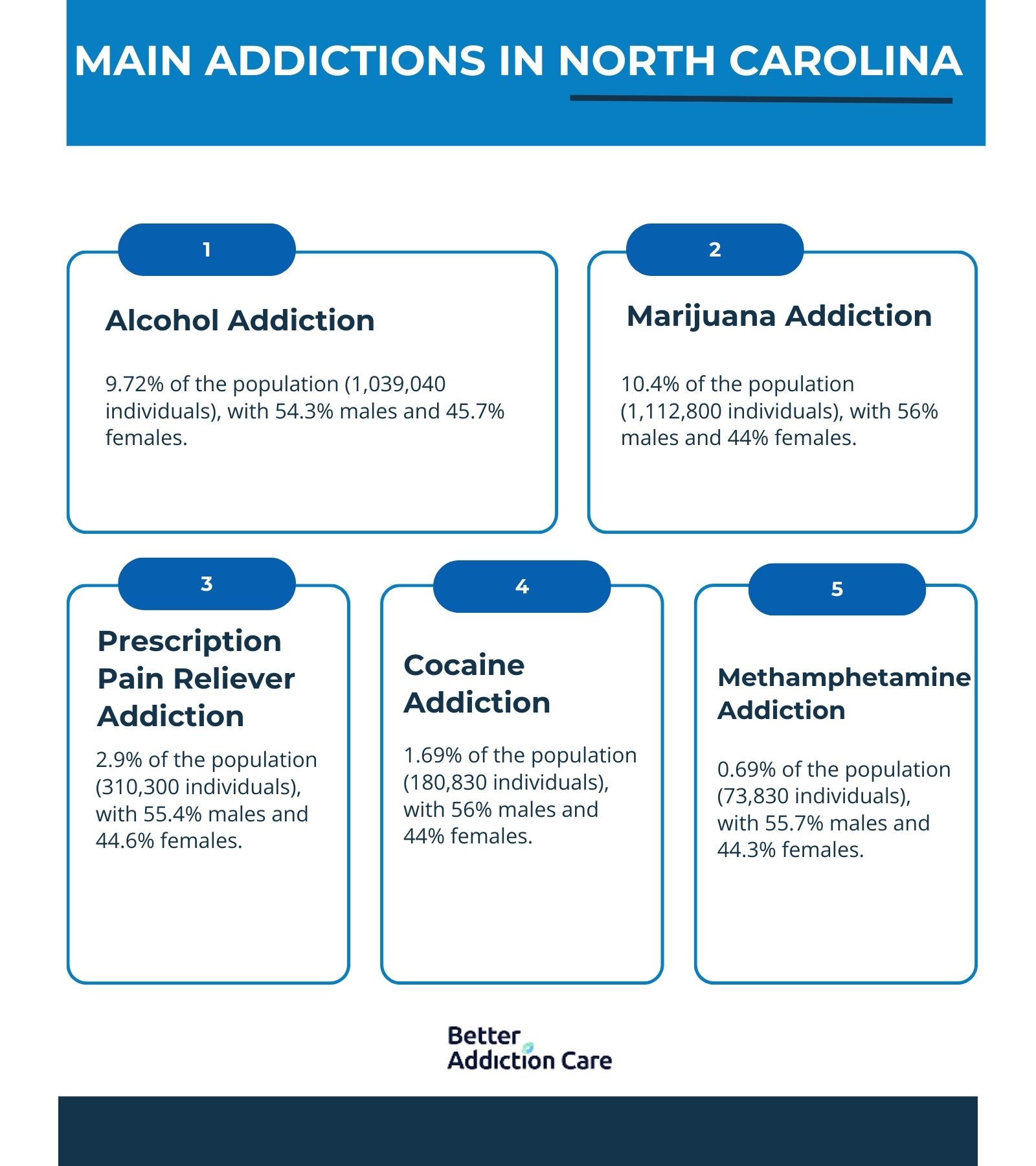
Main Addictions in North Carolina

What is the cost of rehab centers in North Carolina?

The cost of rehab centers in North Carolina is $56,759. Inpatient rehab programs cost $50,000 for a standard 30-day treatment, while outpatient programs are more affordable, averaging around $1,764 per admission. In North Carolina, the cost of rehab for substance addictions varies significantly depending on the type of treatment program and the addiction being addressed.
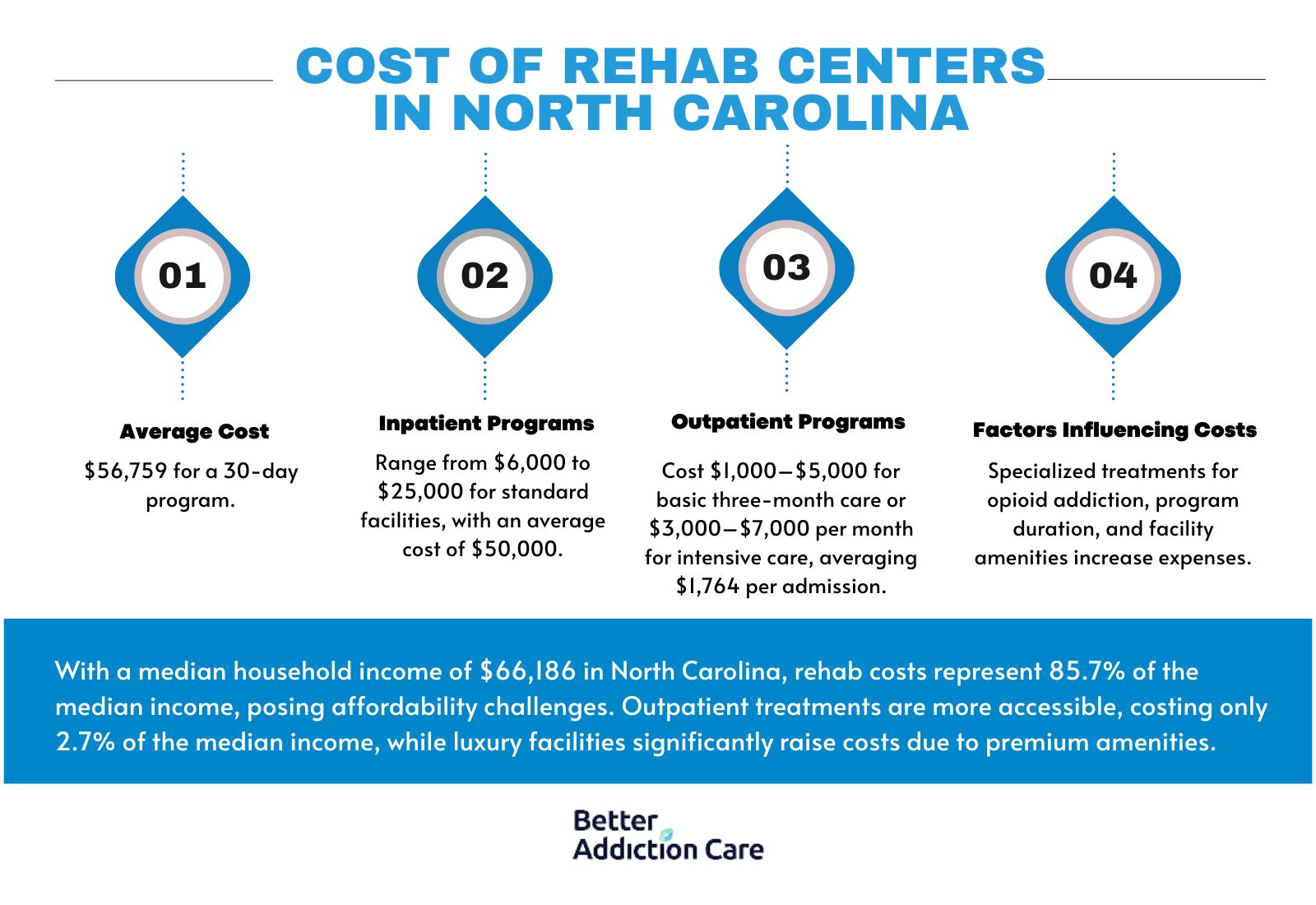
Cost of Rehab Centers in North Carolina

Factors influencing these costs of rehab centers in North Carolina include the type of addiction, with treatments for substances like opioids requiring specialized medications and therapies, and the program’s intensity and duration, as more intensive or longer programs increase expenses. Inpatient treatments range from $6,000 to $25,000 depending on the facility’s amenities, while outpatient programs cost $1,000 to $5,000 for basic three-month programs or $3,000 to $7,000 per month for intensive outpatient care.

North Carolina's median household income is $66,186. The cost of rehab centers constitutes 85.7% of the median income, making it a significant financial burden for many families. The affordability of these treatments varies greatly, outpatient treatment at $1,764 per admission is accessible, representing only 2.7% of the median household income. Costs of rehab centers increase depending on the type of rehab center chosen, with luxury or private facilities charging substantially more due to enhanced amenities and personalized care. These factors underscore the importance of carefully evaluating treatment options to balance cost with the necessary level of care.

What is the cost of LGBTQ+ rehab centers in North Carolina?

The cost of LGBTQ+ rehab centers in North Carolina is $56,000. Inpatient rehab programs cost $50,000 for a standard 30-day treatment, while outpatient programs are more affordable, averaging $1,764 per admission. In North Carolina, the cost of LGBTQ+ rehab for substance addictions varies significantly depending on the type of treatment program and the addiction being addressed.

Factors influencing these costs of LGBTQ+ rehab centers in North Carolina include the type of addiction, with treatments for substances like opioids requiring specialized medications and therapies, and the program’s intensity and duration, as more intensive or longer programs increase expenses. Inpatient treatments range from $6,000 to $25,000 depending on the facility’s amenities, while outpatient programs cost $1,000 to $5,000 for basic three-month programs or $3,000 to $7,000 per month for intensive outpatient care.

North Carolina's median household income is $66,186. The cost of LGBTQ+ rehab centers constitutes 84.6% of the median income, making it a significant financial burden for many families. The affordability of these treatments varies greatly, outpatient treatment at $1,764 per admission is accessible, representing only 2.7% of the median household income. Costs of LGBTQ+ rehab centers increase depending on the type of rehab center chosen, with luxury or private facilities charging substantially more due to enhanced amenities and personalized care. These factors underscore the importance of carefully evaluating treatment options to balance cost with the necessary level of care.

What is the cost of Faith-Based rehab centers in North Carolina?

The cost of Faith-Based rehab centers in North Carolina is $55,490. Inpatient rehab programs cost $50,000 for a standard 30-day treatment, while outpatient programs are more affordable, averaging $1,764 per admission. In North Carolina, the cost of Faith-Based rehab for substance addictions varies significantly depending on the type of treatment program and the addiction being addressed.

Factors influencing these costs of Faith-Based rehab centers in North Carolina include the type of addiction, with treatments for substances like opioids requiring specialized medications and therapies, and the program’s intensity and duration, as more intensive or longer programs increase expenses. Inpatient treatments range from $6,000 to $25,000 depending on the facility’s amenities, while outpatient programs cost $1,000 to $5,000 for basic three-month programs or $3,000 to $7,000 per month for intensive outpatient care.

North Carolina's median household income is $66,186. The cost of Faith-Based rehab centers constitutes 83.8% of the median income, making it a significant financial burden for many families. The affordability of these treatments varies greatly, outpatient treatment at $1,764 per admission is accessible, representing only 2.7% of the median household income. Costs of Faith-Based rehab centers increase depending on the type of rehab center chosen, with luxury or private facilities charging substantially more due to enhanced amenities and personalized care. These factors underscore the importance of carefully evaluating treatment options to balance cost with the necessary level of care.

Common Questions About Rehab

In North Carolina, rehab includes outpatient programs in cities like Charlotte and Raleigh, residential retreats in the Blue Ridge Mountains, and detox services at major hospitals such as Duke University Medical Center and UNC Health. Families often weigh I-40 and I-85 access when comparing care. Touring centers helps compare metro, suburban, and rural options.
Outpatient rehab is usually less costly, while residential programs in mountain or coastal settings cost more due to lodging and intensive services. Some providers offer scholarships.
Most facilities accept private insurance and NC Medicaid. University and employer health plans are also common.
Dual diagnosis tracks often treat depression, trauma, and PTSD, conditions common among veterans, students, and industrial workers. Programs cost more but are partly covered.

Continue Reading

View more Articles